Systems
Bal
Charter services and contracted production concentrate around protected utilities and limited freight handling.
Article contents
At A Glance
- Region
- Branch
- Population
- ~22 million
- Government
- Mining republic (branch anchor)
- Distance from Sol
- 33.81 light-years
- Operational width
- 84 AU
- Gate services
- 5
What Makes This System Distinctive
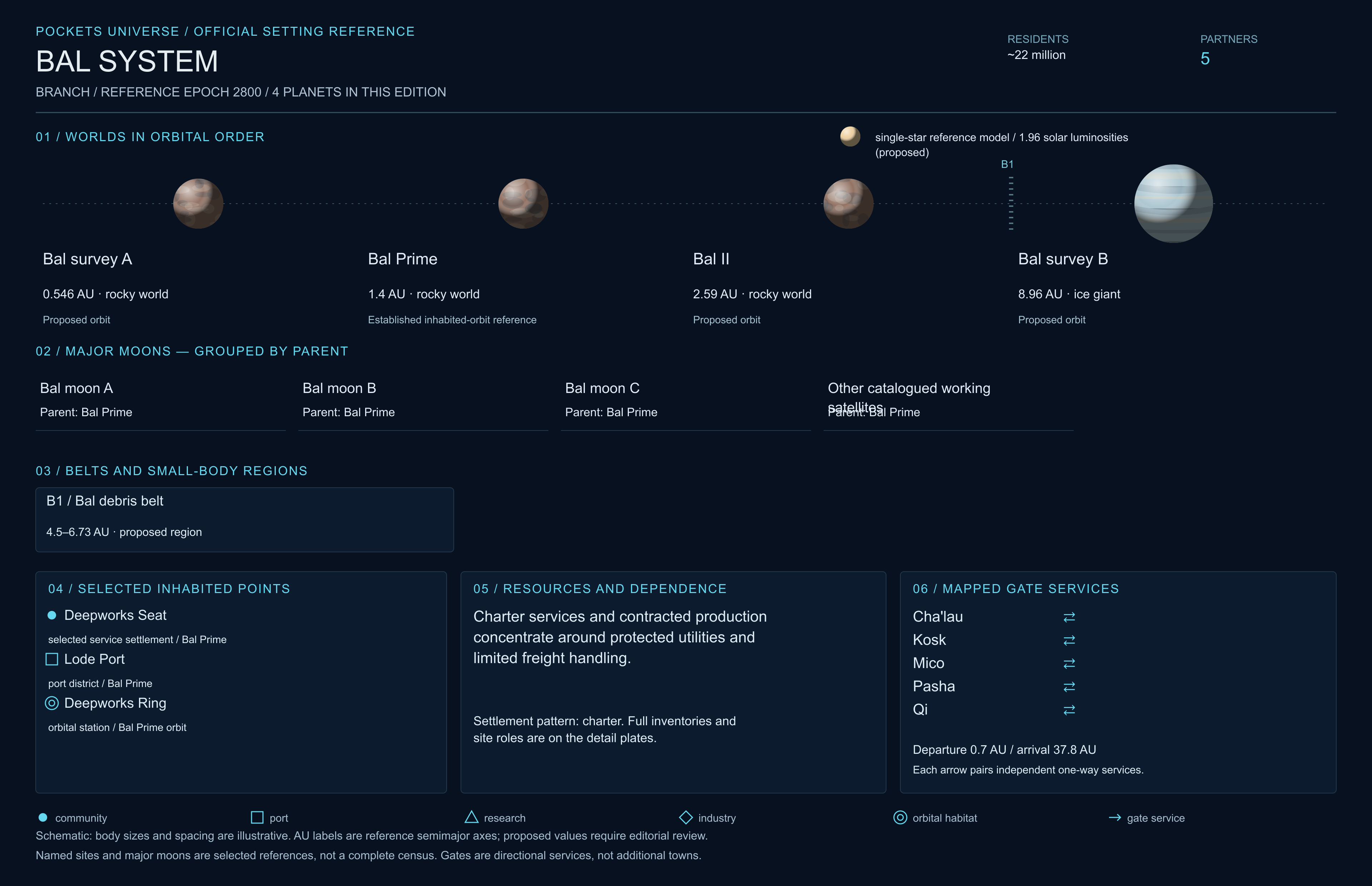
- Bal Prime: Bal Prime’s steep fault scarps and exposed mineral ridges surround the established deep-ore capital. The 4-planet reference inventory spans 0.546–8.96 AU.
- Charter services and contracted production concentrate around protected utilities and limited freight handling.
- 3 individually shown major moon references, plus an unspecified additional group; Bal debris belt complete the selected small-body picture without implying profitable resources everywhere.
Wonders
-
The Fault Stair — Natural · Bal Prime. Successive fault scarps form a vast broken stair through exposed mineral ridges. Long bands of contrasting rock make the ground appear stacked in tilted sheets; a protected survey traverse reveals the changing profile.
-
Deepworks at Shift Change — Built · Deepworks Seat, Bal Prime. Lights mark the interfaces between deep-ore workings, service passages and the protected settlement. At shift change, returning crews and equipment give a human scale to the excavation country and the engineering needed to work beneath it.
Government
An elected governor.
Local Culture
- A “miners’ aristocracy” of old digging families.
- Deep-dig fraternities with their own rites.
- Ore-baron philanthropy that doubles as politics.
Economy And Companies
Bal Deep Mining (the miners’ aristocracy); Lodewright Metals; Pitmen’s Mutual.
Gate Connections
Bal has mapped services to Cha’lau, Kosk, Mico, Pasha, Qi. Generating departure gates and available services are distinct: some crossings require a separate return gate. See Gates and communications.
Reading The Profile
Population figures are approximate. Local cultural descriptions represent traditions and institutions, rather than traits shared by every resident. Navigation distances are authored setting values; they are not measurements of real stars.
Planetary Architecture
single-star reference model. 1.96 solar luminosities and approximately 1.183 solar masses (proposed working model).
| World, in orbital order | Approximate orbit | Composition and conditions |
|---|---|---|
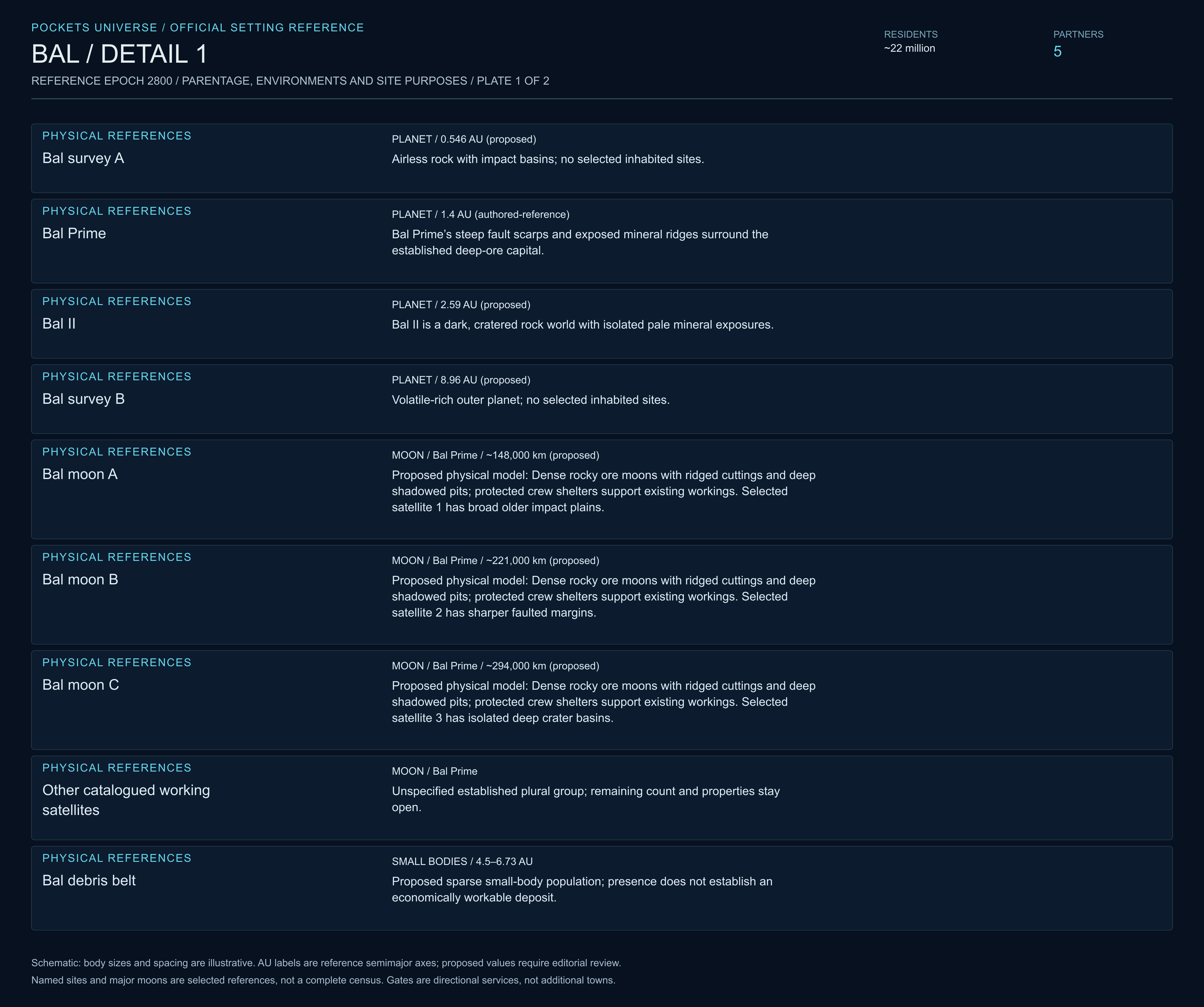
| Bal survey A | 0.546 AU — proposed | rocky world. Airless rock with impact basins; no selected inhabited sites. |
| Bal Prime | 1.4 AU — established inhabited-orbit reference | rocky world. Bal Prime’s steep fault scarps and exposed mineral ridges surround the established deep-ore capital. |
| Bal II | 2.59 AU — proposed | rocky world. Bal II is a dark, cratered rock world with isolated pale mineral exposures. |
| Bal survey B | 8.96 AU — proposed | ice giant. Volatile-rich outer planet; no selected inhabited sites. |
Major Moons
| Moon / group | Parent | Reference conditions |
|---|---|---|
| Bal moon A | Bal Prime — proposed assignment | Proposed physical model: Dense rocky ore moons with ridged cuttings and deep shadowed pits; protected crew shelters support existing workings. Selected satellite 1 has broad older impact plains. Approximate orbital semimajor axis 148,000 km (proposed). |
| Bal moon B | Bal Prime — proposed assignment | Proposed physical model: Dense rocky ore moons with ridged cuttings and deep shadowed pits; protected crew shelters support existing workings. Selected satellite 2 has sharper faulted margins. Approximate orbital semimajor axis 221,000 km (proposed). |
| Bal moon C | Bal Prime — proposed assignment | Proposed physical model: Dense rocky ore moons with ridged cuttings and deep shadowed pits; protected crew shelters support existing workings. Selected satellite 3 has isolated deep crater basins. Approximate orbital semimajor axis 294,000 km (proposed). |
| Other catalogued working satellites | Bal Prime — proposed assignment | Unspecified established plural group; remaining count and properties stay open. |
Named major satellites shown; uncatalogued small satellites are not a surveyed census.
Belts And Small Bodies
| Region | Approximate radial reference | Composition / use |
|---|---|---|
| Bal debris belt | 4.5–6.73 AU — proposed | Proposed sparse small-body population; presence does not establish an economically workable deposit. |
Settlement Network
Charter services and contracted production concentrate around protected utilities and limited freight handling.
| Site / district | Location | Type | Purpose |
|---|---|---|---|
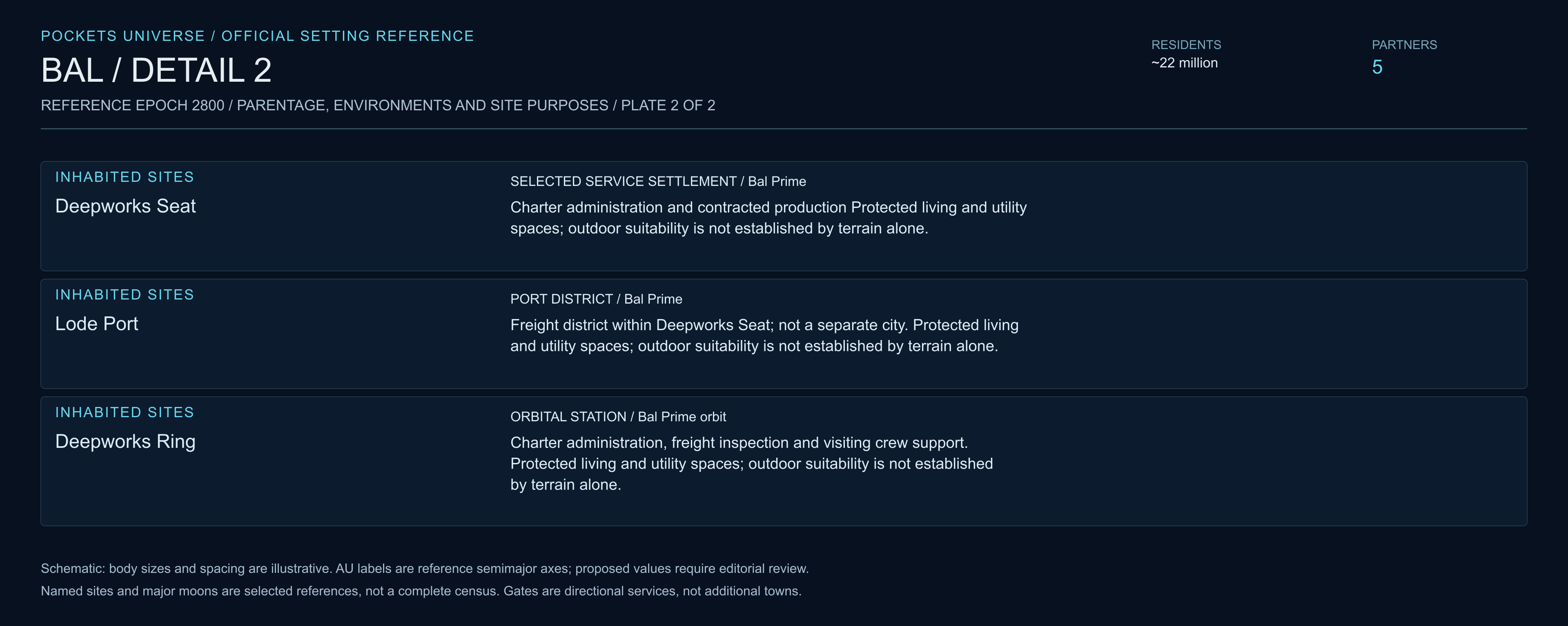
| Deepworks Seat | Bal Prime | selected service settlement | Charter administration and contracted production |
| Lode Port | Bal Prime | port district | Freight district within Deepworks Seat; not a separate city. |
| Deepworks Ring | Bal Prime orbit | orbital station | Charter administration, freight inspection and visiting crew support. |
Port districts, civic buildings and working networks are not additional cities or independent population categories. Protected living areas, maintained power, atmosphere, thermal control and shielding follow local environmental needs. Regional freight supplies specialized components; self-sufficiency is not assumed.
System Atlas
Open the overview above for full-resolution zoom and pan. The detail plates below provide the full reference inventory; their topics are listed with each link. The article also presents these facts as readable text. Body sizes and diagram spacing are illustrative; orbital labels distinguish established references from proposed design values.
Atlas Detail Plates
Reference Model And Limits
This edition combines established setting facts with explicitly proposed astronomy and revised recent worldbuilding. New survey identifiers are provisional labels, not new historical discoveries. A temperate orbit does not establish breathable air, safe weather or native life. New bodies and debris do not establish profitable resources.
- Catalogued moon names/parentage were incomplete: letter identifiers, parent assignments and physical models are proposed, not recovered canon.
- Three selected working moons are proposed reference models; the catalog does not establish a complete moon count.
- Stellar luminosity, unmeasured orbital values, belt boundaries and new physical models are proposed design values requiring editorial approval; they do not certify habitability.
- Existing navigation width describes the transit model, not a hard astronomical edge.
Branch Region
This system belongs to the Cocine Branch. The regional profile compares its member systems, approximate population, industries and everyday security.