Technology
Gates And Communications
One-way wormhole crossings and the practical movement of ships and messages.
Article contents
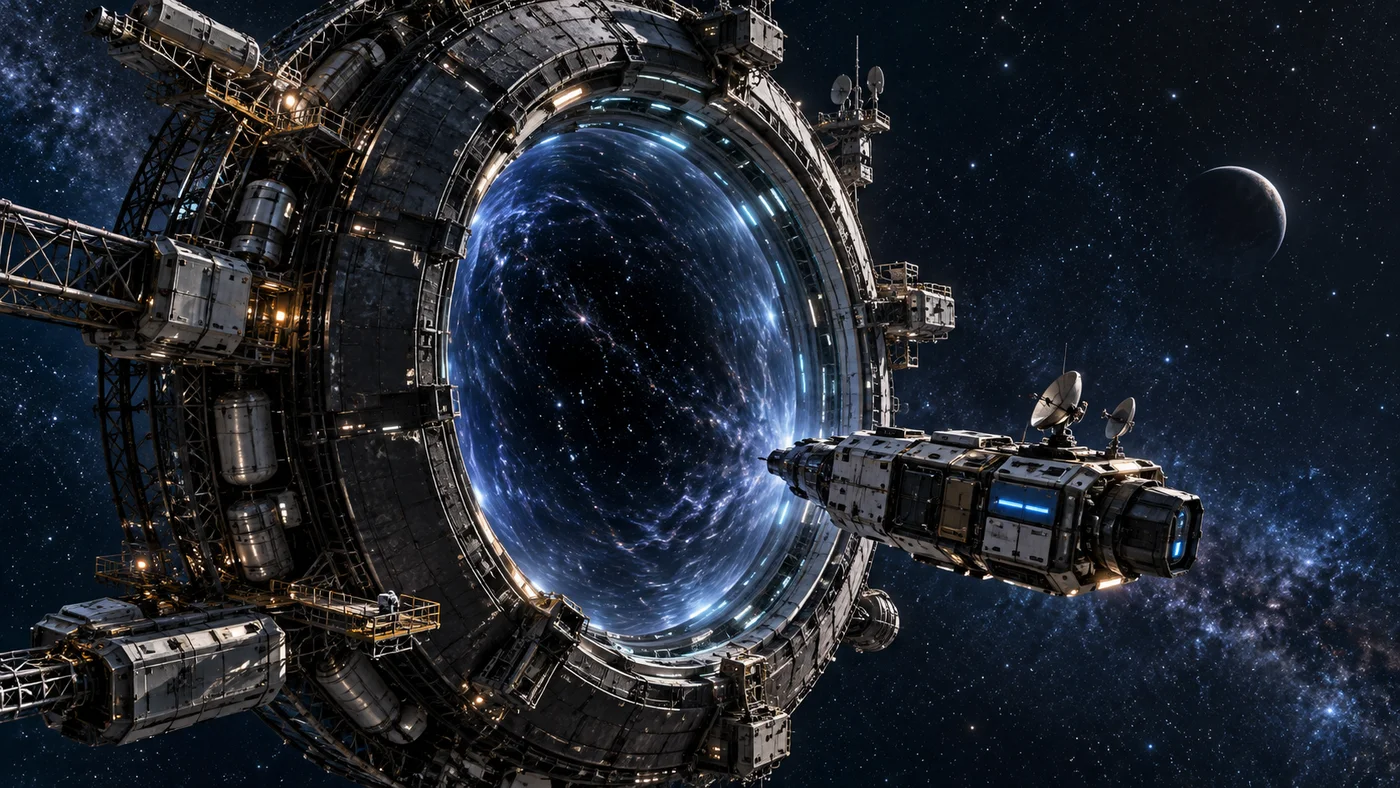
Wormhole gates connect the inhabited systems, carrying ships through a network owned and operated by Ellex Corporation. Ellex invented the technology in 2285. At the 2800 reference date, the network supports inter-system trade, travel, and communications, but distance still shapes all three.
Gates, Mouths, And Local Flight
A wormhole crossing is one-way. The generating departure gate and the arrival mouth serve different purposes: the gate starts a crossing; the mouth is where the vessel emerges in the destination system. Returning requires reaching a separate departure gate.
An onward connection likewise involves its own generating gate. Arrival does not place a ship beside every available exit, or beside the inhabited world. Substantial local flights can separate these locations. The Mason Drive supplies propulsion for these legs; wormhole transit follows a separate timing rule.
| Part of a journey | What it involves |
|---|---|
| Departure | Reaching the generating gate for the chosen service |
| Crossing | One-way wormhole passage to the destination mouth |
| Transfer | Local flight to an onward or return gate |
| Final approach | Travel from the arrival mouth toward the inhabited destination |
Queues, docking, and surface descent add time beyond the crossing and flight estimates.
Passage Time And Clocks
Wormhole passage takes 0.6 external hours per light-year of service separation. Onboard passage time is one sixth of external transit time. A service spanning ten light-years therefore takes six hours outside the wormhole and one hour aboard the crossing vessel.
That rule describes the crossing alone. It does not make a complete journey equally short, and the onboard reduction does not apply automatically to every local flight. An itinerary must account for each service and the physical transfers between them.
How Messages Travel
Ellex operates dedicated communications ships. A ship collects traffic, crosses its gate, and transmits stored data by light beam after emerging. While traveling toward its separate return gate, it collects traffic for the reverse journey and repeats the circuit.
Relay ships near onward gates can receive packet handoffs. A message need not remain aboard one vessel for every local transfer, so news can outrun a passenger ship or relief deployment. Delivery still depends on collection schedules, wormhole passage, light-travel distance, transfers, and queues. A multi-gate exchange can take days even when moving people along the route takes weeks or months.
Inter-system calls are recorded exchanges with waits between messages. Within a system, communication also obeys light-travel distance: immediate conversation is possible only where the local separation permits it.
Feeds And Local Information
The Net / Feeds carries entertainment, opinions, and discussion through overlapping local, regional, and Federation-wide communities. Their inter-system distribution uses delayed carriage. Live local participation does not imply an instantaneous broadcast across the Federation.
Local content restrictions and Ellex’s transport control are separate constraints. Personal assistants can continue working with locally available information during a communications outage, but cannot know an update that has not arrived. See AI and robotics and Daily life.
Reading The Network
The Star map shows connections schematically. Its lines and spacing are not distance measurements. System atlases identify neighboring services and distinguish route availability from generating departure gates.
Straight-line stellar separation, the sum of services on a route, and local flight distance answer different questions. More connections can provide route choices; they do not remove the journey between an arrival mouth and the next gate.