Society
Daily Life
How prosperity, housing, work, and public support differ across the inhabited systems.
Article contents
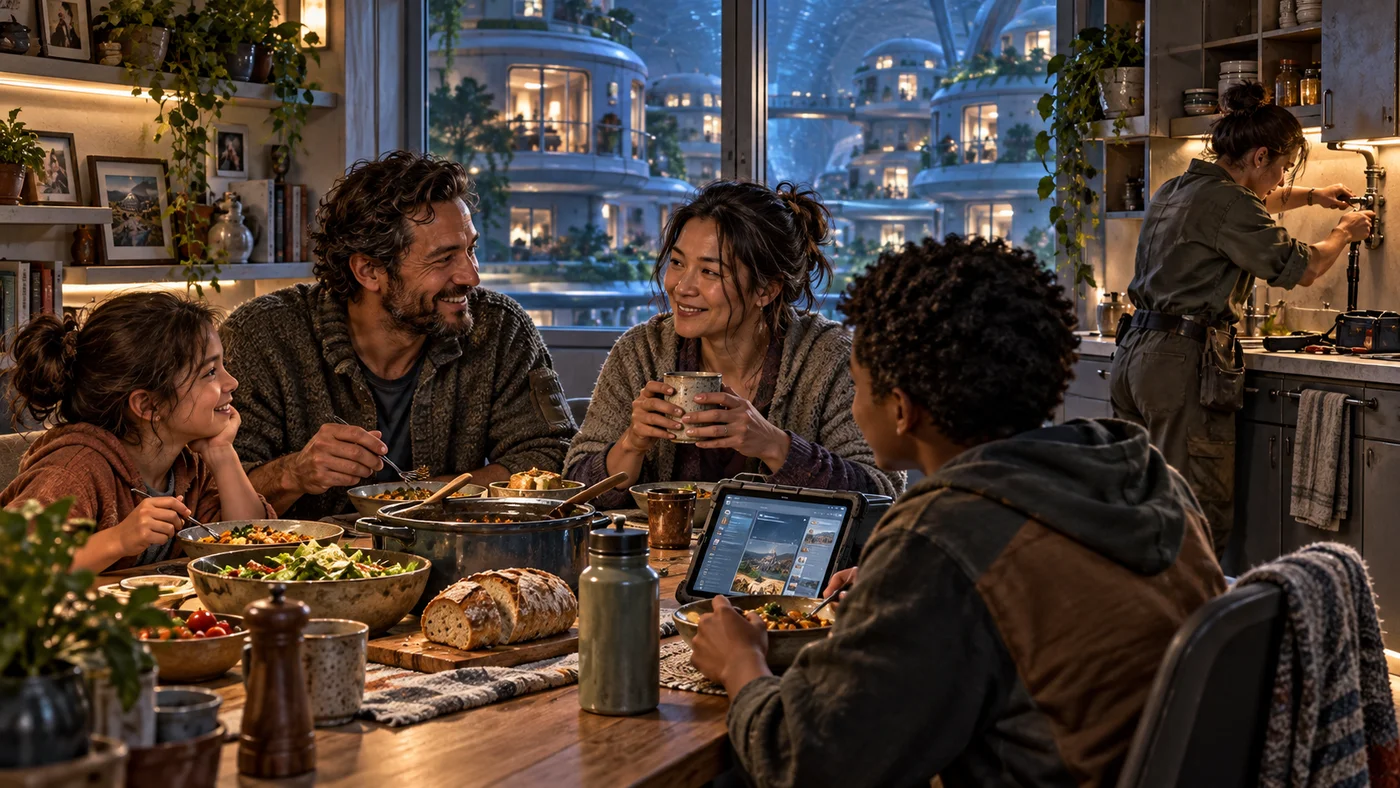
Everyday life varies by system, planet, region, and class. Shared technology and membership in the United Systems of Humankind coexist with very different incomes, homes, services, and local cultures at the 2800 reference date.
Prosperity And Place
The Core 10 generally offers very high living standards, extensive automation, and well-supported services. Poverty, organized crime, uneven policing, and social divisions nevertheless persist. Extensive monitoring does not make institutions omniscient or protection equal.
The Extended Core is generally better supplied than the Branch, with considerable variation between communities. Trade connections, resources, and multiple routes can create opportunities without guaranteeing household prosperity.
Branch residents more often face low wages, scarce parts, delayed access to technology, and weaker clinics and schools. Some communities use indentured labor. These broad patterns do not describe every resident or establish a single government or employer model for the frontier.
Homes And Inhabited Environments
Housing includes apartments, condominiums, and houses, as well as protected settlements and station habitats. Where an atmosphere is unsafe, enclosed bases and underground spaces can be ordinary places to live. Suits and environmental protection are part of routine movement outside suitable shelter.
An inhabited world is not necessarily an open-air world. Local geography and conditions determine how residents move between home, work, and public spaces. System profiles and atlases identify the established settlements and environments for each location.
Food And Household Supplies
Food combines local produce, lab-grown meat, synthetic products, and imports. Familiar staples may be harder to obtain in the Branch. Synthetic beef is common, while conventional beef is less accessible.
Native organisms are not automatically edible, and cooking does not make every alien toxin safe. Available food depends on the local environment and established agriculture as well as deliveries.
Household fabrication can help produce containers, fittings, and other useful objects. It still requires material and suitable equipment; it does not eliminate every supply shortage. See Fabrication and interfaces.
Work, Education, And Care
Robots perform industrial and household work, while people supply supervision, specialized judgment, and labor where automation is too expensive. Ownership of productive machinery and access to maintenance shape how much automation a community can use. Economy and labor covers wages, trade, and labor arrangements in more detail.
Education and healthcare also vary locally. Well-supported centers have better access to specialists and supplies; frontier communities may face weaker schools and long journeys for care. Healthcare is generally obtainable after income loss, but quality, payment arrangements, and entitlements differ.
Medicine and longevity supports lives reaching into the 120s and 130s with continuing care. That possibility does not establish universal free treatment or equal access to renewal.
The Feed And Local Cultures
The Net / Feeds carries entertainment, opinions, discussion, and live participation where local distance permits. Federation-wide distribution travels through delayed communications circuits. News from another system can be old when it arrives, and a recorded exchange can take substantial time.
Governments set different content-access rules. Some allow only heavily monitored local material. Transport control and local restrictions affect circulation in different ways; neither establishes perfect control over every independent copy.
Families, friendships, clubs, sports, festivals, and religious traditions vary between communities. Costly, inconvenient travel helps cultures remain distinct, including several cultures within one system or world.
Travel And Opportunity
Moving between systems requires time and resources, making migration especially difficult for poorer Branch residents. More connections provide options without erasing local flight or gate delays.
Full Mason acceleration and braking require passengers to use gel couches, with food, hydration, hygiene, and clinical support accounted for aboard ship. Travel is a substantial part of life rather than a quick transition between worlds. See Mason Drive and Gates and communications.
The Six Branch Regions
The Branch Systems compares the Kisa, Cocine, Silan, Coska, Cygni and Ballas branches: their working economies, populations, useful destinations and uneven local security.