Society
Economy And Labor
Work, wealth, automation, and the supply networks connecting the Federation's unequal economies.
Article contents
Also known as: Economy, Labor, Trade and labor
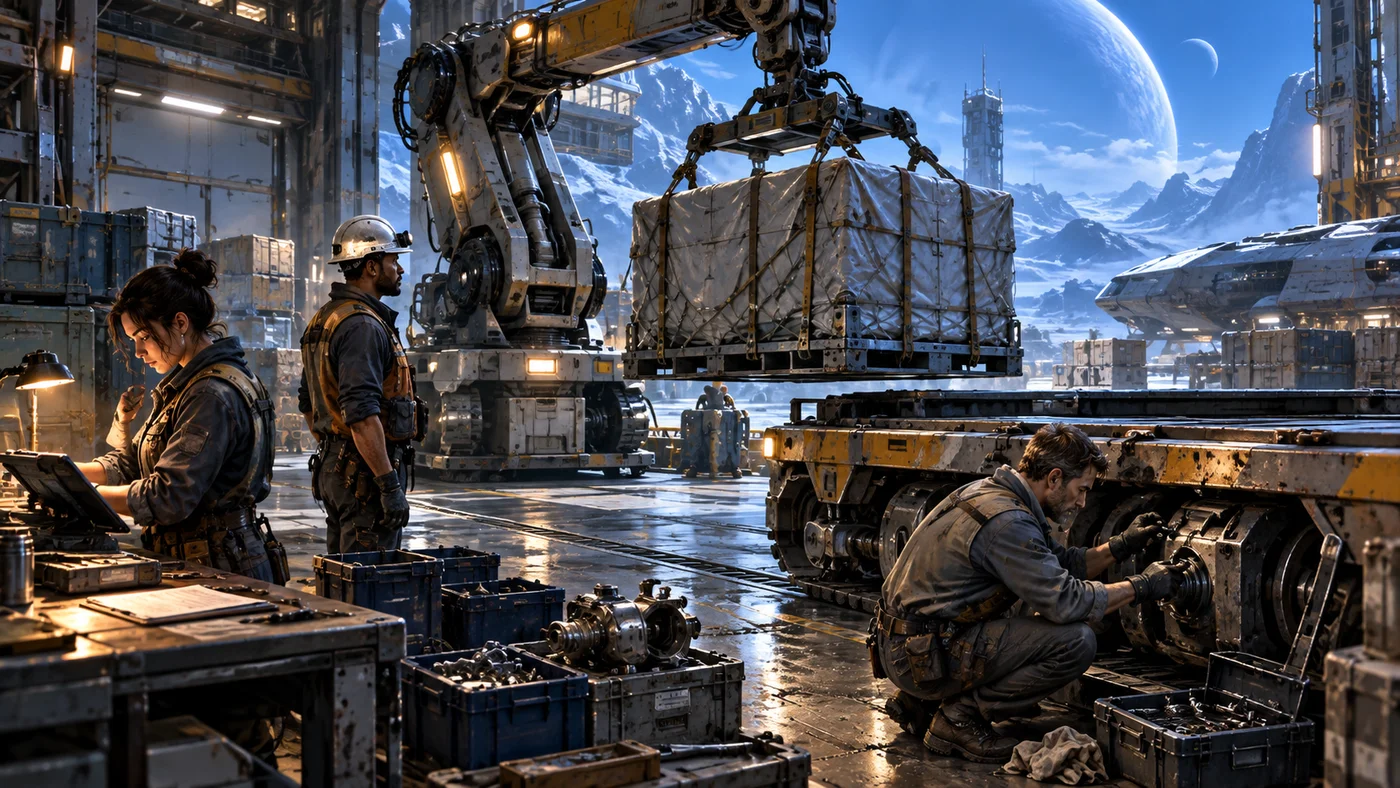
The economy of the United Systems of Humankind spans 68 inhabited systems connected by privately owned wormhole gates. In 2800, access to work, goods, and public services depends heavily on where a person lives, their means, and the institutions governing their community. Advanced technology supports enormous productive capacity, but its benefits are distributed unevenly.
Gate access, resources, reliable deliveries, and local investment shape prosperity. A mapped route establishes a connection; it does not guarantee affordable passage, dependable supplies, or a thriving economy.
Regional Living Standards
| Region | General conditions in 2800 | Economic pressures |
|---|---|---|
| Core 10 | Generally very high living standards and well-developed services. | Poverty, class divisions, and unequal access persist within prosperous societies. |
| Extended Core | Generally better supplied than the Branch, with substantial differences between systems. | More poverty than the Core 10; trade opportunities and local resources vary. |
| Branch | Greater neglect, low wages, and less reliable access to technology and supplies. | Delayed parts, employment shortages, dependence on distant suppliers, and—in some communities—indentured labor. |
These are broad patterns, not descriptions of every resident. Conditions also differ between planets, settlements, employers, and households within a single system. The Daily life article covers housing, healthcare, and other effects of these differences.
Automation And Ownership
Companies generally own productive robots. Automation is therefore tied to control of equipment and investment, rather than equally available to every worker or household. Affluent families may own domestic AI robots that act as housekeepers or nannies. A personal AI on a watch or communications device is distinct from ownership of an expensive physical robot.
Human workers supervise machinery, provide specialized judgment, manage robot teams, and perform tasks where robots cost too much. Manufacturing and infrastructure also depend on maintenance, trained service crews, and replacement equipment. Daro Manufacturing, for example, supplies industrial machinery, robot components, and workshop equipment; replacement parts, leases, and maintenance agreements are important parts of its business.
Automation does not eliminate low wages, employment shortages, or class divisions. Its availability and permitted uses also depend on local policy. See AI and robotics for technology and system-specific restrictions.
Trade And The Cost Of Distance
Ellex Corporation owns the gates and charges tolls. Its control of interstellar passage and official communications gives it influence over governments, businesses, and households throughout the network. Other carriers and firms depend on that infrastructure without owning the gates they use.
Travel remains expensive and inconvenient. Distance affects more than the journey itself: procurement and scheduling can leave Branch communities waiting months for replacement equipment, in addition to gate transit time. Instructions and replies also travel with communications delays, so distant offices cannot coordinate as if they shared an instantaneous network.
Through-traffic, resources to sell, and access to multiple trading partners can support prosperity. The number of gate connections alone is not a measure of wealth. A system with few alternatives may have a narrower choice of buyers and carriers; even a well-connected system needs viable industries and reliable services.
Two carriers illustrate how the network serves local economies:
- Cygnet Logistics, based in Wurnn, operates freight, warehouses, and scheduled distribution services. A canceled sailing or unavailable warehouse slot can affect a clinic’s supplies or a factory’s operations.
- Kisa-Jalun Freight serves the established crossing between Branch Kisa and Extended Core Jalun, linking frontier producers and households to Core markets and contracted onward carriers. The crossing remains Ellex infrastructure.
Frontier Dependence
Branch communities can depend on distant employers and provisioning services for both income and essential goods. When replacement parts arrive late, residents often fabricate substitutes to keep critical infrastructure functioning. Local fabrication still requires materials and does not remove the need for specialist components.
Deliveries involve more than the voyage itself. Workers must receive, check, and move supplies, while maintenance crews fit parts into equipment already in service. A delay can affect both the people waiting for a repair and the people whose work depends on that equipment.
In some systems, scrip economies and indenture restrict workers’ choices. These arrangements are locally varied rather than universal across the Branch. Poverty can also make relocation to the Core effectively unaffordable, even when a route exists.
The frontier’s supply problems have a broader historical context. Expansion was intended to reach one hundred systems, but the High Council halted it after the network reached 68, amid poverty, crime, and unreliable deliveries to outer settlements. Subsidies receded gradually, often before local economies became self-sustaining. The end of expansion and the withdrawal of support were separate processes.
Companies, Credit, And Local Power
Corporate influence takes different forms. Productive assets, finance, specialist knowledge, and essential-service contracts can all give a company leverage, while Ellex retains its distinctive position as gate owner. The following examples show different kinds of dependence:
| Institution | Economic role | Why it matters locally |
|---|---|---|
| Meridian Trust | Finance for habitats, municipalities, ships, and infrastructure. | Refinancing can determine whether a town repairs an air plant or a shipowner retains a fleet. |
| Daro Manufacturing | Machinery, productive robots, parts, and maintenance. | Installed equipment and trained service crews make supplier changes consequential. |
| Mast Chartered Company | Heavy industry and charter government in Mast. | Housing, employment, and administration overlap, connecting labor disputes to local governing power. |
Mast’s company government is a specific local arrangement. Corporate influence elsewhere does not establish company government throughout the Federation; the Core 10 retains democratic local governments.
Household Costs And Public Support
Housing, food, utilities, and care remain material concerns in an automated society. Protected settlements and habitats require air systems, shielding, heat, and continuing maintenance. Imported goods depend on suppliers and transport, while local production depends on resources and equipment.
No single wage, rent, fare, or affordability standard describes all 68 systems. Wealth and purchasing power differ by class and location. Public support, healthcare access, and payment arrangements also vary locally; the Federation does not provide a uniform welfare guarantee.
The population-based federal tax-sharing fund is a distinct source of public finance. It receives roughly one-third of federal tax receipts collected across all 68 systems, but its beneficiaries in 2800 are the Core 10. Its distribution should not be confused with equal support for every member system or a standard household entitlement.
Local Institutions
For the circumstances of a particular community, consult its system profile: local government, principal industries, settlements, and gate neighbors provide context that Federation-wide averages cannot supply. Start with Sol, Wurnn, Mast, Kisa, and Jalun for examples of different economic settings.
Related reference articles include Daily life, AI and robotics, Medicine and longevity, and Ellex Corporation.
The Six Branch Regions
The Branch Systems compares the Kisa, Cocine, Silan, Coska, Cygni and Ballas branches: their working economies, populations, useful destinations and uneven local security.