Systems
Sol
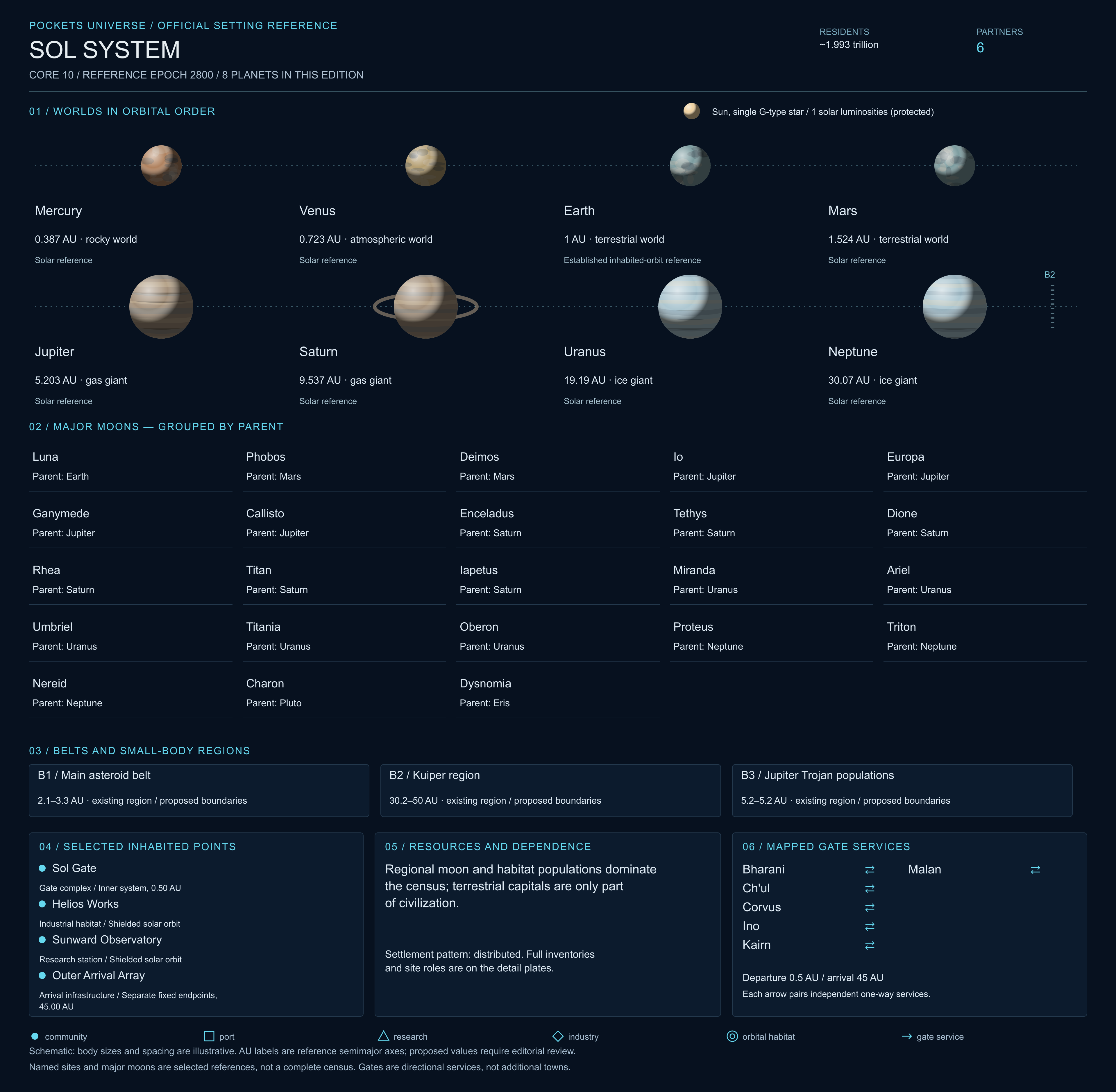
Regional moon and habitat populations dominate the census; terrestrial capitals are only part of civilization.
Article contents
At A Glance
- Region
- Core 10
- Population
- ~1.993 trillion
- Government
- Federal democratic republic (federation capital)
- Distance from Sol
- 0.00 light-years
- Operational width
- 100 AU
- Gate services
- 6
What Makes This System Distinctive
- Earth: Humanity’s home world and federal political center. The 8-planet reference inventory spans 0.387–30.07 AU.
- Regional moon and habitat populations dominate the census; terrestrial capitals are only part of civilization.
- 23 individually shown major moon references; Main asteroid belt and Kuiper region and Jupiter Trojan populations complete the selected small-body picture without implying profitable resources everywhere.
Wonders
-
Earth’s Andean Heritage Landscape — Natural and built · Earth. The Andean Heritage Network connects human cultural memory with the mountain landscape of the natural cradle world. For visitors raised in enclosures or orbital towns, the relationship between open country, inherited places and a living planetary environment is extraordinary.
-
Mariner Greenway — Built · Mars. Agricultural and residential districts occupy the great Martian canyon landscape on a mature terraformed world. The meeting of immense ancient terrain and deliberately maintained habitability makes the Greenway both a scenic destination and a record of planetary engineering.
-
Aphrodite Drift — Built · Venus cloud layer. An inhabited cloud municipality floats above Venus’s hostile surface environment. The changing cloud horizon around engineered human streets makes arrival itself a spectacle; ordinary residential life belongs in the atmosphere rather than on the ground below.
-
The Founding Archives — Built · Luna. The established lunar archives preserve the documentary memory of humanity’s political expansion. Their protected public spaces, set within a settled moon’s austere surroundings, make the survival of original records a destination alongside the larger lunar cityscape.
-
Ceres Exchange — Built · Ceres. The established Belt trading centre gathers communities whose homes and workplaces are scattered across small bodies and habitats. Its commercial spaces make the scale of human settlement visible through the variety of people and cargo passing through them.
-
The Jovian Moon Prospect — Natural · Galilean moon region. Jupiter’s immense globe dominates views from its established moon and orbital communities. A protected visitor route within the research and shipyard network lets travellers encounter the contrast between the giant planet and the human-scale structures around it.
-
Saturn’s Rings from Kronos Ringport — Natural and built · Saturn region. The ring system provides an enormous changing plane of light around the established ring-service port. Views depend on the craft or station geometry, making the contrast between delicate-looking rings and their planetary scale part of the experience.
-
Miranda’s Fault Country — Natural · Miranda. The moon’s dramatic faulted terrain is a destination reached through the established research network. Seen from protected transport associated with Miranda Fault Lab, the abrupt changes in relief make a small outer-system moon feel geologically immense.
-
Triton’s Outer-System Horizon — Natural · Triton. The protected community of Triton Haven offers a base within Neptune’s moon network. The stark moon landscape and distant blue planetary prospect make a very different destination from the dense, brightly connected inner system.
-
The Long-Night Settlements — Built · Kuiper and dwarf-planet communities. Protected places such as Sputnik Township and Long Night Habitat maintain human life far from the inner system. Their inhabited light against distant, dark country is a wonder of sustained engineering and community rather than a claim of easy self-sufficiency.
Government
Seat of the High Council, Senate, and House; a largely ceremonial planetary governorship sits beneath the federal institutions. Renata Beck’s home system.
Local Culture
- Reverence for “old Earth” lineage and the founding records; ancestry-tourism is a major industry.
- Ferocious status hierarchy among ministries, where which office you serve outranks what you own.
- So cosmopolitan it’s rootless, everyone is from somewhere else, and “true Sol” is a contested myth.
Economy And Companies
Ellex Corp (gates and comms); Meridian Trust (the oldest banking house); Lumen Media (the federation’s paper of record).
Gate Connections
Sol has mapped services to Bharani, Ch’ul, Corvus, Ino, Kairn, Malan. Generating departure gates and available services are distinct: some crossings require a separate return gate. See Gates and communications.
Reading The Profile
Population figures are approximate. Local cultural descriptions represent traditions and institutions, rather than traits shared by every resident. Navigation distances are authored setting values; they are not measurements of real stars.
Planetary Architecture
Sun, single G-type star. 1 solar luminosities and approximately 1 solar masses (solar reference).
| World, in orbital order | Approximate orbit | Composition and conditions |
|---|---|---|
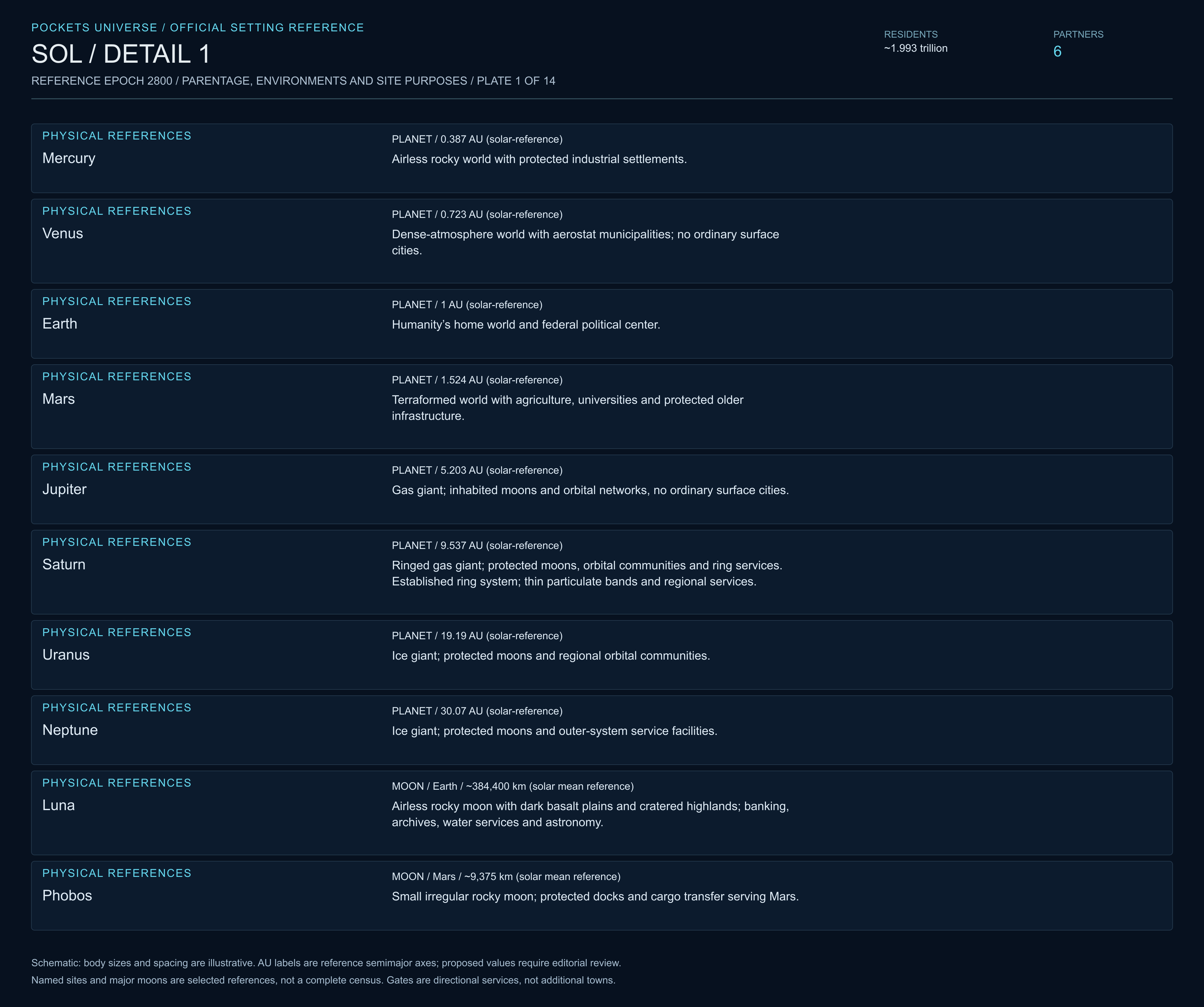
| Mercury | 0.387 AU — solar reference | rocky world. Airless rocky world with protected industrial settlements. |
| Venus | 0.723 AU — solar reference | atmospheric world. Dense-atmosphere world with aerostat municipalities; no ordinary surface cities. |
| Earth | 1 AU — established inhabited-orbit reference | terrestrial world. Humanity’s home world and federal political center. |
| Mars | 1.524 AU — solar reference | terrestrial world. Terraformed world with agriculture, universities and protected older infrastructure. |
| Jupiter | 5.203 AU — solar reference | gas giant. Gas giant; inhabited moons and orbital networks, no ordinary surface cities. |
| Saturn | 9.537 AU — solar reference | gas giant. Ringed gas giant; protected moons, orbital communities and ring services. Established ring system; thin particulate bands and regional services. |
| Uranus | 19.19 AU — solar reference | ice giant. Ice giant; protected moons and regional orbital communities. |
| Neptune | 30.07 AU — solar reference | ice giant. Ice giant; protected moons and outer-system service facilities. |
Major Moons
| Moon / group | Parent | Reference conditions |
|---|---|---|
| Luna | Earth | Airless rocky moon with dark basalt plains and cratered highlands; banking, archives, water services and astronomy. Approximate orbital semimajor axis 384,400 km (solar mean reference). |
| Phobos | Mars | Small irregular rocky moon; protected docks and cargo transfer serving Mars. Approximate orbital semimajor axis 9,375 km (solar mean reference). |
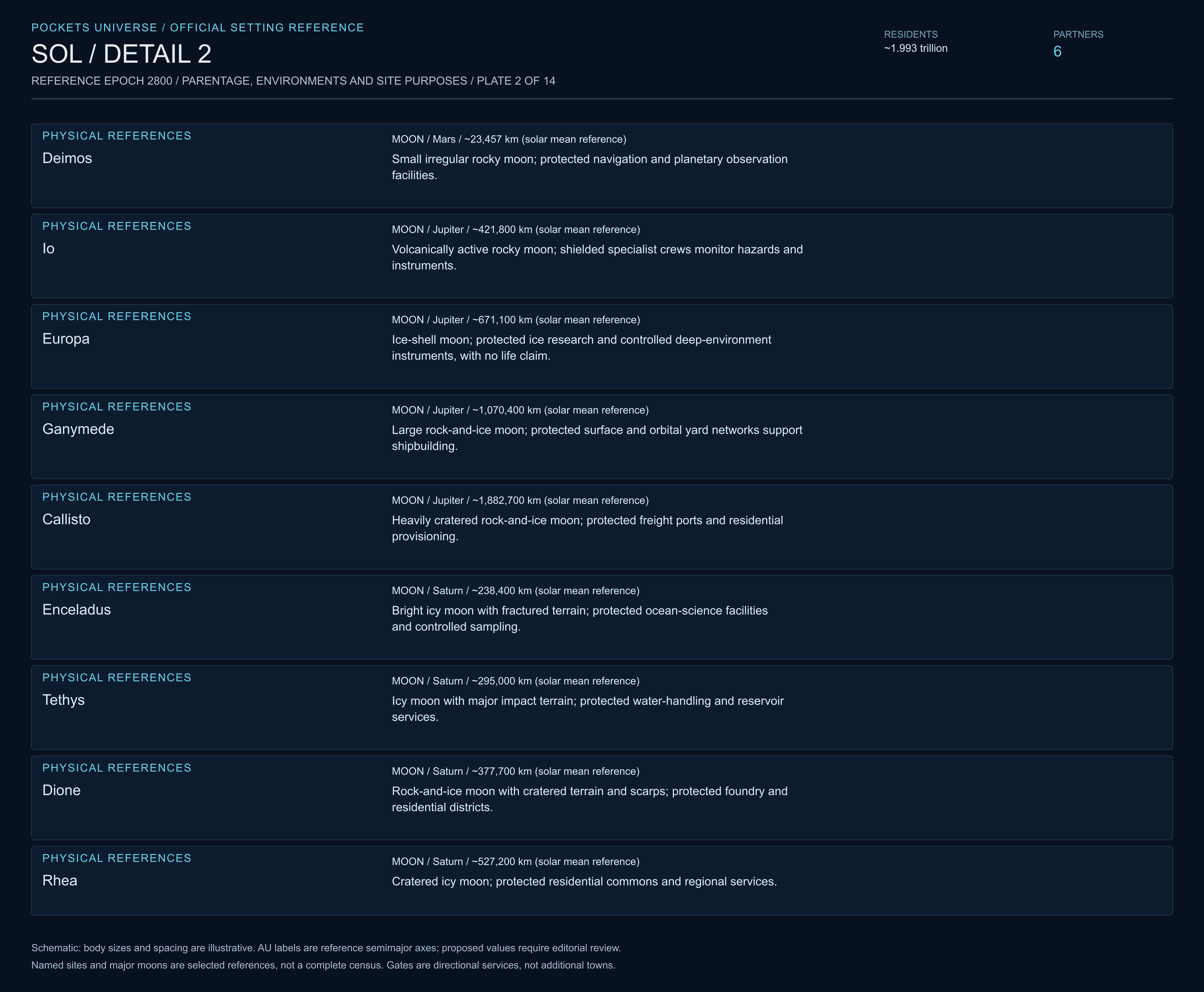
| Deimos | Mars | Small irregular rocky moon; protected navigation and planetary observation facilities. Approximate orbital semimajor axis 23,457 km (solar mean reference). |
| Io | Jupiter | Volcanically active rocky moon; shielded specialist crews monitor hazards and instruments. Approximate orbital semimajor axis 421,800 km (solar mean reference). |
| Europa | Jupiter | Ice-shell moon; protected ice research and controlled deep-environment instruments, with no life claim. Approximate orbital semimajor axis 671,100 km (solar mean reference). |
| Ganymede | Jupiter | Large rock-and-ice moon; protected surface and orbital yard networks support shipbuilding. Approximate orbital semimajor axis 1,070,400 km (solar mean reference). |
| Callisto | Jupiter | Heavily cratered rock-and-ice moon; protected freight ports and residential provisioning. Approximate orbital semimajor axis 1,882,700 km (solar mean reference). |
| Enceladus | Saturn | Bright icy moon with fractured terrain; protected ocean-science facilities and controlled sampling. Approximate orbital semimajor axis 238,400 km (solar mean reference). |
| Tethys | Saturn | Icy moon with major impact terrain; protected water-handling and reservoir services. Approximate orbital semimajor axis 295,000 km (solar mean reference). |
| Dione | Saturn | Rock-and-ice moon with cratered terrain and scarps; protected foundry and residential districts. Approximate orbital semimajor axis 377,700 km (solar mean reference). |
| Rhea | Saturn | Cratered icy moon; protected residential commons and regional services. Approximate orbital semimajor axis 527,200 km (solar mean reference). |
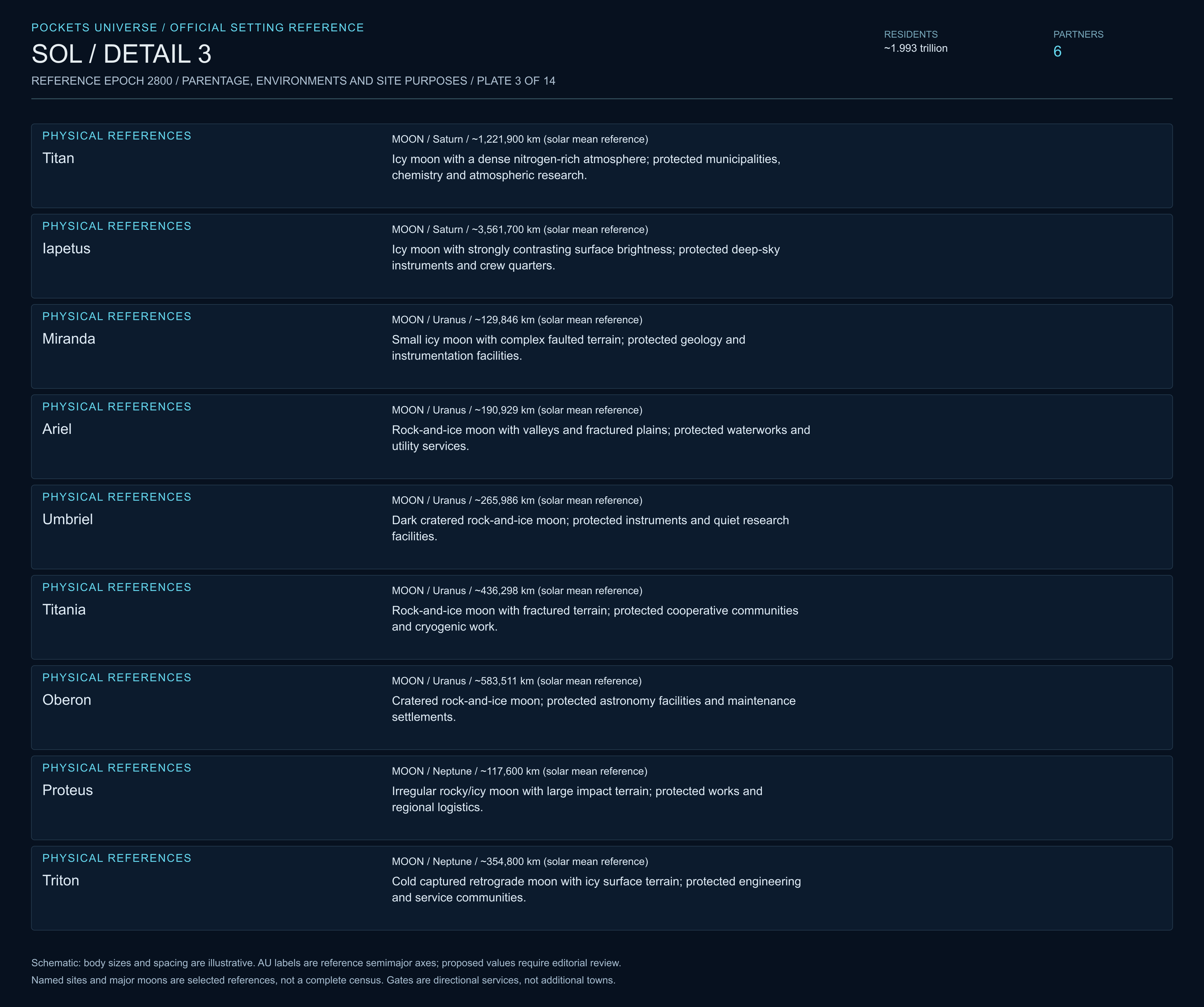
| Titan | Saturn | Icy moon with a dense nitrogen-rich atmosphere; protected municipalities, chemistry and atmospheric research. Approximate orbital semimajor axis 1,221,900 km (solar mean reference). |
| Iapetus | Saturn | Icy moon with strongly contrasting surface brightness; protected deep-sky instruments and crew quarters. Approximate orbital semimajor axis 3,561,700 km (solar mean reference). |
| Miranda | Uranus | Small icy moon with complex faulted terrain; protected geology and instrumentation facilities. Approximate orbital semimajor axis 129,846 km (solar mean reference). |
| Ariel | Uranus | Rock-and-ice moon with valleys and fractured plains; protected waterworks and utility services. Approximate orbital semimajor axis 190,929 km (solar mean reference). |
| Umbriel | Uranus | Dark cratered rock-and-ice moon; protected instruments and quiet research facilities. Approximate orbital semimajor axis 265,986 km (solar mean reference). |
| Titania | Uranus | Rock-and-ice moon with fractured terrain; protected cooperative communities and cryogenic work. Approximate orbital semimajor axis 436,298 km (solar mean reference). |
| Oberon | Uranus | Cratered rock-and-ice moon; protected astronomy facilities and maintenance settlements. Approximate orbital semimajor axis 583,511 km (solar mean reference). |
| Proteus | Neptune | Irregular rocky/icy moon with large impact terrain; protected works and regional logistics. Approximate orbital semimajor axis 117,600 km (solar mean reference). |
| Triton | Neptune | Cold captured retrograde moon with icy surface terrain; protected engineering and service communities. Approximate orbital semimajor axis 354,800 km (solar mean reference). |
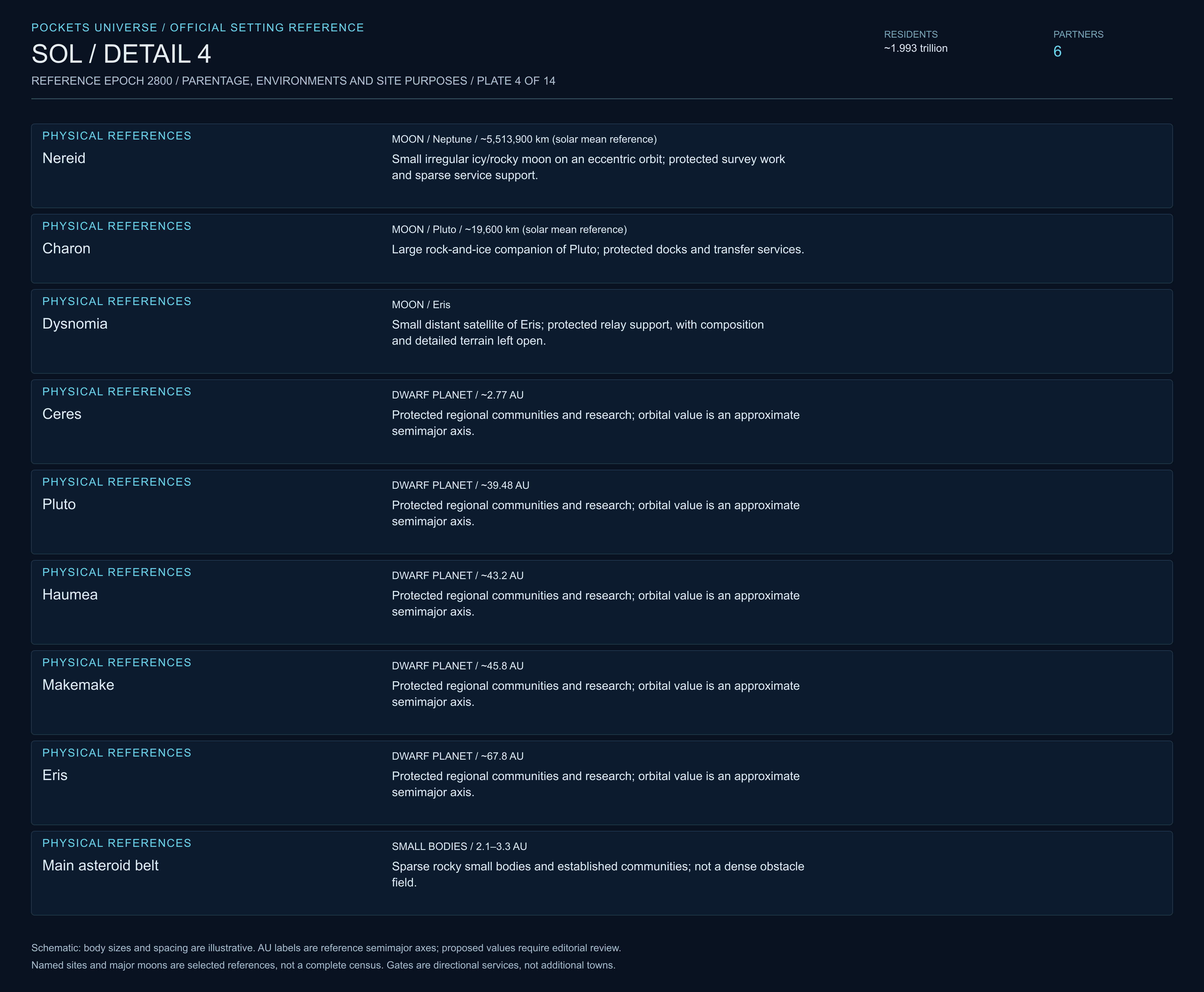
| Nereid | Neptune | Small irregular icy/rocky moon on an eccentric orbit; protected survey work and sparse service support. Approximate orbital semimajor axis 5,513,900 km (solar mean reference). |
| Charon | Pluto | Large rock-and-ice companion of Pluto; protected docks and transfer services. Approximate orbital semimajor axis 19,600 km (solar mean reference). |
| Dysnomia | Eris | Small distant satellite of Eris; protected relay support, with composition and detailed terrain left open. |
Named major satellites shown; uncatalogued small satellites are not a surveyed census.
Solar moon distances are rounded historical mean references from JPL satellite elements, rather than a navigation ephemeris for 2800.
Belts And Small Bodies
| Region | Approximate radial reference | Composition / use |
|---|---|---|
| Main asteroid belt | 2.1–3.3 AU — proposed region boundaries | Sparse rocky small bodies and established communities; not a dense obstacle field. |
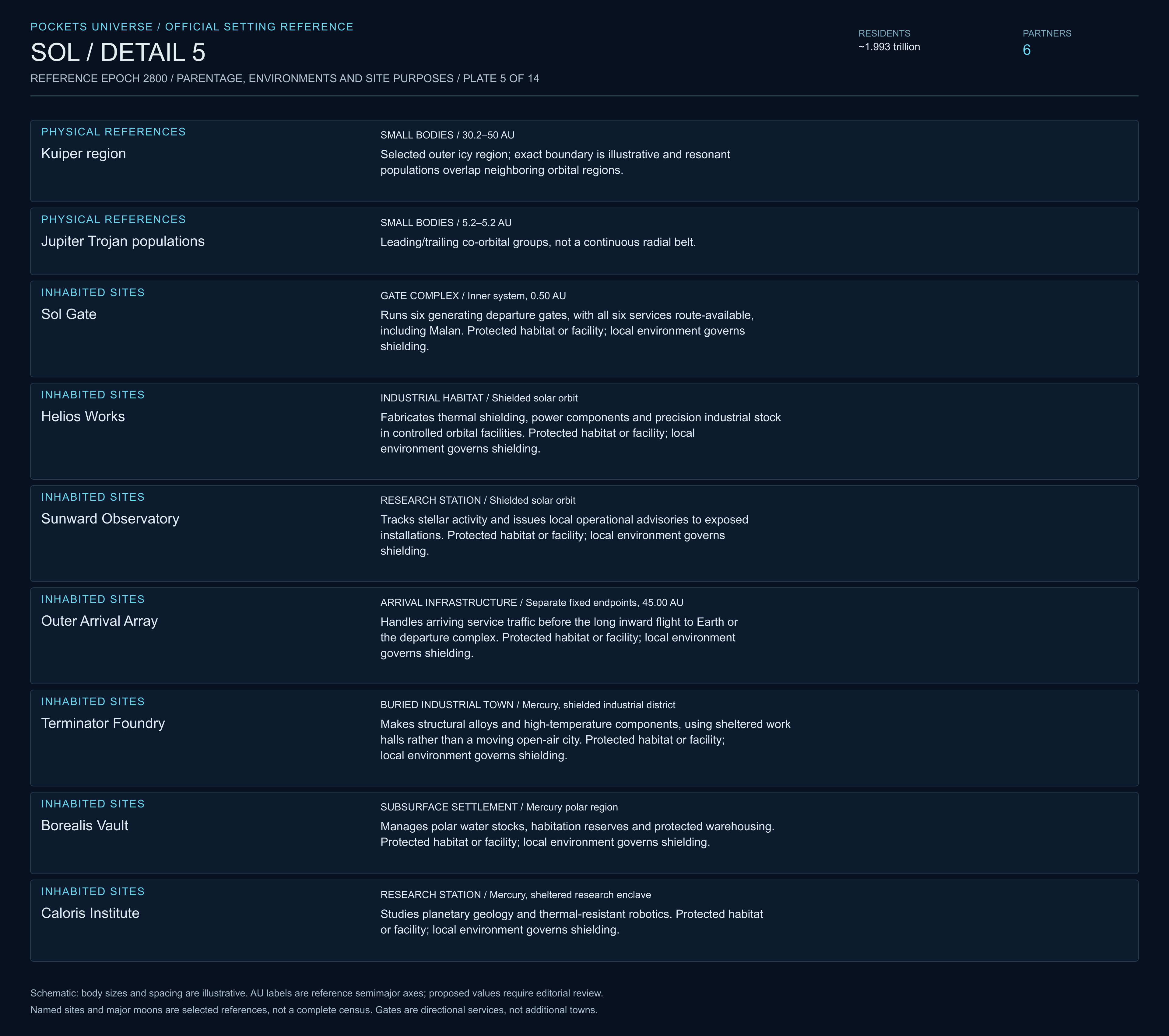
| Kuiper region | 30.2–50 AU — proposed region boundaries | Selected outer icy region; exact boundary is illustrative and resonant populations overlap neighboring orbital regions. |
| Jupiter Trojan populations | 5.2–5.2 AU — proposed region boundaries | Leading/trailing co-orbital groups, not a continuous radial belt. |
| Dwarf planet | Approximate orbit | Reference use |
|---|---|---|
| Ceres | 2.77 AU | Protected regional communities and research; orbital value is an approximate semimajor axis. |
| Pluto | 39.48 AU | Protected regional communities and research; orbital value is an approximate semimajor axis. |
| Haumea | 43.2 AU | Protected regional communities and research; orbital value is an approximate semimajor axis. |
| Makemake | 45.8 AU | Protected regional communities and research; orbital value is an approximate semimajor axis. |
| Eris | 67.8 AU | Protected regional communities and research; orbital value is an approximate semimajor axis. |
Settlement Network
Regional moon and habitat populations dominate the census; terrestrial capitals are only part of civilization.
| Site / district | Location | Type | Purpose |
|---|---|---|---|
| Sol Gate | Inner system, 0.50 AU | Gate complex | Runs six generating departure gates, with all six services route-available, including Malan. |
| Helios Works | Shielded solar orbit | Industrial habitat | Fabricates thermal shielding, power components and precision industrial stock in controlled orbital facilities. |
| Sunward Observatory | Shielded solar orbit | Research station | Tracks stellar activity and issues local operational advisories to exposed installations. |
| Outer Arrival Array | Separate fixed endpoints, 45.00 AU | Arrival infrastructure | Handles arriving service traffic before the long inward flight to Earth or the departure complex. |
| Terminator Foundry | Mercury, shielded industrial district | Buried industrial town | Makes structural alloys and high-temperature components, using sheltered work halls rather than a moving open-air city. |
| Borealis Vault | Mercury polar region | Subsurface settlement | Manages polar water stocks, habitation reserves and protected warehousing. |
| Caloris Institute | Mercury, sheltered research enclave | Research station | Studies planetary geology and thermal-resistant robotics. |
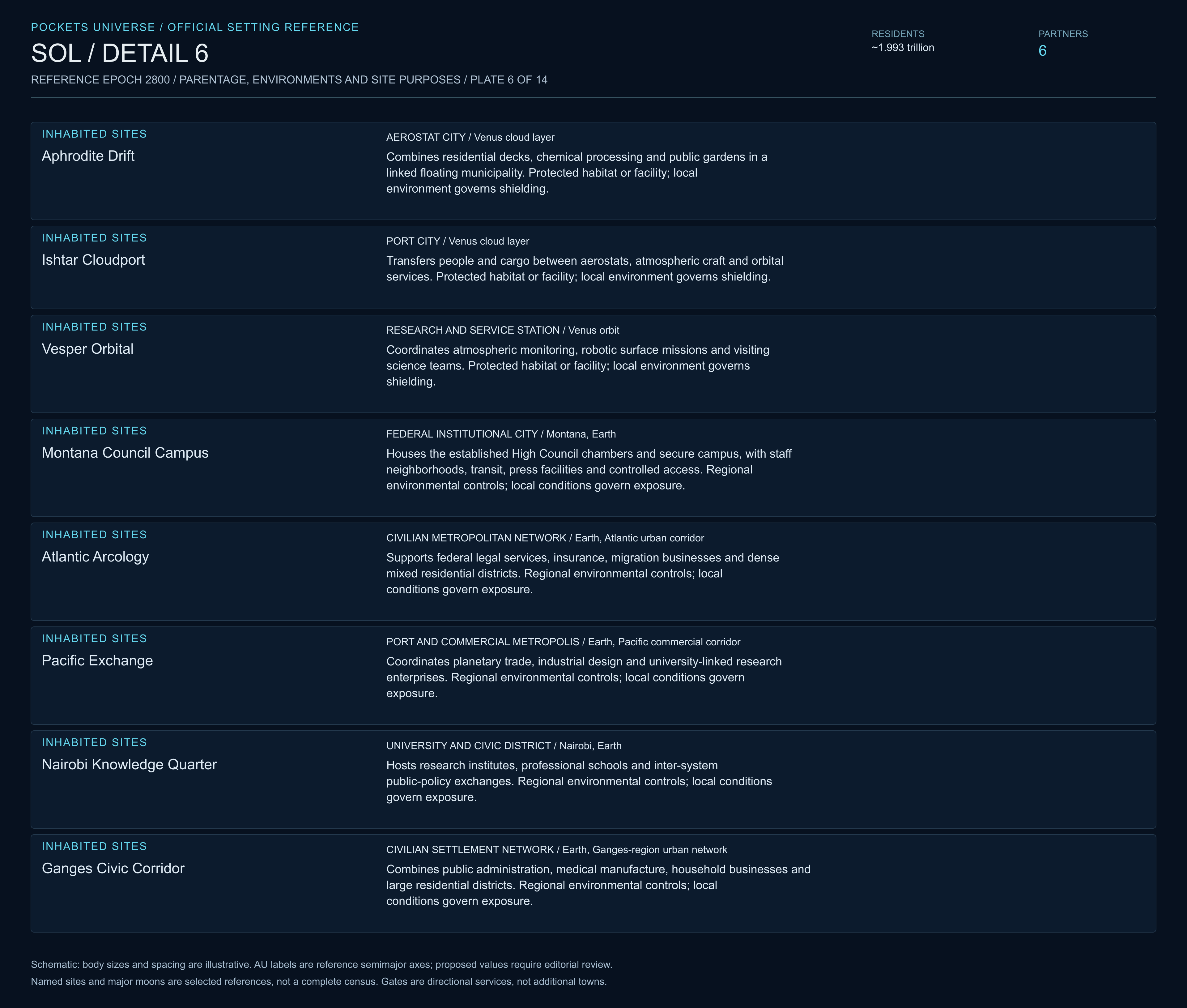
| Aphrodite Drift | Venus cloud layer | Aerostat city | Combines residential decks, chemical processing and public gardens in a linked floating municipality. |
| Ishtar Cloudport | Venus cloud layer | Port city | Transfers people and cargo between aerostats, atmospheric craft and orbital services. |
| Vesper Orbital | Venus orbit | Research and service station | Coordinates atmospheric monitoring, robotic surface missions and visiting science teams. |
| Montana Council Campus | Montana, Earth | Federal institutional city | Houses the established High Council chambers and secure campus, with staff neighborhoods, transit, press facilities and controlled access. |
| Atlantic Arcology | Earth, Atlantic urban corridor | Civilian metropolitan network | Supports federal legal services, insurance, migration businesses and dense mixed residential districts. |
| Pacific Exchange | Earth, Pacific commercial corridor | Port and commercial metropolis | Coordinates planetary trade, industrial design and university-linked research enterprises. |
| Nairobi Knowledge Quarter | Nairobi, Earth | University and civic district | Hosts research institutes, professional schools and inter-system public-policy exchanges. |
| Ganges Civic Corridor | Earth, Ganges-region urban network | Civilian settlement network | Combines public administration, medical manufacture, household businesses and large residential districts. |
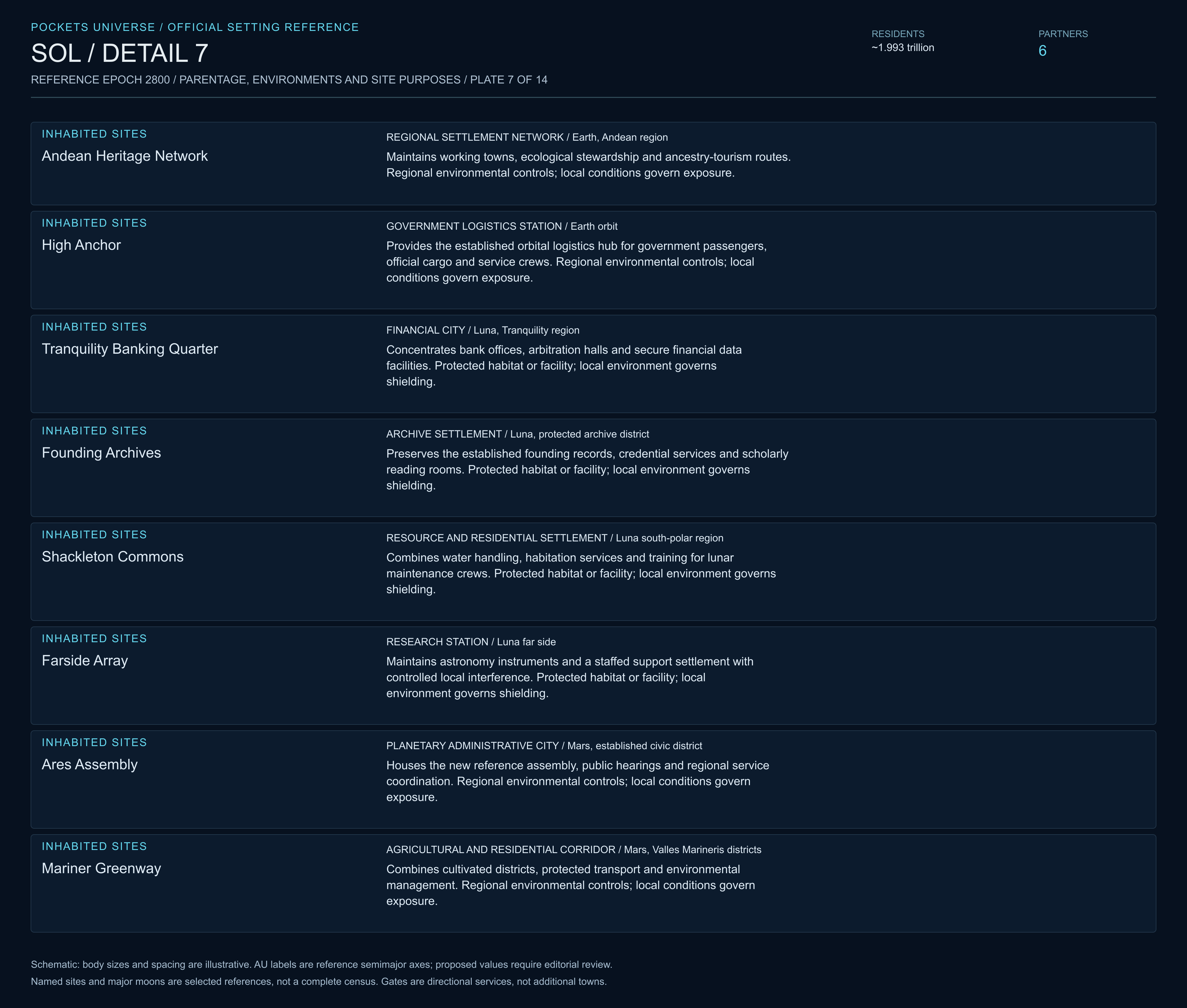
| Andean Heritage Network | Earth, Andean region | Regional settlement network | Maintains working towns, ecological stewardship and ancestry-tourism routes. |
| High Anchor | Earth orbit | Government logistics station | Provides the established orbital logistics hub for government passengers, official cargo and service crews. |
| Tranquility Banking Quarter | Luna, Tranquility region | Financial city | Concentrates bank offices, arbitration halls and secure financial data facilities. |
| Founding Archives | Luna, protected archive district | Archive settlement | Preserves the established founding records, credential services and scholarly reading rooms. |
| Shackleton Commons | Luna south-polar region | Resource and residential settlement | Combines water handling, habitation services and training for lunar maintenance crews. |
| Farside Array | Luna far side | Research station | Maintains astronomy instruments and a staffed support settlement with controlled local interference. |
| Ares Assembly | Mars, established civic district | Planetary administrative city | Houses the new reference assembly, public hearings and regional service coordination. |
| Mariner Greenway | Mars, Valles Marineris districts | Agricultural and residential corridor | Combines cultivated districts, protected transport and environmental management. |
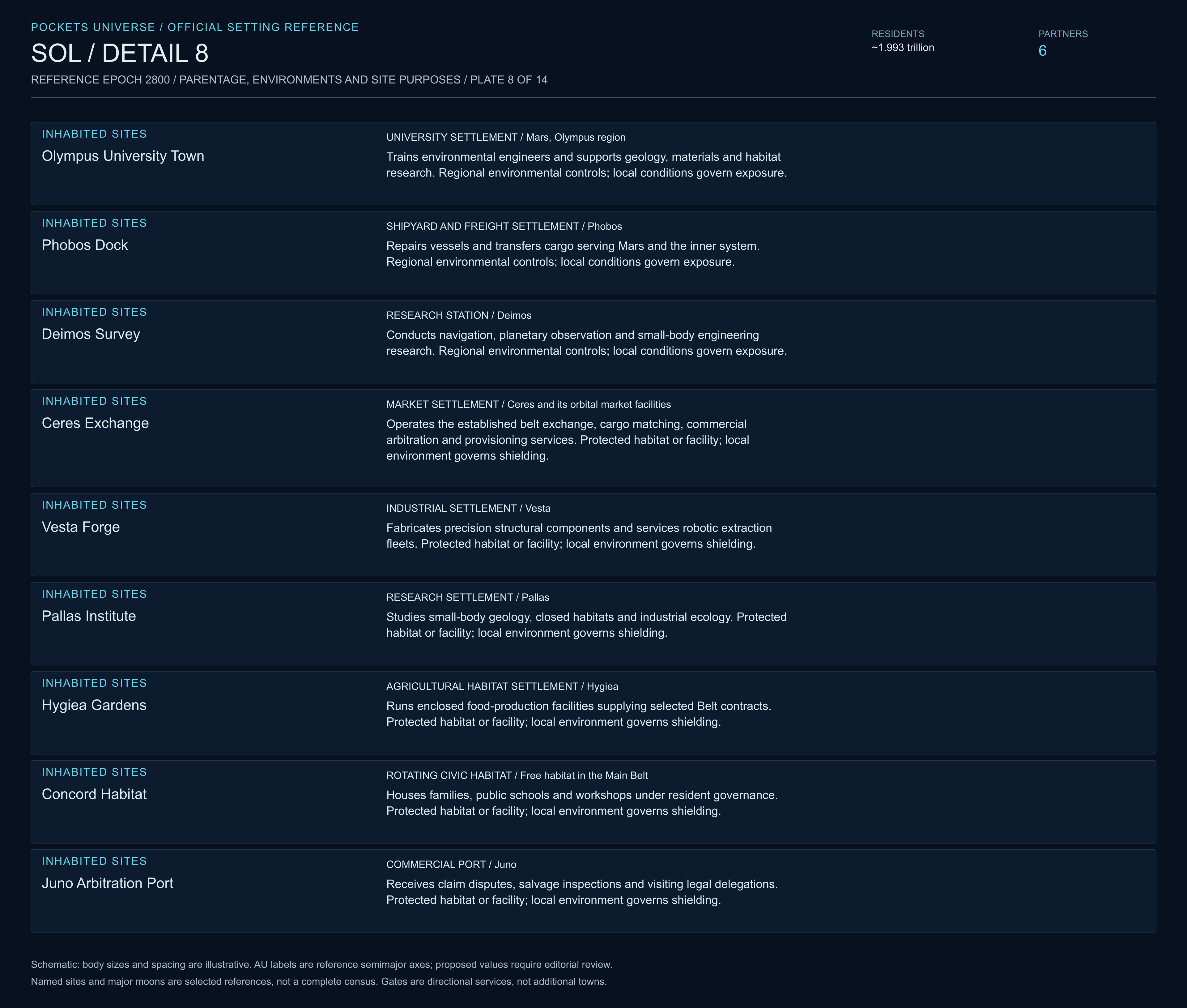
| Olympus University Town | Mars, Olympus region | University settlement | Trains environmental engineers and supports geology, materials and habitat research. |
| Phobos Dock | Phobos | Shipyard and freight settlement | Repairs vessels and transfers cargo serving Mars and the inner system. |
| Deimos Survey | Deimos | Research station | Conducts navigation, planetary observation and small-body engineering research. |
| Ceres Exchange | Ceres and its orbital market facilities | Market settlement | Operates the established belt exchange, cargo matching, commercial arbitration and provisioning services. |
| Vesta Forge | Vesta | Industrial settlement | Fabricates precision structural components and services robotic extraction fleets. |
| Pallas Institute | Pallas | Research settlement | Studies small-body geology, closed habitats and industrial ecology. |
| Hygiea Gardens | Hygiea | Agricultural habitat settlement | Runs enclosed food-production facilities supplying selected Belt contracts. |
| Concord Habitat | Free habitat in the Main Belt | Rotating civic habitat | Houses families, public schools and workshops under resident governance. |
| Juno Arbitration Port | Juno | Commercial port | Receives claim disputes, salvage inspections and visiting legal delegations. |
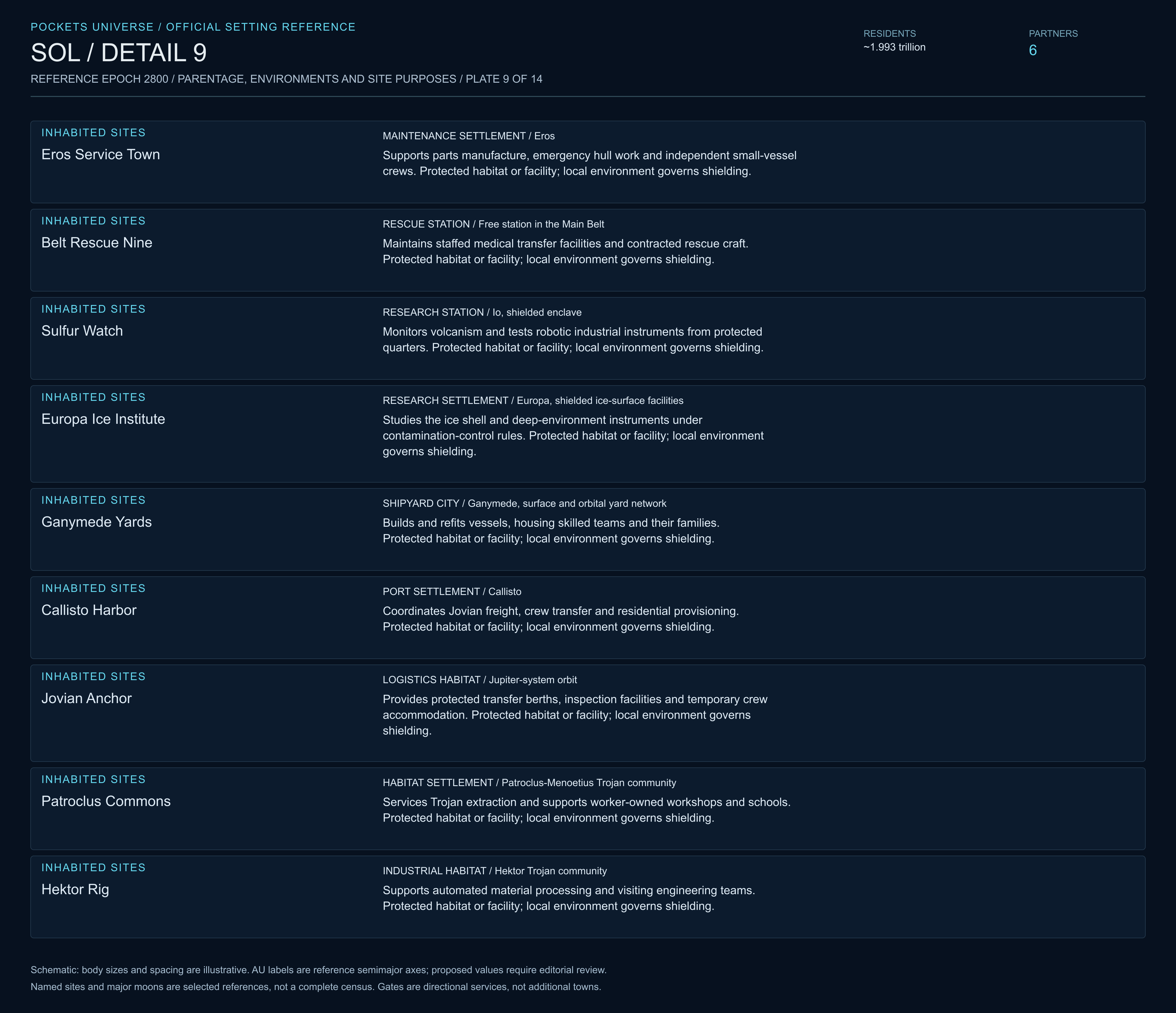
| Eros Service Town | Eros | Maintenance settlement | Supports parts manufacture, emergency hull work and independent small-vessel crews. |
| Belt Rescue Nine | Free station in the Main Belt | Rescue station | Maintains staffed medical transfer facilities and contracted rescue craft. |
| Sulfur Watch | Io, shielded enclave | Research station | Monitors volcanism and tests robotic industrial instruments from protected quarters. |
| Europa Ice Institute | Europa, shielded ice-surface facilities | Research settlement | Studies the ice shell and deep-environment instruments under contamination-control rules. |
| Ganymede Yards | Ganymede, surface and orbital yard network | Shipyard city | Builds and refits vessels, housing skilled teams and their families. |
| Callisto Harbor | Callisto | Port settlement | Coordinates Jovian freight, crew transfer and residential provisioning. |
| Jovian Anchor | Jupiter-system orbit | Logistics habitat | Provides protected transfer berths, inspection facilities and temporary crew accommodation. |
| Patroclus Commons | Patroclus-Menoetius Trojan community | Habitat settlement | Services Trojan extraction and supports worker-owned workshops and schools. |
| Hektor Rig | Hektor Trojan community | Industrial habitat | Supports automated material processing and visiting engineering teams. |
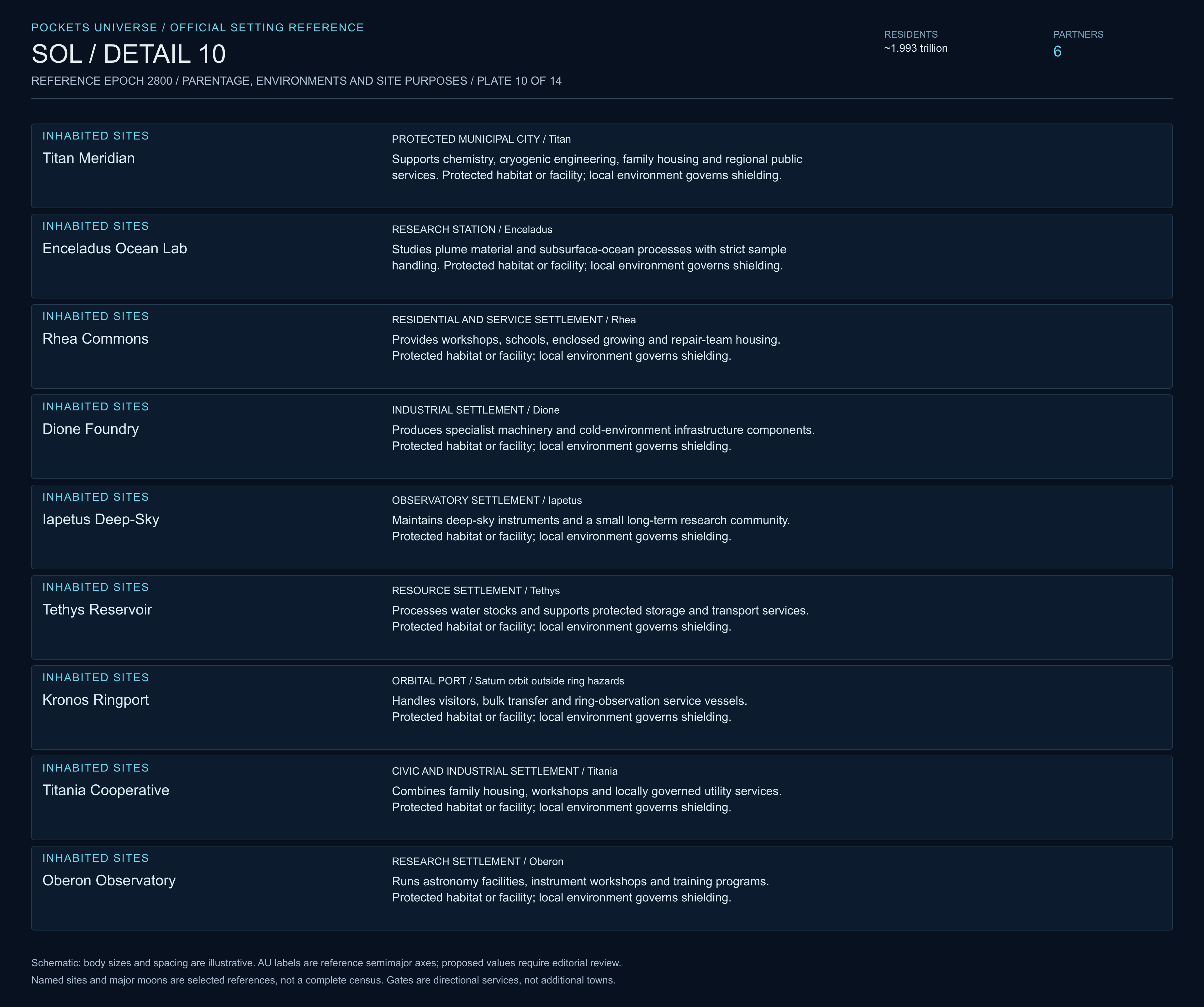
| Titan Meridian | Titan | Protected municipal city | Supports chemistry, cryogenic engineering, family housing and regional public services. |
| Enceladus Ocean Lab | Enceladus | Research station | Studies plume material and subsurface-ocean processes with strict sample handling. |
| Rhea Commons | Rhea | Residential and service settlement | Provides workshops, schools, enclosed growing and repair-team housing. |
| Dione Foundry | Dione | Industrial settlement | Produces specialist machinery and cold-environment infrastructure components. |
| Iapetus Deep-Sky | Iapetus | Observatory settlement | Maintains deep-sky instruments and a small long-term research community. |
| Tethys Reservoir | Tethys | Resource settlement | Processes water stocks and supports protected storage and transport services. |
| Kronos Ringport | Saturn orbit outside ring hazards | Orbital port | Handles visitors, bulk transfer and ring-observation service vessels. |
| Titania Cooperative | Titania | Civic and industrial settlement | Combines family housing, workshops and locally governed utility services. |
| Oberon Observatory | Oberon | Research settlement | Runs astronomy facilities, instrument workshops and training programs. |
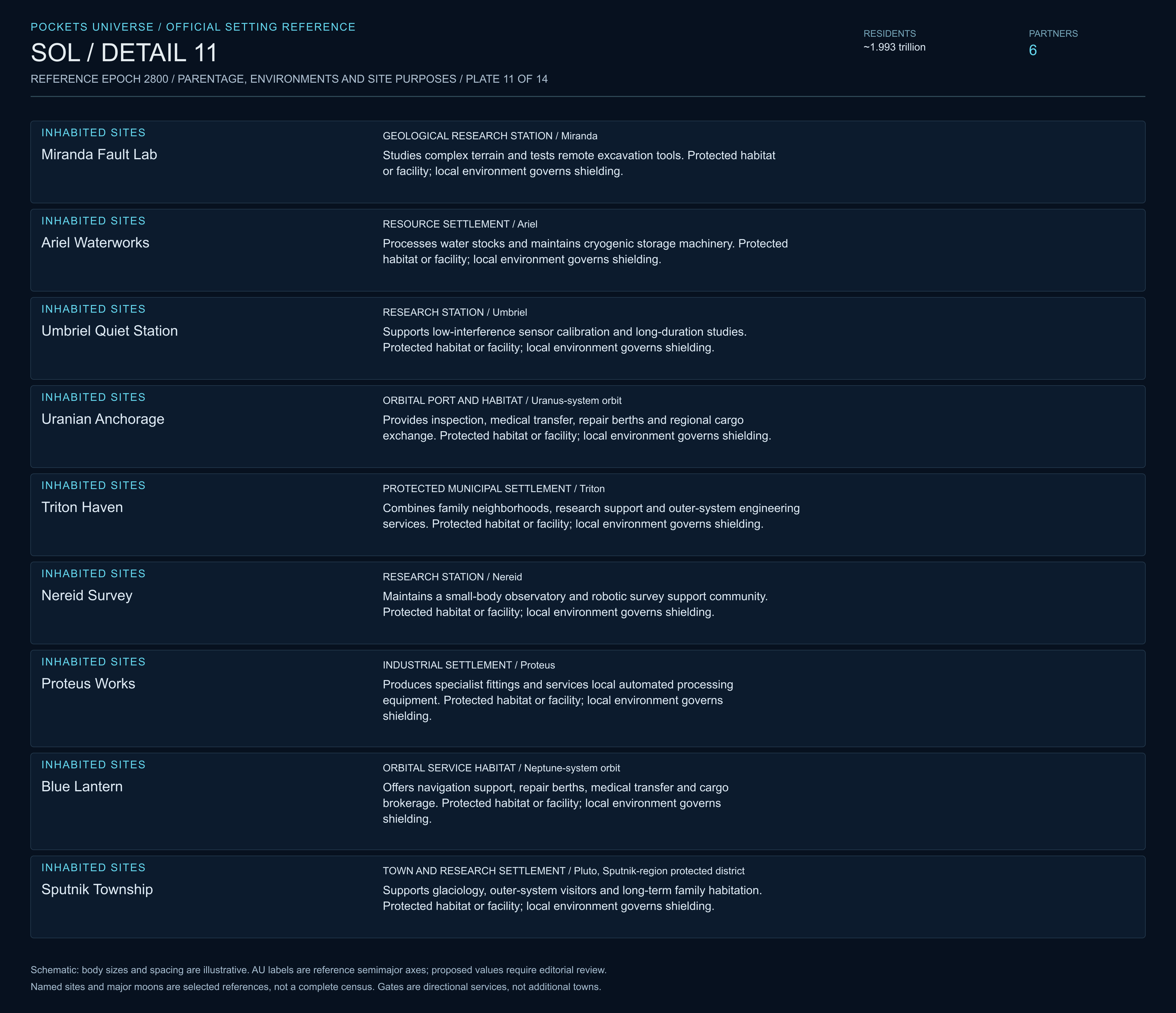
| Miranda Fault Lab | Miranda | Geological research station | Studies complex terrain and tests remote excavation tools. |
| Ariel Waterworks | Ariel | Resource settlement | Processes water stocks and maintains cryogenic storage machinery. |
| Umbriel Quiet Station | Umbriel | Research station | Supports low-interference sensor calibration and long-duration studies. |
| Uranian Anchorage | Uranus-system orbit | Orbital port and habitat | Provides inspection, medical transfer, repair berths and regional cargo exchange. |
| Triton Haven | Triton | Protected municipal settlement | Combines family neighborhoods, research support and outer-system engineering services. |
| Nereid Survey | Nereid | Research station | Maintains a small-body observatory and robotic survey support community. |
| Proteus Works | Proteus | Industrial settlement | Produces specialist fittings and services local automated processing equipment. |
| Blue Lantern | Neptune-system orbit | Orbital service habitat | Offers navigation support, repair berths, medical transfer and cargo brokerage. |
| Sputnik Township | Pluto, Sputnik-region protected district | Town and research settlement | Supports glaciology, outer-system visitors and long-term family habitation. |
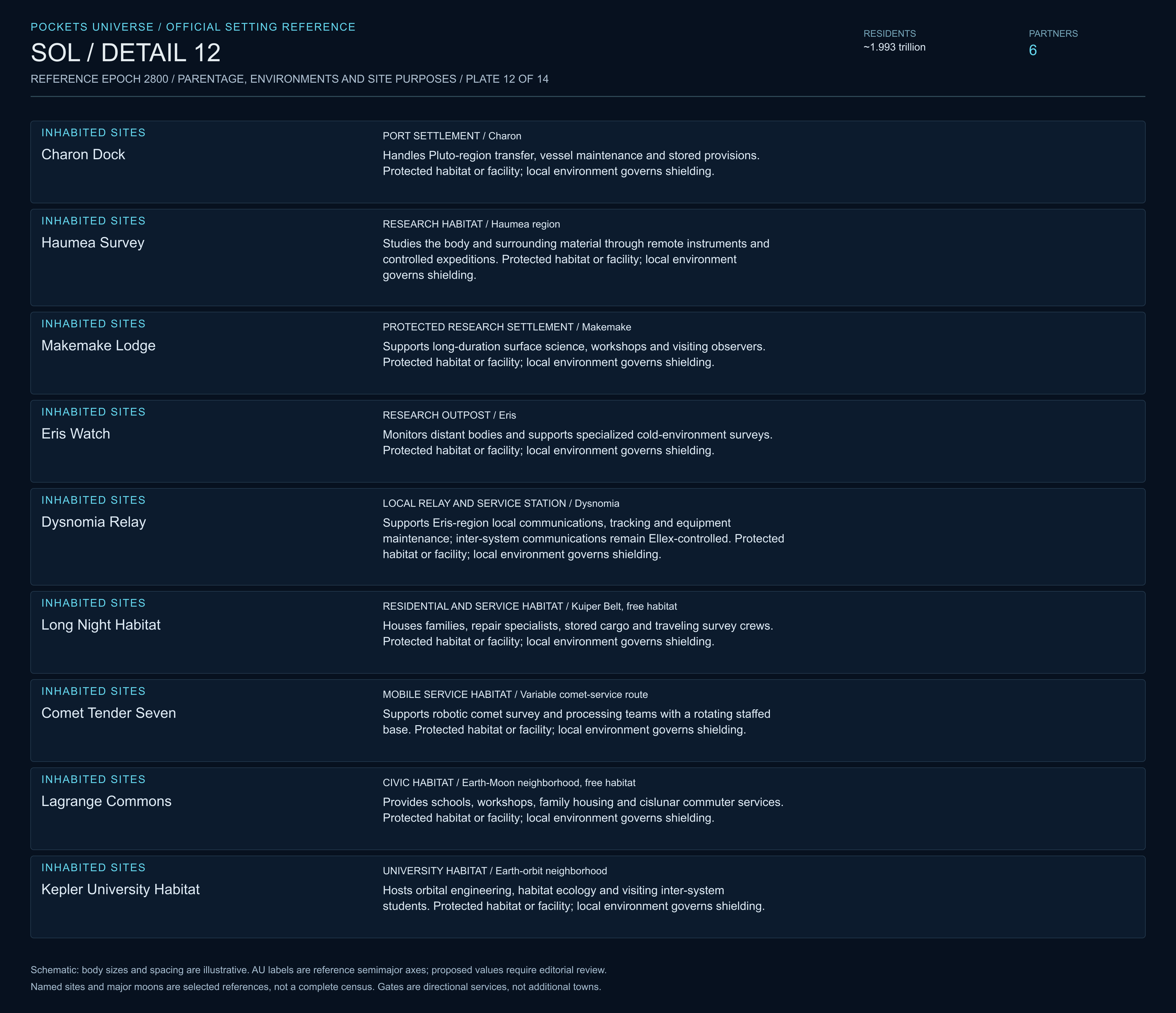
| Charon Dock | Charon | Port settlement | Handles Pluto-region transfer, vessel maintenance and stored provisions. |
| Haumea Survey | Haumea region | Research habitat | Studies the body and surrounding material through remote instruments and controlled expeditions. |
| Makemake Lodge | Makemake | Protected research settlement | Supports long-duration surface science, workshops and visiting observers. |
| Eris Watch | Eris | Research outpost | Monitors distant bodies and supports specialized cold-environment surveys. |
| Dysnomia Relay | Dysnomia | Local relay and service station | Supports Eris-region local communications, tracking and equipment maintenance; inter-system communications remain Ellex-controlled. |
| Long Night Habitat | Kuiper Belt, free habitat | Residential and service habitat | Houses families, repair specialists, stored cargo and traveling survey crews. |
| Comet Tender Seven | Variable comet-service route | Mobile service habitat | Supports robotic comet survey and processing teams with a rotating staffed base. |
| Lagrange Commons | Earth-Moon neighborhood, free habitat | Civic habitat | Provides schools, workshops, family housing and cislunar commuter services. |
| Kepler University Habitat | Earth-orbit neighborhood | University habitat | Hosts orbital engineering, habitat ecology and visiting inter-system students. |
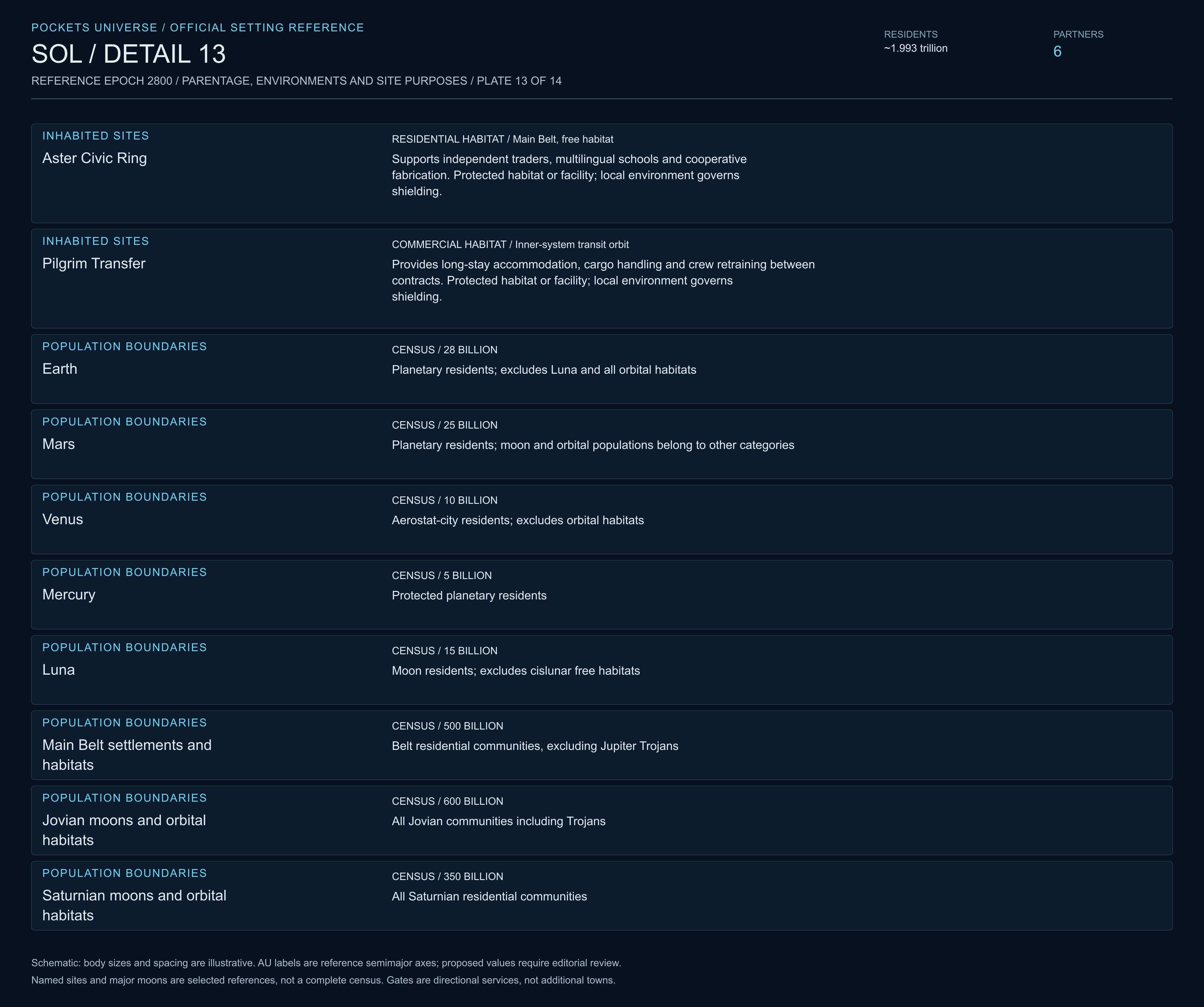
| Aster Civic Ring | Main Belt, free habitat | Residential habitat | Supports independent traders, multilingual schools and cooperative fabrication. |
| Pilgrim Transfer | Inner-system transit orbit | Commercial habitat | Provides long-stay accommodation, cargo handling and crew retraining between contracts. |
Port districts, civic buildings and working networks are not additional cities or independent population categories. Protected living areas, maintained power, atmosphere, thermal control and shielding follow local environmental needs. Regional freight supplies specialized components; self-sufficiency is not assumed.
Population Boundaries
| Exclusive category | Residents, billions | Boundary |
|---|---|---|
| Earth | 28 | Planetary residents; excludes Luna and all orbital habitats |
| Mars | 25 | Planetary residents; moon and orbital populations belong to other categories |
| Venus | 10 | Aerostat-city residents; excludes orbital habitats |
| Mercury | 5 | Protected planetary residents |
| Luna | 15 | Moon residents; excludes cislunar free habitats |
| Main Belt settlements and habitats | 500 | Belt residential communities, excluding Jupiter Trojans |
| Jovian moons and orbital habitats | 600 | All Jovian communities including Trojans |
| Saturnian moons and orbital habitats | 350 | All Saturnian residential communities |
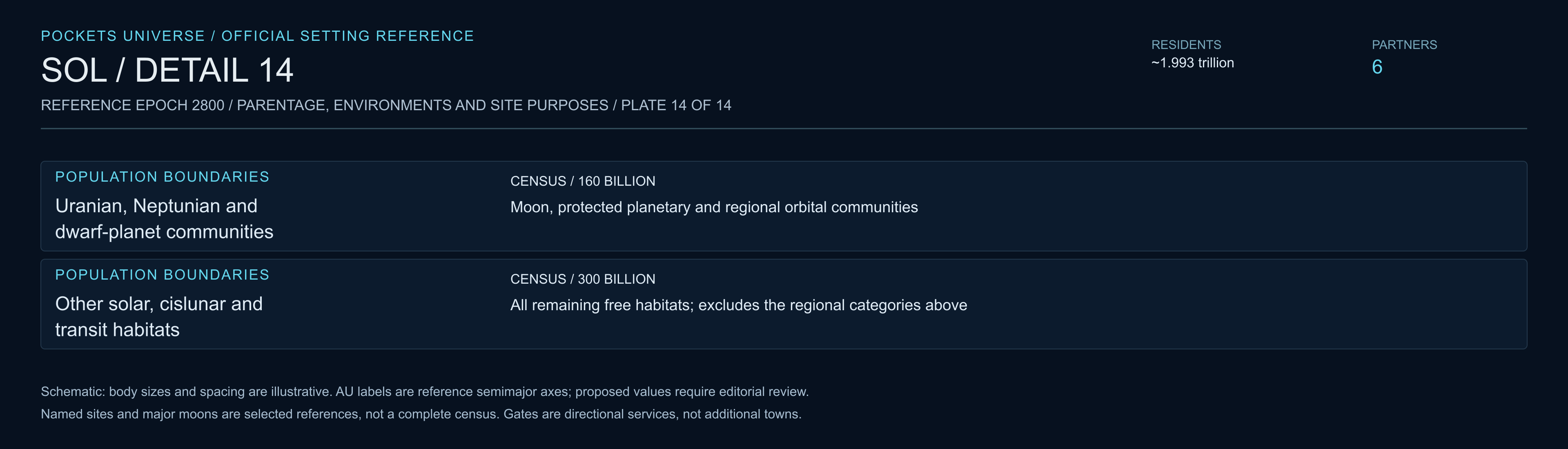
| Uranian, Neptunian and dwarf-planet communities | 160 | Moon, protected planetary and regional orbital communities |
| Other solar, cislunar and transit habitats | 300 | All remaining free habitats; excludes the regional categories above |
These categories total 1,993 billion residents. Named facilities belong to these categories and are not added again.
System Atlas
Open the overview above for full-resolution zoom and pan. The detail plates below provide the full reference inventory; their topics are listed with each link. The article also presents these facts as readable text. Body sizes and diagram spacing are illustrative; orbital labels distinguish established references from proposed design values.
Atlas Detail Plates
- Sol detail plate 1: worlds and physical features
- Sol detail plate 2: worlds and physical features
- Sol detail plate 3: worlds and physical features
- Sol detail plate 4: worlds and physical features
- Sol detail plate 5: worlds and physical features, settlements and facilities
- Sol detail plate 6: settlements and facilities
- Sol detail plate 7: settlements and facilities
- Sol detail plate 8: settlements and facilities
- Sol detail plate 9: settlements and facilities
- Sol detail plate 10: settlements and facilities
- Sol detail plate 11: settlements and facilities
- Sol detail plate 12: settlements and facilities
- Sol detail plate 13: settlements and facilities, population categories
- Sol detail plate 14: population categories
Reference Model And Limits
This edition combines established setting facts with explicitly proposed astronomy and revised recent worldbuilding. New survey identifiers are provisional labels, not new historical discoveries. A temperate orbit does not establish breathable air, safe weather or native life. New bodies and debris do not establish profitable resources.
- Solar moon distances are approximate historical mean semimajor axes from JPL, not navigation ephemerides propagated to 2800.
City And Station Profiles
- Atlantic Arcology — Supports federal legal services, insurance, migration businesses and dense mixed residential districts.
- Aphrodite Drift — Combines residential decks, chemical processing and public gardens in a linked floating municipality.
- Ceres Exchange — Operates the established belt exchange, cargo matching, commercial arbitration and provisioning services.