Systems
Ch'ul
Drainage works connect raised neighborhoods; dry industrial districts are separate from floodplain housing.
Article contents
At A Glance
- Region
- Core 10
- Population
- ~1.2 trillion
- Government
- Federal parliamentary democratic republic
- Distance from Sol
- 6.92 light-years
- Operational width
- 46 AU
- Gate services
- 5
What Makes This System Distinctive
- Ch’ul Prime: A humid blue-brown world with shifting floodplains, enormous wetland basins and raised urban causeways. Settled areas can support outdoor human life, but flood planning shapes daily movement. The 5-planet reference inventory spans 0.36–7.52 AU.
- Drainage works connect raised neighborhoods; dry industrial districts are separate from floodplain housing.
- 2 individually shown major moon references; Ch’ul Belt complete the selected small-body picture without implying profitable resources everywhere.
A founding manufacturing-and-banking power whose social obligations are both useful support networks and opportunities for favoritism. Civic pride is strong, and voters distinguish reciprocal help from abuse of public funds.
Wonders
-
The Wetland Causeways — Built · Ch’ul Prime. Raised urban routes thread enormous wetland basins and shifting floodplains. Long views along the causeways show inhabited neighbourhoods appearing to float above the water, with drainage engineering and ordinary outdoor life sharing the same remarkable landscape.
-
Daro’s Coastal Terraces — Built · Daro. Engineered coastal terraces step down toward shallow seas, their drainage districts tracing deliberate lines across the shore. From protected visitor routes, the meeting of water, terraced ground and passenger infrastructure shows an entire coast shaped for habitation.
-
Foundry City — Built · Ch’ul II. Heavy industry and skilled residential districts occupy a hot, metal-rich world. The scale of automated production beside protected human streets makes the city a destination for industrial architecture; active machinery remains separated from public circulation.
Government
Elected representatives form a coalition cabinet; planet and habitat districts retain municipal autonomy. Patronage networks influence contracts and candidate recruitment but cannot legally assign votes or hereditary seats. Independent investigators and opposition media can defeat a machine. Theo Marin’s federal role remains intact.
Local Culture
- A handshake is followed by a written public receipt; old deal-making manners coexist with insistence on enforceable records.
- District festivals display repaired industrial machines beside monumental architecture.
- Families keep favor books that include meals, care and repairs; reformers draw a firm line at official favors.
Worlds And Moons
| Body | Environment and habitation |
|---|---|
| Ch’ul Prime | A humid blue-brown world with shifting floodplains, enormous wetland basins and raised urban causeways. Settled areas can support outdoor human life, but flood planning shapes daily movement. |
| Ch’ul II | A hot, dry metal-rich world with protected industrial towns and a thin dusty atmosphere. |
| Daro | A shallow-sea residential world whose developed coasts are engineered terraces and drainage districts, not an effortless suburban Eden. |
| Veil and Tace | Two small moons of the capital, with protected finance and technical settlements. |
Civic And Political Traditions
Civic Works Coalition (Manufacturing investment, jobs and district infrastructure; vulnerable to connected-contractor scandals.); Clear Accounts Party (Open tenders, municipal audits and conflict-of-interest rules; strong among professionals and independent businesses.); Daro Neighborhood Federation (Housing, schools and transport affordability; converts resident associations into electoral campaigns.)
Economy And Companies
Daro Manufacturing; the Ch’ul Clearing Houses; Sable Holdings (where the quietly dirty money rests).
Gate Connections
Ch’ul has mapped services to Bharani, Corvus, Malan, Sol, Xiu. Generating departure gates and available services are distinct: some crossings require a separate return gate. See Gates and communications.
Reading The Profile
Population figures are approximate. Local cultural descriptions represent traditions and institutions, rather than traits shared by every resident. Navigation distances are authored setting values; they are not measurements of real stars.
Settlements And Landmarks
Named places include planetary communities, orbital habitats, working ports, and research facilities. These are examples within larger settlement networks.
| Body or district | Site | Purpose |
|---|---|---|
| Ch’ul Prime | Agreement Hall | Elected federal-style system assembly |
| Ch’ul Prime | Grand Civic Steps | Public debating space and founding monuments |
| Ch’ul II | Foundry City | Automated heavy industry and skilled residential districts |
| Ch’ul II | Workers Proof Institute | Industrial safety and independent technical certification |
| Daro | Neighborhood Forum | Civic associations and housing services |
| Daro | Garden Transit Hub | Passenger connections and family districts |
| Veil | Veil Banking Quarter | Established private finance, now subject to public law and audits |
| Tace | Tace Technical College | Moon engineering and repair training |
| Ch’ul Prime orbit | The Ledger | Established orbital banking platform |
| Daro orbit | Handshake Ring | Residential habitat and public service offices |
| Ch’ul Belt | Sable Exchange | Private holdings and commodity trade; connected interests face review |
| Ch’ul Belt | Open Tender Yard | Competitive repair contracts and ship services |
| Outer habitat districts | Witness Commons | Records, public-interest reporting and resident housing |
| Outer habitat districts | Long Receipt Observatory | Survey research and outer traffic tracking |
| Inner departure radius | Ch’ul Gate | Existing Ellex departure complex |
| Outer arrival radius | Ch’ul Arrival Services | Existing outer arrival-mouth services |
Planetary Architecture
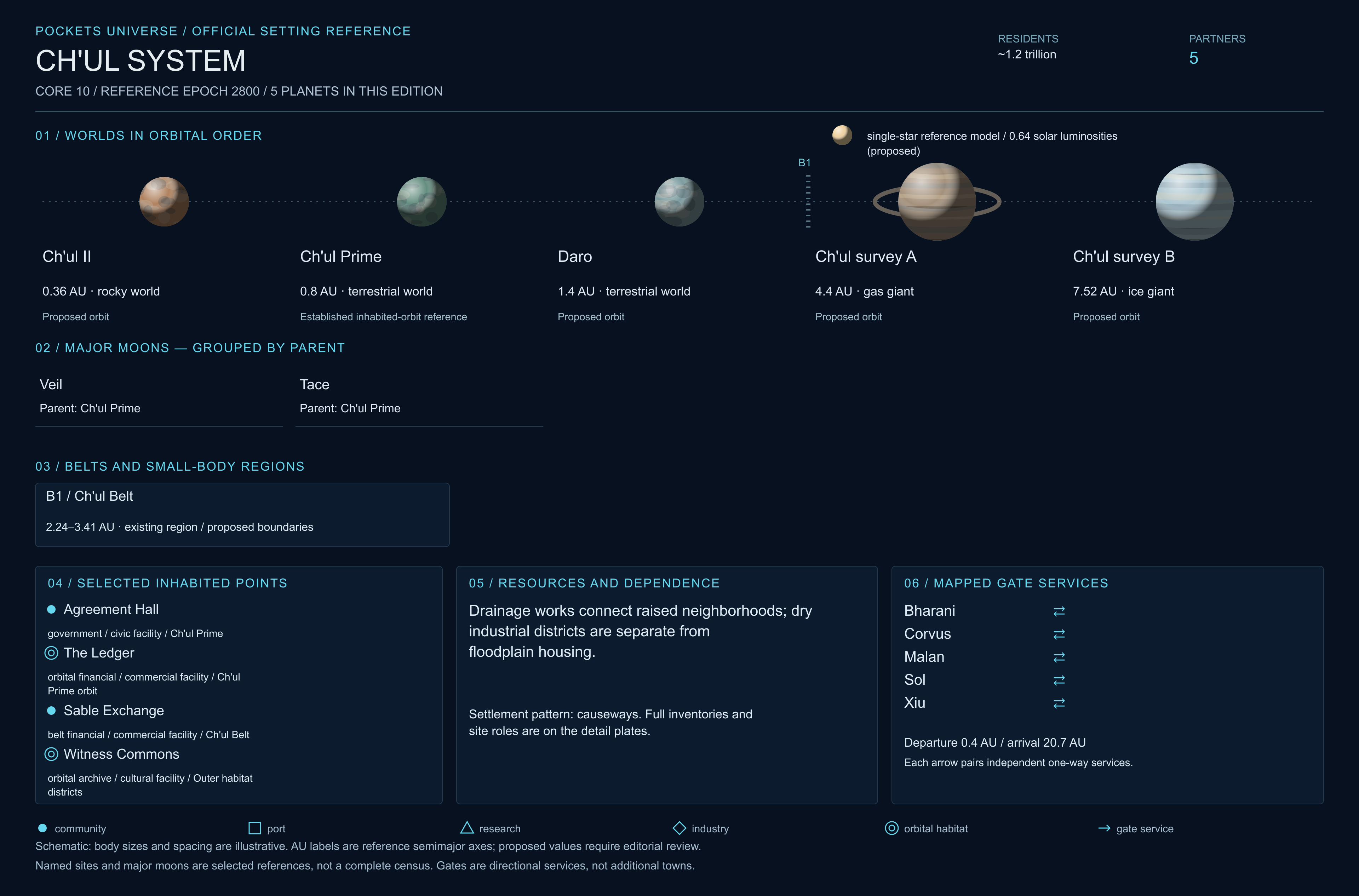
single-star reference model. 0.64 solar luminosities and approximately 0.894 solar masses (proposed working model).
| World, in orbital order | Approximate orbit | Composition and conditions |
|---|---|---|
| Ch’ul II | 0.36 AU — proposed | rocky world. A hot, dry metal-rich world with protected industrial towns and a thin dusty atmosphere. |
| Ch’ul Prime | 0.8 AU — established inhabited-orbit reference | terrestrial world. A humid blue-brown world with shifting floodplains, enormous wetland basins and raised urban causeways. Settled areas can support outdoor human life, but flood planning shapes daily movement. |
| Daro | 1.4 AU — proposed | terrestrial world. A shallow-sea residential world whose developed coasts are engineered terraces and drainage districts, not an effortless suburban Eden. |
| Ch’ul survey A | 4.4 AU — proposed | gas giant. Hydrogen-rich giant with no solid residential surface; no selected inhabited sites. Proposed faint dust ring; no residential platform or dense debris barrier. |
| Ch’ul survey B | 7.52 AU — proposed | ice giant. Volatile-rich outer planet; no selected inhabited sites. |
Major Moons
| Moon / group | Parent | Reference conditions |
|---|---|---|
| Veil | Ch’ul Prime | Two small moons of the capital, with protected finance and technical settlements. Approximate orbital semimajor axis 90,000 km (proposed). |
| Tace | Ch’ul Prime | Two small moons of the capital, with protected finance and technical settlements. Approximate orbital semimajor axis 167,000 km (proposed). |
Named major satellites shown; uncatalogued small satellites are not a surveyed census.
Belts And Small Bodies
| Region | Approximate radial reference | Composition / use |
|---|---|---|
| Ch’ul Belt | 2.24–3.41 AU — proposed region boundaries | Established belt communities; boundaries are a proposed schematic model, not a resource census. |
Settlement Network
Drainage works connect raised neighborhoods; dry industrial districts are separate from floodplain housing.
| Site / district | Location | Type | Purpose |
|---|---|---|---|
| Agreement Hall | Ch’ul Prime | government / civic facility | Elected federal-style system assembly |
| Grand Civic Steps | Ch’ul Prime | government / civic facility | Public debating space and founding monuments |
| Foundry City | Ch’ul II | industry / repair facility | Automated heavy industry and skilled residential districts |
| Workers Proof Institute | Ch’ul II | research / education facility | Industrial safety and independent technical certification |
| Neighborhood Forum | Daro | government / civic facility | Civic associations and housing services |
| Garden Transit Hub | Daro | port / logistics facility | Passenger connections and family districts |
| Veil Banking Quarter | Veil | financial / commercial facility | Established private finance, now subject to public law and audits |
| Tace Technical College | Tace | research / education facility | Moon engineering and repair training |
| The Ledger | Ch’ul Prime orbit | orbital financial / commercial facility | Established orbital banking platform |
| Handshake Ring | Daro orbit | orbital residential / community district | Residential habitat and public service offices |
| Sable Exchange | Ch’ul Belt | belt financial / commercial facility | Private holdings and commodity trade; connected interests face review |
| Open Tender Yard | Ch’ul Belt | belt industry / repair facility | Competitive repair contracts and ship services |
| Witness Commons | Outer habitat districts | orbital archive / cultural facility | Records, public-interest reporting and resident housing |
| Long Receipt Observatory | Outer habitat districts | orbital research / education facility | Survey research and outer traffic tracking |
| Ch’ul Gate | Inner departure radius | gate infrastructure | Existing Ellex departure complex |
| Ch’ul Arrival Services | Outer arrival radius | gate infrastructure | Existing outer arrival-mouth services |
Port districts, civic buildings and working networks are not additional cities or independent population categories. Protected living areas, maintained power, atmosphere, thermal control and shielding follow local environmental needs. Regional freight supplies specialized components; self-sufficiency is not assumed.
Population Boundaries
| Exclusive category | Residents, billions | Boundary |
|---|---|---|
| Ch’ul Prime | 28 | Capital-world residents |
| Ch’ul II | 20 | Industrial-world residents |
| Daro | 12 | Residential-world residents |
| Veil and Tace | 4 | Combined moon residents |
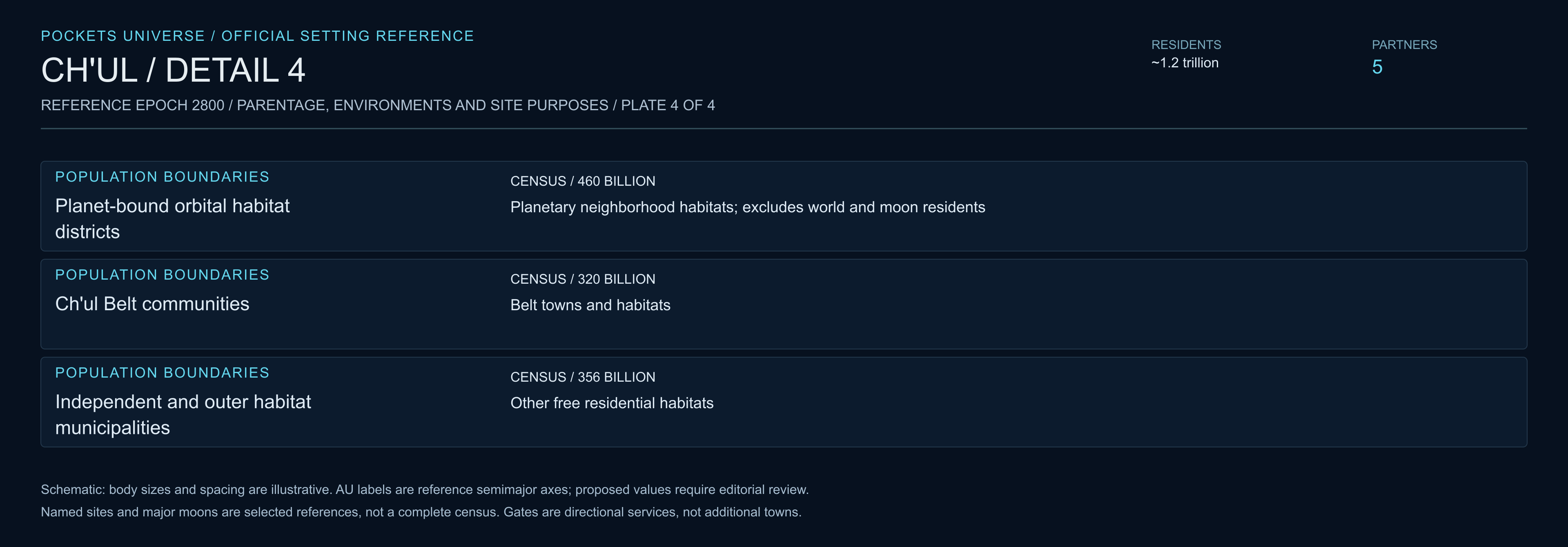
| Planet-bound orbital habitat districts | 460 | Planetary neighborhood habitats; excludes world and moon residents |
| Ch’ul Belt communities | 320 | Belt towns and habitats |
| Independent and outer habitat municipalities | 356 | Other free residential habitats |
These categories total 1,200 billion residents. Named facilities belong to these categories and are not added again.
System Atlas
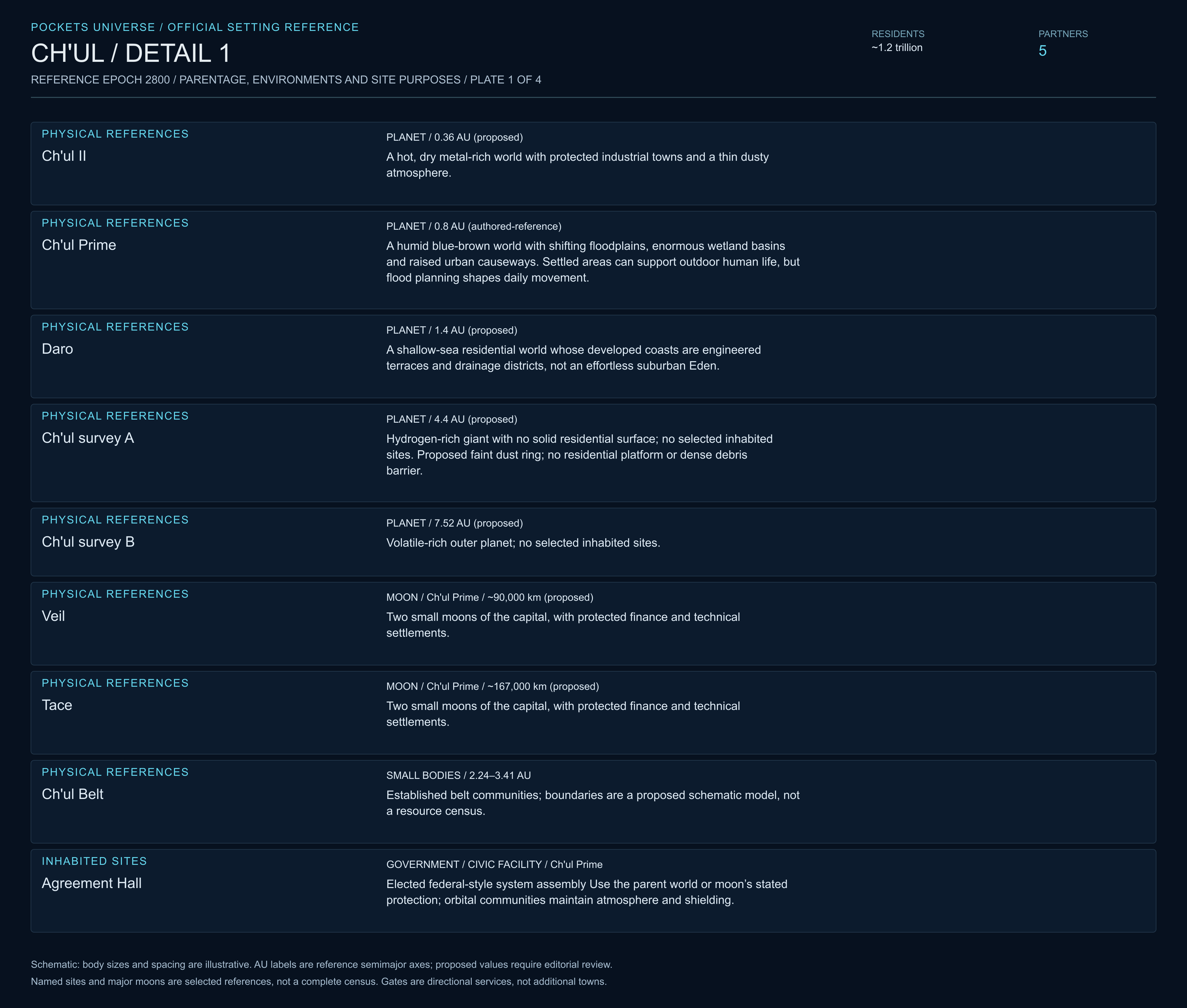
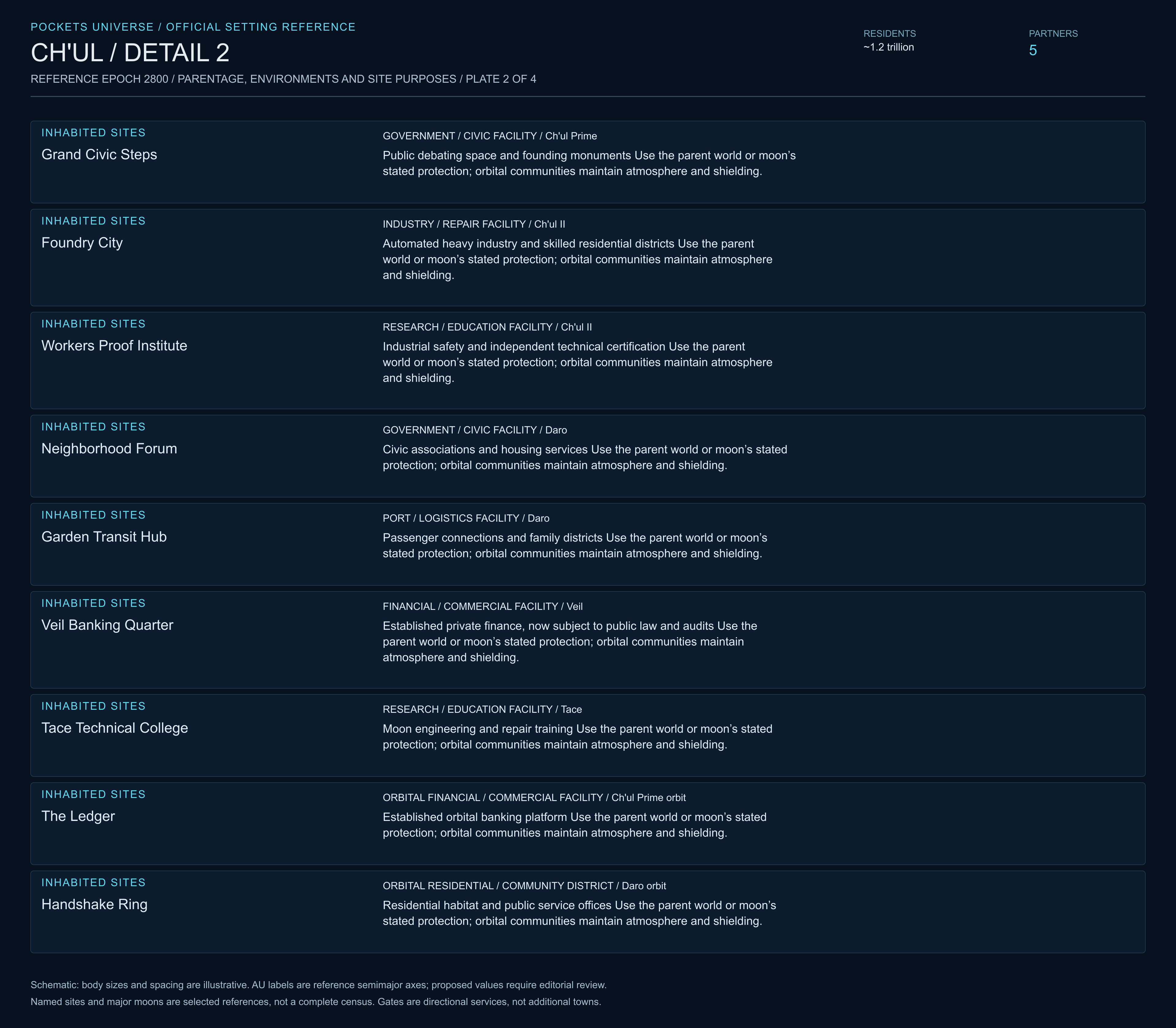
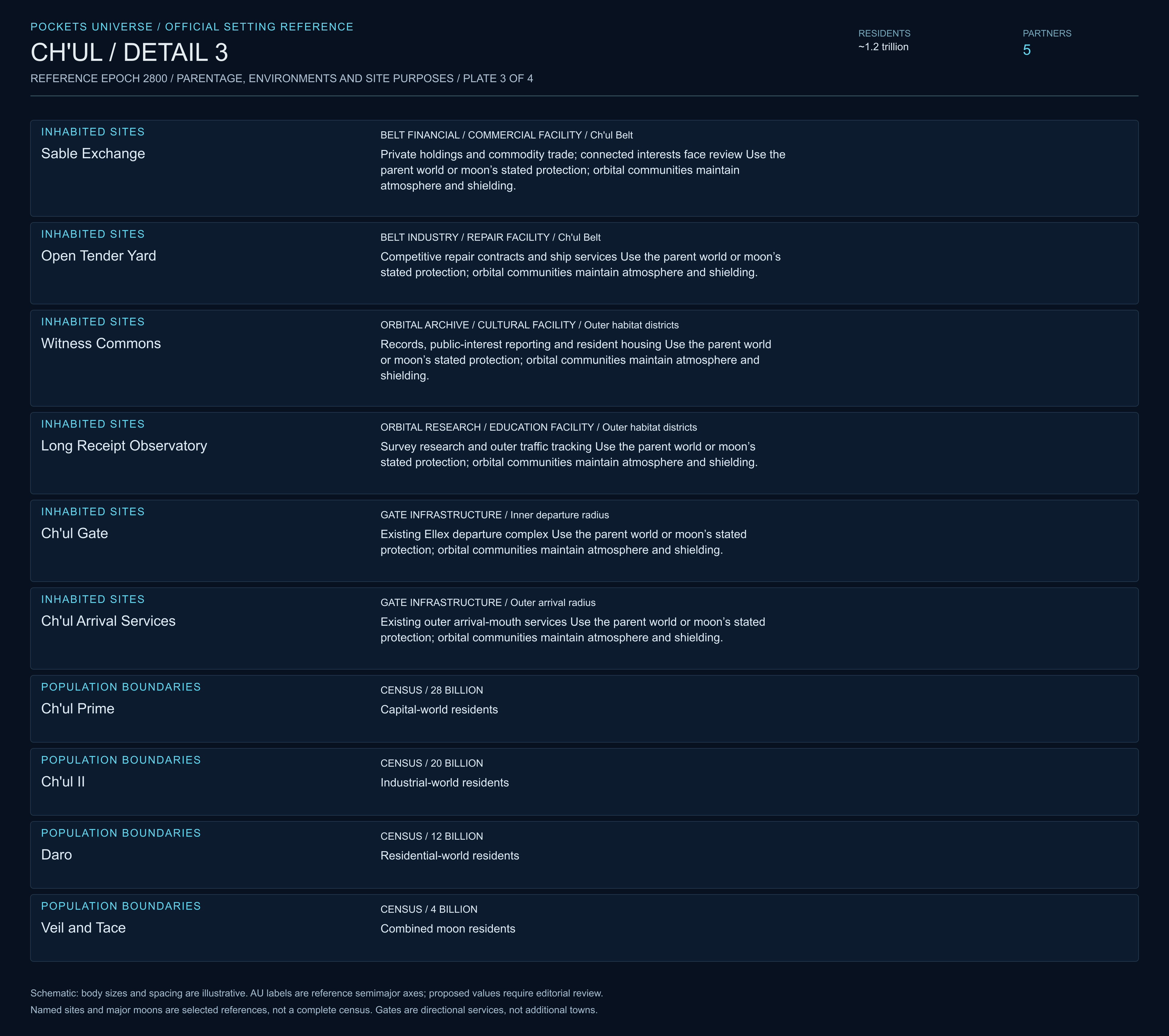
Open the overview above for full-resolution zoom and pan. The detail plates below provide the full reference inventory; their topics are listed with each link. The article also presents these facts as readable text. Body sizes and diagram spacing are illustrative; orbital labels distinguish established references from proposed design values.
Atlas Detail Plates
- Ch’ul detail plate 1: worlds and physical features, settlements and facilities
- Ch’ul detail plate 2: settlements and facilities
- Ch’ul detail plate 3: settlements and facilities, population categories
- Ch’ul detail plate 4: population categories
Reference Model And Limits
This edition combines established setting facts with explicitly proposed astronomy and revised recent worldbuilding. New survey identifiers are provisional labels, not new historical discoveries. A temperate orbit does not establish breathable air, safe weather or native life. New bodies and debris do not establish profitable resources.
- Stellar luminosity, unmeasured orbital values, belt boundaries and new physical models are proposed design values requiring editorial approval; they do not certify habitability.
- Existing navigation width describes the transit model, not a hard astronomical edge.
City And Station Profiles
- Foundry City — Automated heavy industry and skilled residential districts.