Systems
Malan
Dust management and enclosed agriculture link inhabited worlds without making them open-air paradises.
Article contents
At A Glance
- Region
- Core 10
- Population
- ~0.6 trillion
- Government
- Parliamentary democratic republic
- Distance from Sol
- 17.50 light-years
- Operational width
- 68 AU
- Gate services
- 6
What Makes This System Distinctive
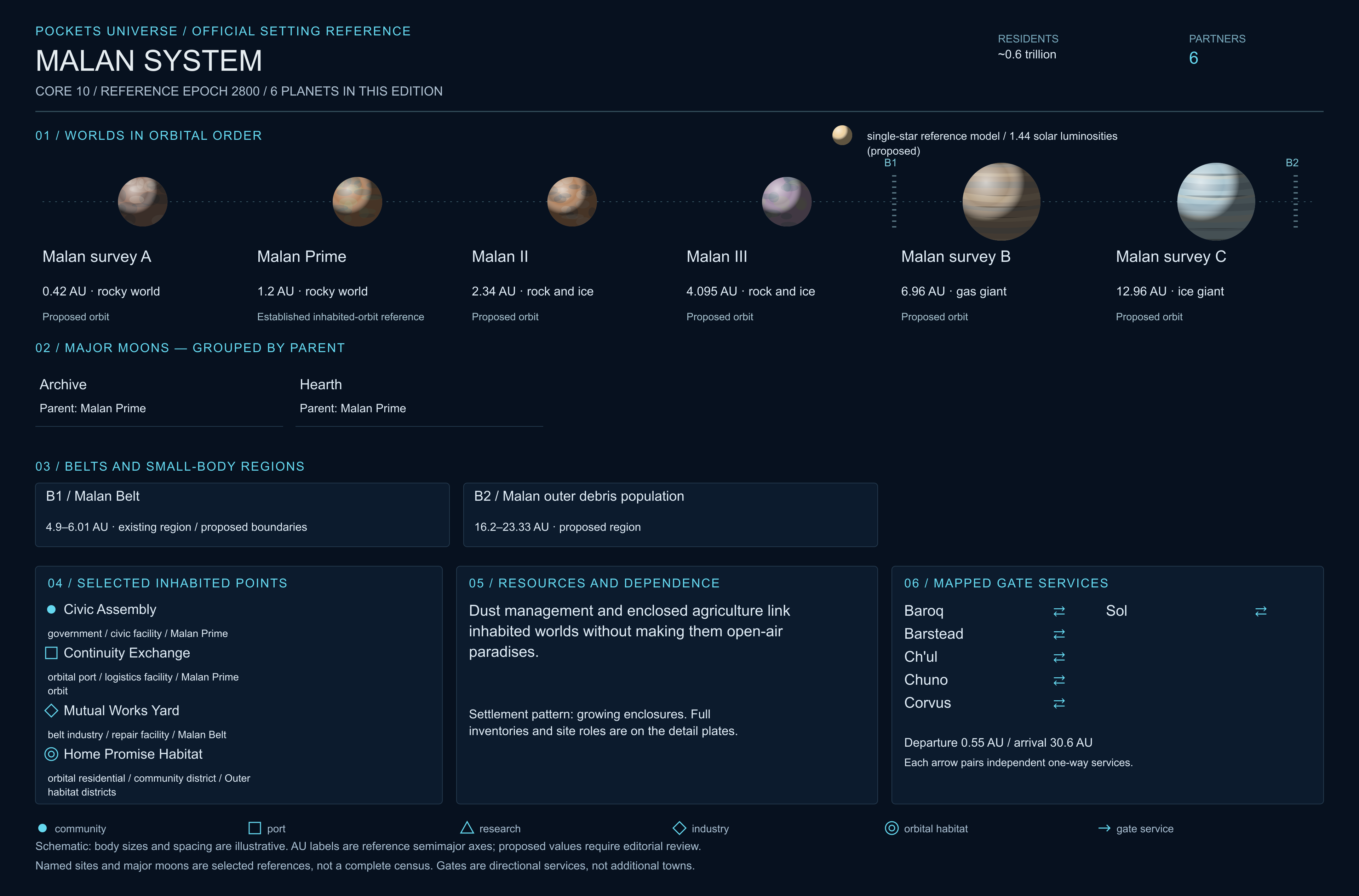
- Malan Prime: An ochre highland world with pale dusty sky and limited dark seas. Cities manage air quality and agricultural enclosure rather than relying on an Earthlike ecosystem. The 6-planet reference inventory spans 0.42–12.96 AU.
- Dust management and enclosed agriculture link inhabited worlds without making them open-air paradises.
- 2 individually shown major moon references; Malan Belt and Malan outer debris population complete the selected small-body picture without implying profitable resources everywhere.
A fully inhabited Core manufacturing-and-finance power with an apprenticeship culture and strong civic reliability. It participates in federal trade, research and representation; its citizens are neither presumed lost nor treated as survivors of a sealed system.
Wonders
-
The Paired-Sun Prospect — Natural · Malan Prime. The close pair of suns gives the dusty highlands a distinctive changing illumination. From a protected viewing space, differences in the light across ridges and limited dark seas make the system’s stellar setting part of the landscape.
-
Hearth’s Frost Margins — Natural · Malan III. Seasonal frost traces the edges of the settled landscape around Hearth District. A protected approach during the changing season shows pale ground giving way to darker country beside maintained food-production enclosures.
-
Continuity Exchange — Built · Malan Prime orbit. The established finance and passenger station gathers the system’s civic and commercial movement. Its inhabited spaces above a world lit by paired suns make the ordinary work of arrivals and exchange visually distinctive.
Government
An elected assembly and coalition cabinet govern an integrated manufacturing-and-finance republic with independent courts. Local planet and habitat councils deliver ordinary services. All six mapped departure services function in 2800.
Local Culture
- Apprenticeship anniversaries are celebrated like birthdays, and mentors are expected to return the favor in retirement.
- Public parks display repaired machinery with technicians’ names rather than company owners.
- Neighbors exchange written promises to check on elderly residents during shift changes.
Worlds And Moons
| Body | Environment and habitation |
|---|---|
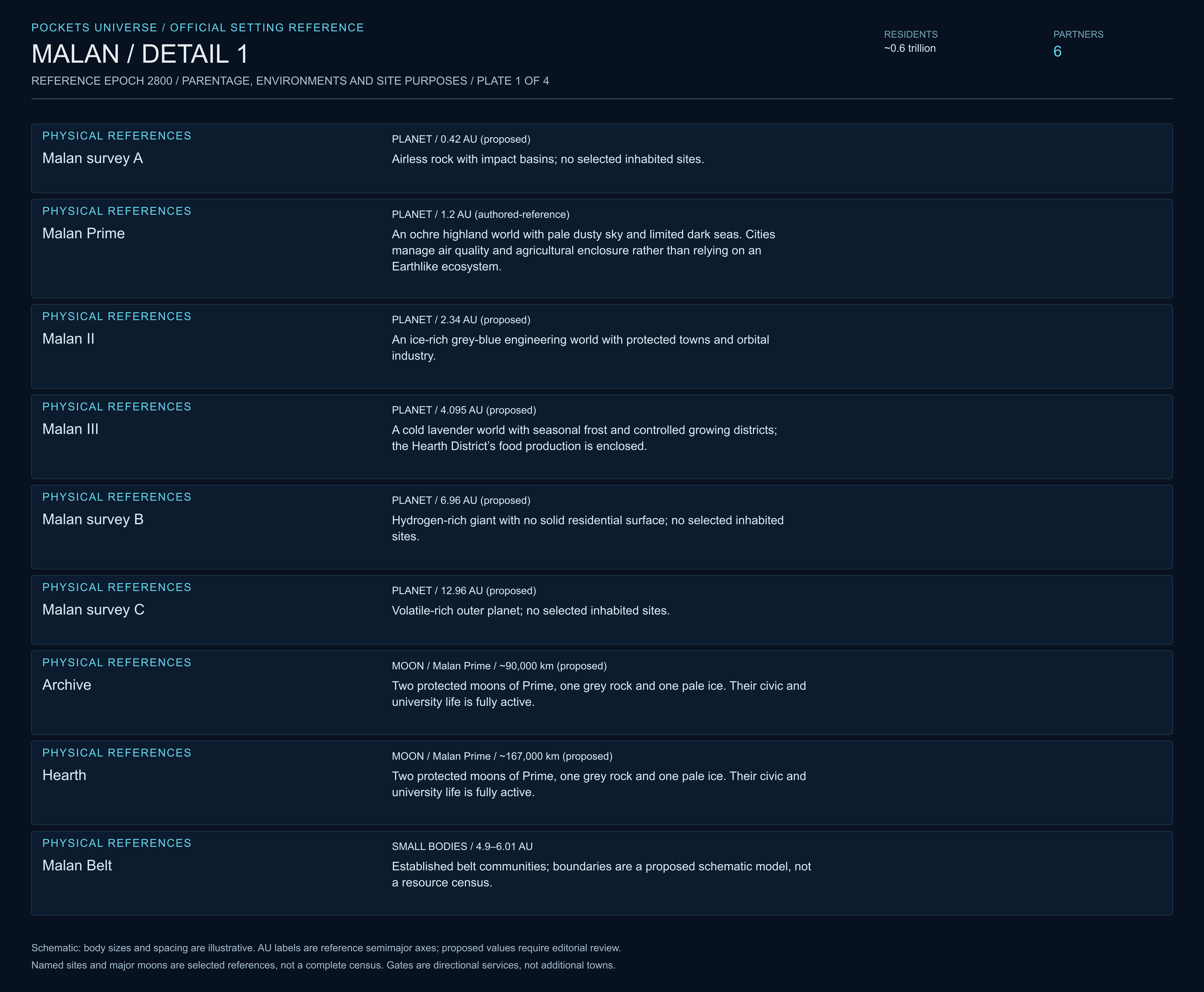
| Malan Prime | An ochre highland world with pale dusty sky and limited dark seas. Cities manage air quality and agricultural enclosure rather than relying on an Earthlike ecosystem. |
| Malan II | An ice-rich grey-blue engineering world with protected towns and orbital industry. |
| Malan III | A cold lavender world with seasonal frost and controlled growing districts; the Hearth District’s food production is enclosed. |
| Archive and Hearth | Two protected moons of Prime, one grey rock and one pale ice. Their civic and university life is fully active. |
Civic And Political Traditions
Civic Production Party (Industry, apprenticeship and steady public services.); Open Accounts Alliance (Transparent finance, independent audits and housing access.); Habitat Social League (Resident utility ownership and worker protections.)
Economy And Companies
Malan Civic Works (industrial engineering); Hearth Mutual Finance (resident banking); Archive Instruments (research equipment).
Gate Connections
Malan has mapped services to Baroq, Barstead, Ch’ul, Chuno, Corvus, Sol. Generating departure gates and available services are distinct: some crossings require a separate return gate. See Gates and communications.
Reading The Profile
Population figures are approximate. Local cultural descriptions represent traditions and institutions, rather than traits shared by every resident. Navigation distances are authored setting values; they are not measurements of real stars.
Settlements And Landmarks
Named places include planetary communities, orbital habitats, working ports, and research facilities. These are examples within larger settlement networks.
| Body or district | Site | Purpose |
|---|---|---|
| Malan Prime | Civic Assembly | Elected parliament and public hearings |
| Malan Prime | Apprentice Square | Community festivals and trades education |
| Malan II | Sister Works | Industry and resident neighborhoods |
| Malan III | Hearth District | Food production and civic housing |
| Archive moon | Archive Commons | Civic records and university services |
| Hearth moon | Hearth Research Town | Habitat science and family housing |
| Malan Prime orbit | Continuity Exchange | Finance and passenger station |
| Malan II orbit | Apprentice Ring | Residential and industrial habitat |
| Malan Belt | Mutual Works Yard | Repair and extraction services |
| Malan Belt | Common Ledger Market | Commodity and public-contract exchange |
| Outer habitat districts | Last Light Observatory | Survey instruments and staff quarters |
| Outer habitat districts | Home Promise Habitat | Residential municipality |
| Inner departure radius | Malan Gate | Six mapped generating departure services, all available |
| Outer arrival radius | Malan Arrival Services | Existing fixed outer endpoints and passenger services |
Planetary Architecture
single-star reference model. 1.44 solar luminosities and approximately 1.095 solar masses (proposed working model).
| World, in orbital order | Approximate orbit | Composition and conditions |
|---|---|---|
| Malan survey A | 0.42 AU — proposed | rocky world. Airless rock with impact basins; no selected inhabited sites. |
| Malan Prime | 1.2 AU — established inhabited-orbit reference | rocky world. An ochre highland world with pale dusty sky and limited dark seas. Cities manage air quality and agricultural enclosure rather than relying on an Earthlike ecosystem. |
| Malan II | 2.34 AU — proposed | rock and ice. An ice-rich grey-blue engineering world with protected towns and orbital industry. |
| Malan III | 4.095 AU — proposed | rock and ice. A cold lavender world with seasonal frost and controlled growing districts; the Hearth District’s food production is enclosed. |
| Malan survey B | 6.96 AU — proposed | gas giant. Hydrogen-rich giant with no solid residential surface; no selected inhabited sites. |
| Malan survey C | 12.96 AU — proposed | ice giant. Volatile-rich outer planet; no selected inhabited sites. |
Major Moons
| Moon / group | Parent | Reference conditions |
|---|---|---|
| Archive | Malan Prime | Two protected moons of Prime, one grey rock and one pale ice. Their civic and university life is fully active. Approximate orbital semimajor axis 90,000 km (proposed). |
| Hearth | Malan Prime | Two protected moons of Prime, one grey rock and one pale ice. Their civic and university life is fully active. Approximate orbital semimajor axis 167,000 km (proposed). |
Named major satellites shown; uncatalogued small satellites are not a surveyed census.
Belts And Small Bodies
| Region | Approximate radial reference | Composition / use |
|---|---|---|
| Malan Belt | 4.9–6.01 AU — proposed region boundaries | Established belt communities; boundaries are a proposed schematic model, not a resource census. |
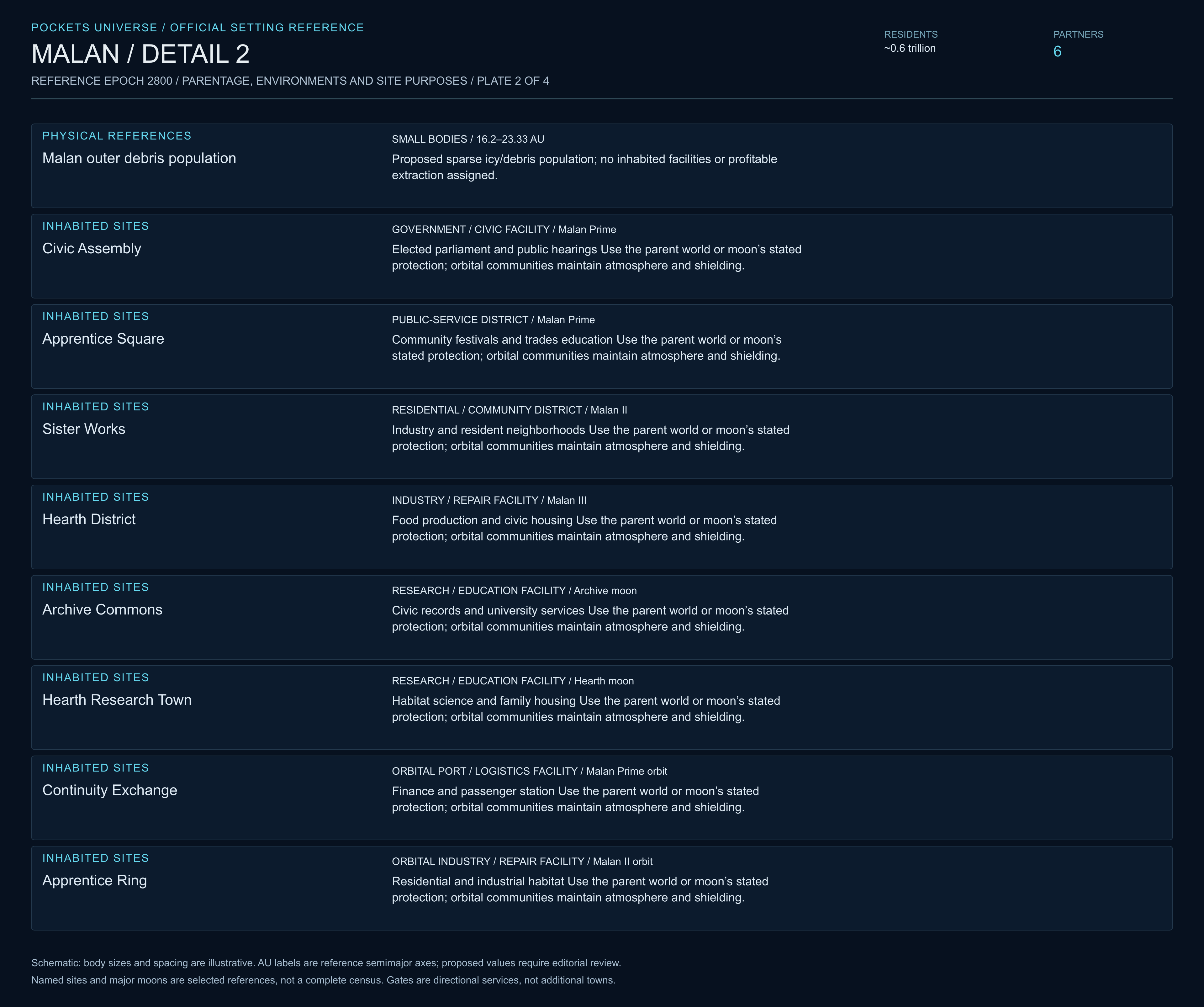
| Malan outer debris population | 16.2–23.33 AU — proposed | Proposed sparse icy/debris population; no inhabited facilities or profitable extraction assigned. |
Settlement Network
Dust management and enclosed agriculture link inhabited worlds without making them open-air paradises.
| Site / district | Location | Type | Purpose |
|---|---|---|---|
| Civic Assembly | Malan Prime | government / civic facility | Elected parliament and public hearings |
| Apprentice Square | Malan Prime | public-service district | Community festivals and trades education |
| Sister Works | Malan II | residential / community district | Industry and resident neighborhoods |
| Hearth District | Malan III | industry / repair facility | Food production and civic housing |
| Archive Commons | Archive moon | research / education facility | Civic records and university services |
| Hearth Research Town | Hearth moon | research / education facility | Habitat science and family housing |
| Continuity Exchange | Malan Prime orbit | orbital port / logistics facility | Finance and passenger station |
| Apprentice Ring | Malan II orbit | orbital industry / repair facility | Residential and industrial habitat |
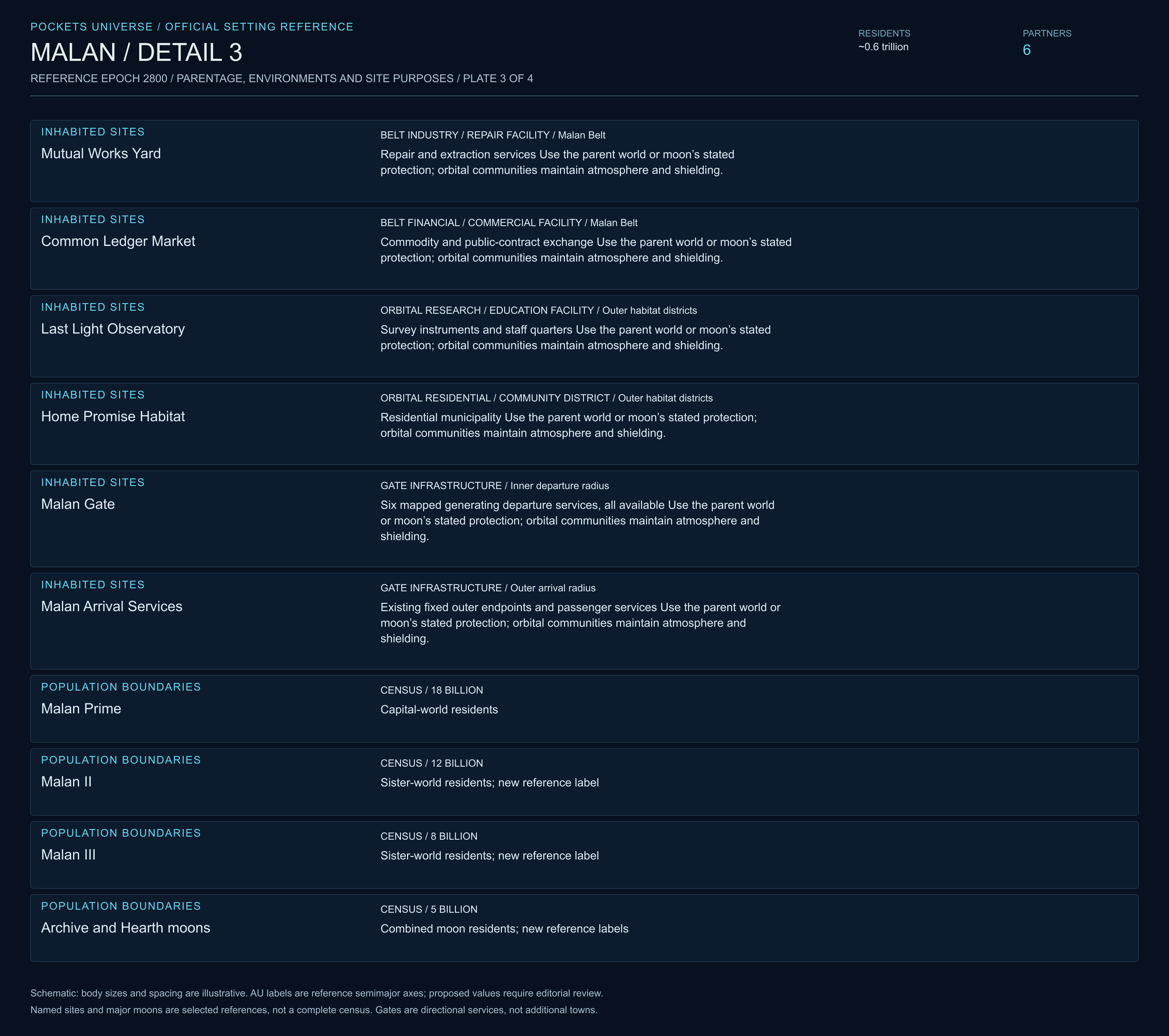
| Mutual Works Yard | Malan Belt | belt industry / repair facility | Repair and extraction services |
| Common Ledger Market | Malan Belt | belt financial / commercial facility | Commodity and public-contract exchange |
| Last Light Observatory | Outer habitat districts | orbital research / education facility | Survey instruments and staff quarters |
| Home Promise Habitat | Outer habitat districts | orbital residential / community district | Residential municipality |
| Malan Gate | Inner departure radius | gate infrastructure | Six mapped generating departure services, all available |
| Malan Arrival Services | Outer arrival radius | gate infrastructure | Existing fixed outer endpoints and passenger services |
Port districts, civic buildings and working networks are not additional cities or independent population categories. Protected living areas, maintained power, atmosphere, thermal control and shielding follow local environmental needs. Regional freight supplies specialized components; self-sufficiency is not assumed.
Population Boundaries
| Exclusive category | Residents, billions | Boundary |
|---|---|---|
| Malan Prime | 18 | Capital-world residents |
| Malan II | 12 | Sister-world residents; new reference label |
| Malan III | 8 | Sister-world residents; new reference label |
| Archive and Hearth moons | 5 | Combined moon residents; new reference labels |
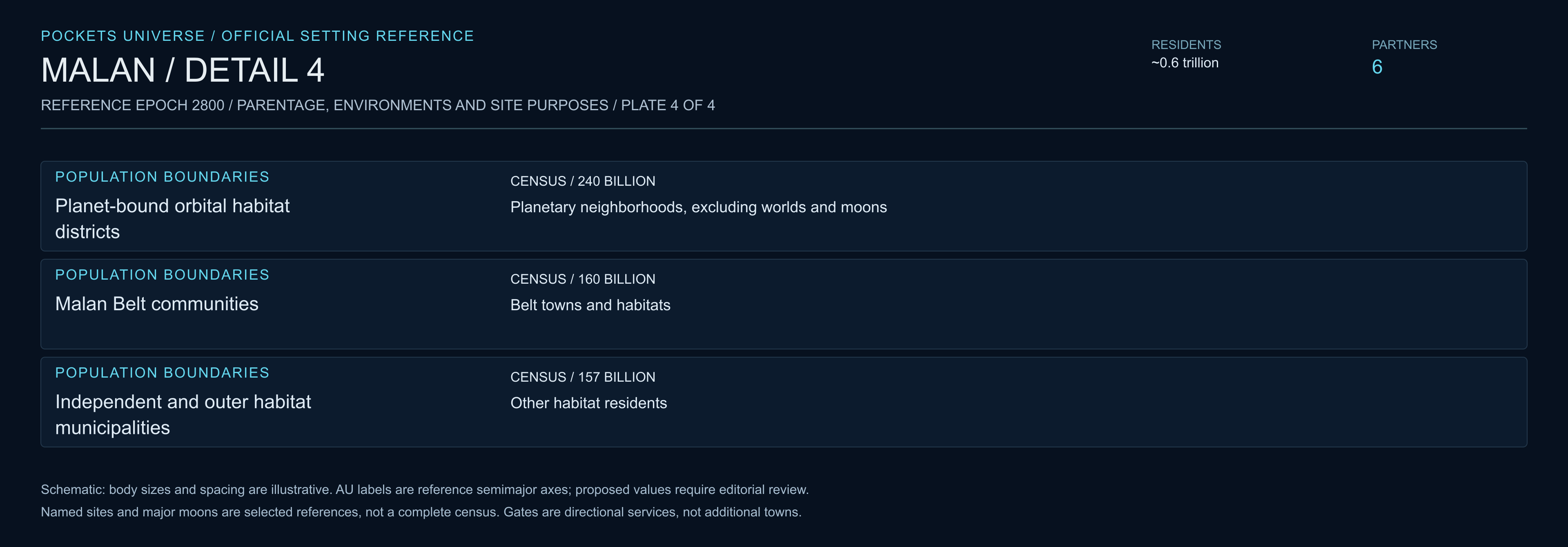
| Planet-bound orbital habitat districts | 240 | Planetary neighborhoods, excluding worlds and moons |
| Malan Belt communities | 160 | Belt towns and habitats |
| Independent and outer habitat municipalities | 157 | Other habitat residents |
These categories total 600 billion residents. Named facilities belong to these categories and are not added again.
System Atlas
Open the overview above for full-resolution zoom and pan. The detail plates below provide the full reference inventory; their topics are listed with each link. The article also presents these facts as readable text. Body sizes and diagram spacing are illustrative; orbital labels distinguish established references from proposed design values.
Atlas Detail Plates
- Malan detail plate 1: worlds and physical features
- Malan detail plate 2: worlds and physical features, settlements and facilities
- Malan detail plate 3: settlements and facilities, population categories
- Malan detail plate 4: population categories
Reference Model And Limits
This edition combines established setting facts with explicitly proposed astronomy and revised recent worldbuilding. New survey identifiers are provisional labels, not new historical discoveries. A temperate orbit does not establish breathable air, safe weather or native life. New bodies and debris do not establish profitable resources.
- Stellar luminosity, unmeasured orbital values, belt boundaries and new physical models are proposed design values requiring editorial approval; they do not certify habitability.
- Existing navigation width describes the transit model, not a hard astronomical edge.
City And Station Profiles
- Continuity Exchange — Finance and passenger station.