Systems
Chuno
Tethered ocean cities and buried ice terminals need different maintenance and evacuation systems.
Article contents
At A Glance
- Region
- Core 10
- Population
- ~0.65 trillion
- Government
- Democratic republic with representative government and referenda
- Distance from Sol
- 20.11 light-years
- Operational width
- 42 AU
- Gate services
- 4
What Makes This System Distinctive
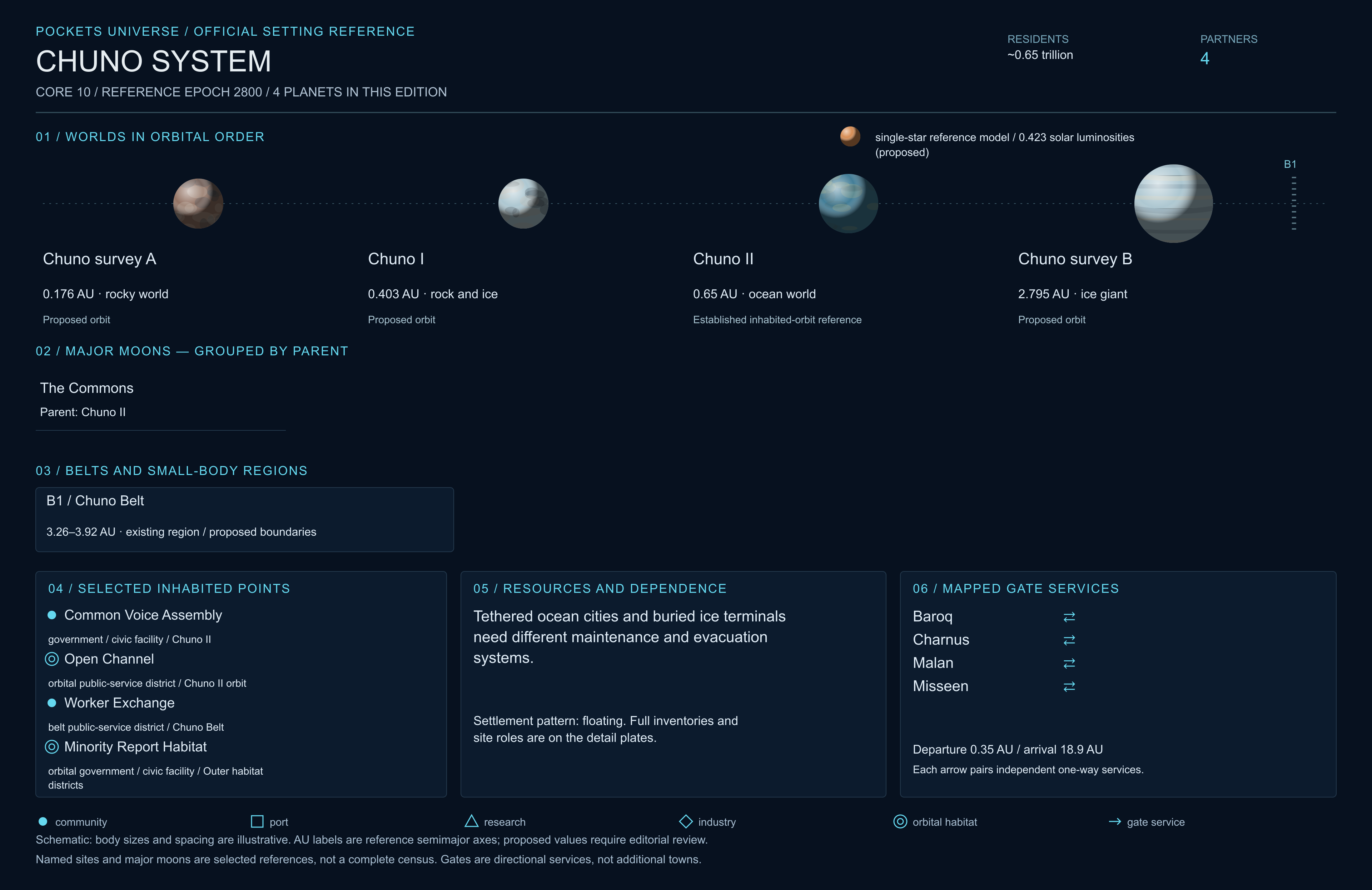
- Chuno II: A turquoise global-ocean capital with almost no natural land. Its 15-billion planetary residents occupy sealed floating and tethered city networks; ocean travel and municipal relocation are central services. The 4-planet reference inventory spans 0.176–2.795 AU.
- Tethered ocean cities and buried ice terminals need different maintenance and evacuation systems.
- 1 individually shown major moon references; Chuno Belt complete the selected small-body picture without implying profitable resources everywhere.
A free-press stronghold built around distrust of concentrated power. It remains deeply committed to federal institutions while insisting that public records and dissent make those institutions legitimate.
Wonders
-
The Ocean Municipalities — Built · Chuno II. Sealed floating and tethered municipalities interrupt an almost landless global ocean. From an enclosed passenger approach, the linked city structures and seemingly unbroken water horizon make one of the Core’s clearest images of an engineered home.
-
Commons Assembly Park — Built · The Commons. Civic parkland and assembly facilities occupy enclosed, atmosphere-managed lunar landscapes. A green public gathering space surrounded by cratered terrain turns ordinary recreation into an extraordinary demonstration of shared environmental maintenance.
-
The Buried Port of Free Port City — Built · Chuno I. Protected passenger terminals lie beneath an ice-covered world. Moving from the bleak exterior approach into busy migrant neighbourhoods makes the contrast between planetary isolation and civic openness an architectural experience.
Government
An elected legislature and accountable rotating executive facilitators manage ordinary policy, with secure referenda for major questions. Judicial rights do not depend on winning a public vote. Referenda supplement representation; their frequency does not eliminate day-to-day administration.
Local Culture
- Neighbors celebrate ballot submission with shared food, but abstainers retain equal access to services.
- Public notices include a short plain-language dissent beside the majority decision.
- Local comedy nights reenact municipal debates; politicians who can laugh at their imitation gain respect.
Worlds And Moons
| Body | Environment and habitation |
|---|---|
| Chuno II | A turquoise global-ocean capital with almost no natural land. Its 15-billion planetary residents occupy sealed floating and tethered city networks; ocean travel and municipal relocation are central services. |
| Chuno I | An ice-covered port world with buried terminals and protected towns. |
| The Commons | A cratered moon of II. Its civic parkland occupies enclosed landscapes with managed air, while assembly grounds and research support are sheltered. |
Civic And Political Traditions
Common Voice Coalition (Broad participation, public services and accessible referendum design.); Practical Assembly Party (Fewer routine plebiscites, stronger transparent administration and clearer responsibility.); Open Record Alliance (Press freedom, source protection and access to procurement records; rejects corporate censorship.)
Economy And Companies
the Free Press Cooperative; Chuno Civic Software; the Commons Exchange (worker-owned).
Gate Connections
Chuno has mapped services to Baroq, Charnus, Malan, Misseen. Generating departure gates and available services are distinct: some crossings require a separate return gate. See Gates and communications.
Reading The Profile
Population figures are approximate. Local cultural descriptions represent traditions and institutions, rather than traits shared by every resident. Navigation distances are authored setting values; they are not measurements of real stars.
Settlements And Landmarks
Named places include planetary communities, orbital habitats, working ports, and research facilities. These are examples within larger settlement networks.
| Body or district | Site | Purpose |
|---|---|---|
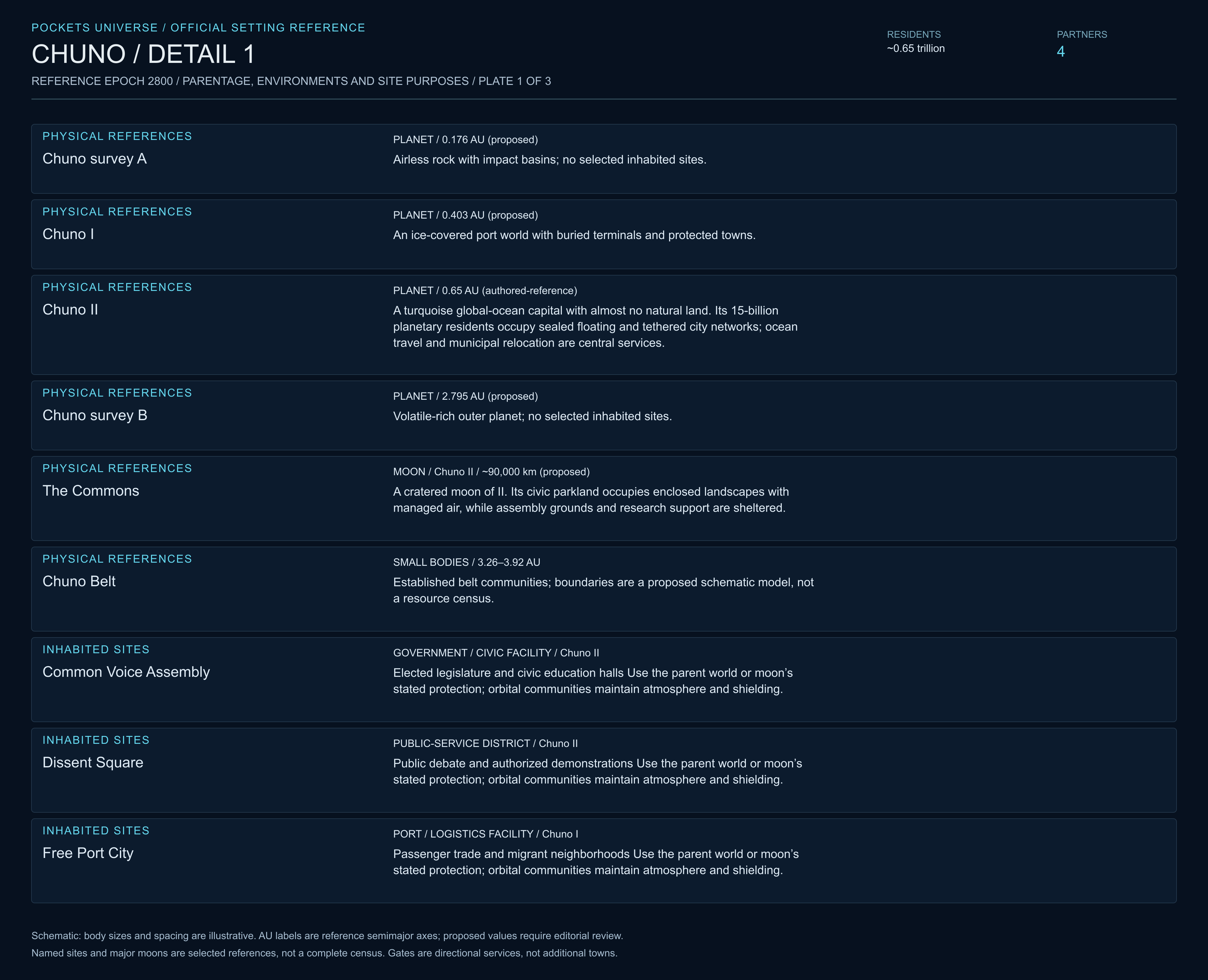
| Chuno II | Common Voice Assembly | Elected legislature and civic education halls |
| Chuno II | Dissent Square | Public debate and authorized demonstrations |
| Chuno I | Free Port City | Passenger trade and migrant neighborhoods |
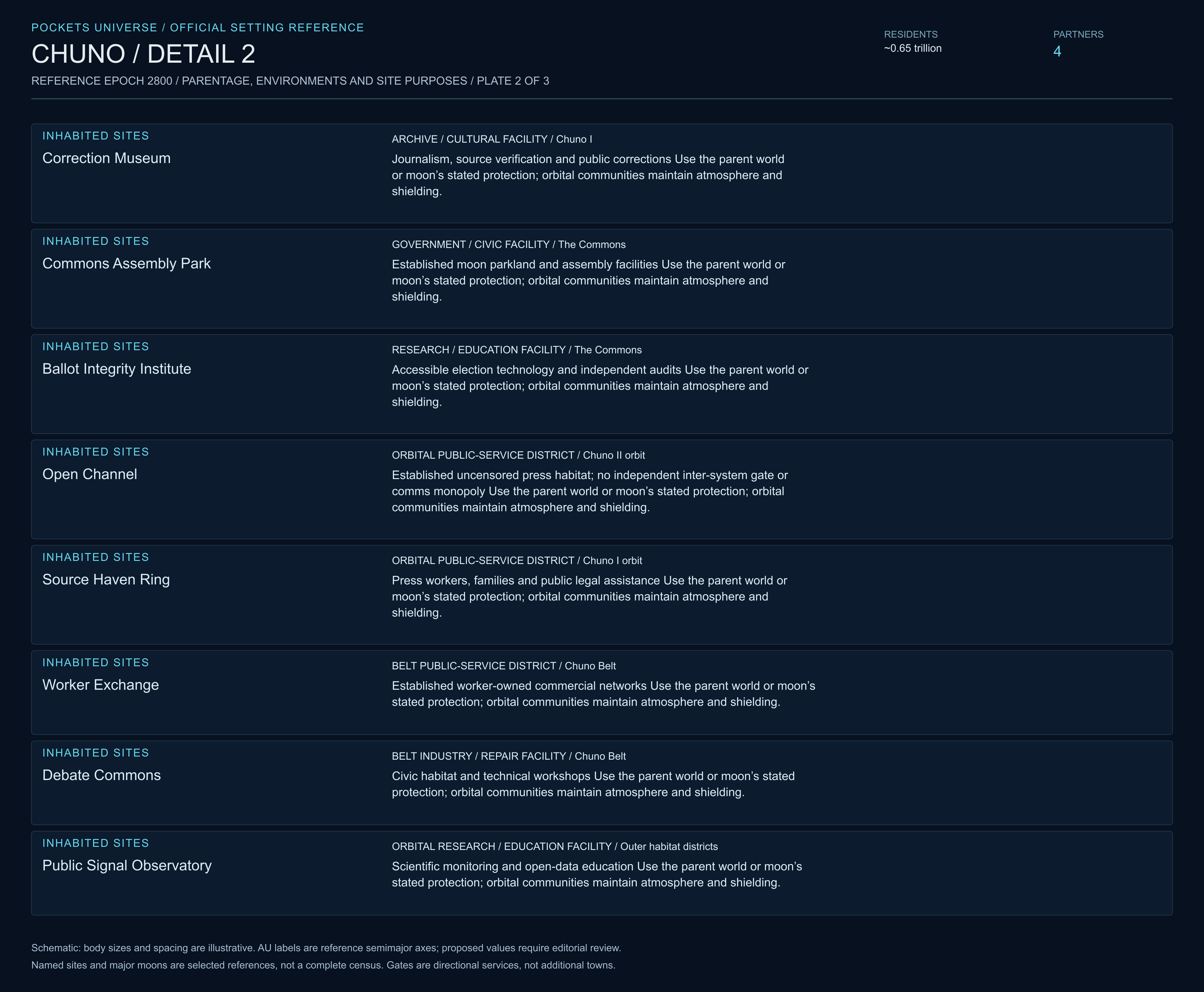
| Chuno I | Correction Museum | Journalism, source verification and public corrections |
| The Commons | Commons Assembly Park | Established moon parkland and assembly facilities |
| The Commons | Ballot Integrity Institute | Accessible election technology and independent audits |
| Chuno II orbit | Open Channel | Established uncensored press habitat; no independent inter-system gate or comms monopoly |
| Chuno I orbit | Source Haven Ring | Press workers, families and public legal assistance |
| Chuno Belt | Worker Exchange | Established worker-owned commercial networks |
| Chuno Belt | Debate Commons | Civic habitat and technical workshops |
| Outer habitat districts | Public Signal Observatory | Scientific monitoring and open-data education |
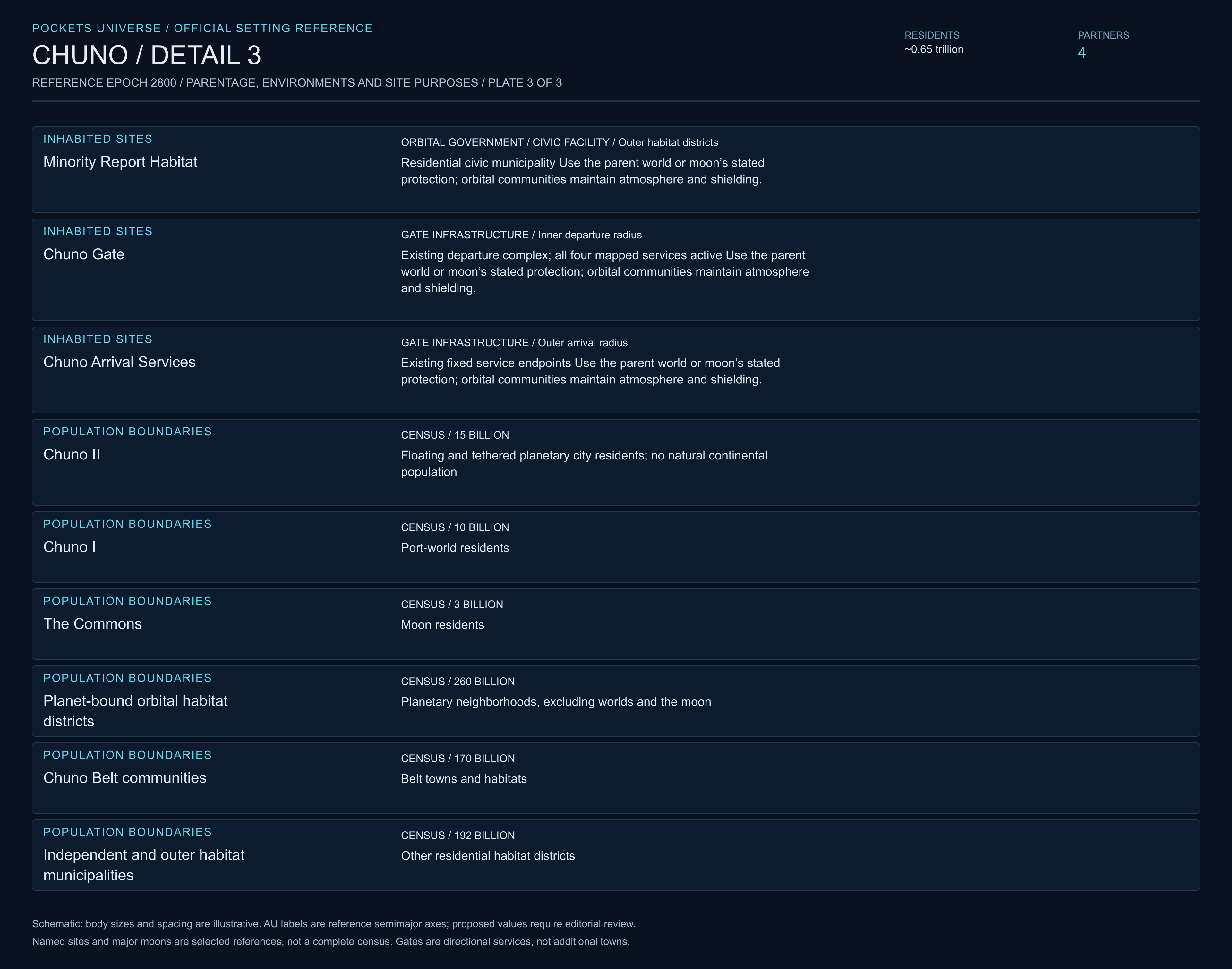
| Outer habitat districts | Minority Report Habitat | Residential civic municipality |
| Inner departure radius | Chuno Gate | Existing departure complex; all four mapped services active |
| Outer arrival radius | Chuno Arrival Services | Existing fixed service endpoints |
Planetary Architecture
single-star reference model. 0.423 solar luminosities and approximately 0.806 solar masses (proposed working model).
| World, in orbital order | Approximate orbit | Composition and conditions |
|---|---|---|
| Chuno survey A | 0.176 AU — proposed | rocky world. Airless rock with impact basins; no selected inhabited sites. |
| Chuno I | 0.403 AU — proposed | rock and ice. An ice-covered port world with buried terminals and protected towns. |
| Chuno II | 0.65 AU — established inhabited-orbit reference | ocean world. A turquoise global-ocean capital with almost no natural land. Its 15-billion planetary residents occupy sealed floating and tethered city networks; ocean travel and municipal relocation are central services. |
| Chuno survey B | 2.795 AU — proposed | ice giant. Volatile-rich outer planet; no selected inhabited sites. |
Major Moons
| Moon / group | Parent | Reference conditions |
|---|---|---|
| The Commons | Chuno II | A cratered moon of II. Its civic parkland occupies enclosed landscapes with managed air, while assembly grounds and research support are sheltered. Approximate orbital semimajor axis 90,000 km (proposed). |
Named major satellites shown; uncatalogued small satellites are not a surveyed census.
Belts And Small Bodies
| Region | Approximate radial reference | Composition / use |
|---|---|---|
| Chuno Belt | 3.26–3.92 AU — proposed region boundaries | Established belt communities; boundaries are a proposed schematic model, not a resource census. |
Settlement Network
Tethered ocean cities and buried ice terminals need different maintenance and evacuation systems.
| Site / district | Location | Type | Purpose |
|---|---|---|---|
| Common Voice Assembly | Chuno II | government / civic facility | Elected legislature and civic education halls |
| Dissent Square | Chuno II | public-service district | Public debate and authorized demonstrations |
| Free Port City | Chuno I | port / logistics facility | Passenger trade and migrant neighborhoods |
| Correction Museum | Chuno I | archive / cultural facility | Journalism, source verification and public corrections |
| Commons Assembly Park | The Commons | government / civic facility | Established moon parkland and assembly facilities |
| Ballot Integrity Institute | The Commons | research / education facility | Accessible election technology and independent audits |
| Open Channel | Chuno II orbit | orbital public-service district | Established uncensored press habitat; no independent inter-system gate or comms monopoly |
| Source Haven Ring | Chuno I orbit | orbital public-service district | Press workers, families and public legal assistance |
| Worker Exchange | Chuno Belt | belt public-service district | Established worker-owned commercial networks |
| Debate Commons | Chuno Belt | belt industry / repair facility | Civic habitat and technical workshops |
| Public Signal Observatory | Outer habitat districts | orbital research / education facility | Scientific monitoring and open-data education |
| Minority Report Habitat | Outer habitat districts | orbital government / civic facility | Residential civic municipality |
| Chuno Gate | Inner departure radius | gate infrastructure | Existing departure complex; all four mapped services active |
| Chuno Arrival Services | Outer arrival radius | gate infrastructure | Existing fixed service endpoints |
Port districts, civic buildings and working networks are not additional cities or independent population categories. Protected living areas, maintained power, atmosphere, thermal control and shielding follow local environmental needs. Regional freight supplies specialized components; self-sufficiency is not assumed.
Population Boundaries
| Exclusive category | Residents, billions | Boundary |
|---|---|---|
| Chuno II | 15 | Floating and tethered planetary city residents; no natural continental population |
| Chuno I | 10 | Port-world residents |
| The Commons | 3 | Moon residents |
| Planet-bound orbital habitat districts | 260 | Planetary neighborhoods, excluding worlds and the moon |
| Chuno Belt communities | 170 | Belt towns and habitats |
| Independent and outer habitat municipalities | 192 | Other residential habitat districts |
These categories total 650 billion residents. Named facilities belong to these categories and are not added again.
System Atlas
Open the overview above for full-resolution zoom and pan. The detail plates below provide the full reference inventory; their topics are listed with each link. The article also presents these facts as readable text. Body sizes and diagram spacing are illustrative; orbital labels distinguish established references from proposed design values.
Atlas Detail Plates
- Chuno detail plate 1: worlds and physical features, settlements and facilities
- Chuno detail plate 2: settlements and facilities
- Chuno detail plate 3: settlements and facilities, population categories
Reference Model And Limits
This edition combines established setting facts with explicitly proposed astronomy and revised recent worldbuilding. New survey identifiers are provisional labels, not new historical discoveries. A temperate orbit does not establish breathable air, safe weather or native life. New bodies and debris do not establish profitable resources.
- Stellar luminosity, unmeasured orbital values, belt boundaries and new physical models are proposed design values requiring editorial approval; they do not certify habitability.
- Existing navigation width describes the transit model, not a hard astronomical edge.
City And Station Profiles
- Free Port City — Passenger trade and migrant neighborhoods.