Systems
Corvus
Chemical rainfall confines the capital to protected cities; ocean ports use artificial islands.
Article contents
At A Glance
- Region
- Core 10
- Population
- ~0.95 trillion
- Government
- Parliamentary democratic republic with a civic religious tradition
- Distance from Sol
- 11.63 light-years
- Operational width
- 52 AU
- Gate services
- 5
What Makes This System Distinctive
- Corvus II: An amber-clouded rocky capital with copper land and dark mineral seas. Ordinary residential cities are enclosed; unfiltered air and rainfall are unsafe. The 6-planet reference inventory spans 0.207–12.6 AU.
- Chemical rainfall confines the capital to protected cities; ocean ports use artificial islands.
- 2 individually shown major moon references; Corvus Belt and Corvus outer debris population complete the selected small-body picture without implying profitable resources everywhere.
A devout founding tradition lives alongside cosmopolitan ports and scientific communities. Religious organizations may persuade voters and run charities, while government legitimacy comes from elections rather than clerical sanction.
Wonders
-
The Amber Mineral Coast — Natural · Corvus II. Amber clouds hang over copper land and dark mineral seas. The layered colours are best seen through the protected city boundary, where unsafe air and seasonal rainfall turn the view into a reminder of the world’s deceptive first promise.
-
Open Port’s Artificial Archipelagos — Built · Corvus I. Protected islands and offshore structures carry a city across an ocean-dominated world. An enclosed passenger approach reveals how narrow the line between inhabited space and open water can be, without a continental mainland behind it.
-
First Lamp Observatory — Built · Twin Lamps. The protected lunar observatory offers a destination tied to the two moons whose cycles shape the traditional calendar. Crater landscapes, the other Lamp’s changing position and the clouded capital world connect astronomical observation with everyday civic time.
Government
A premier is accountable to an elected assembly and independent courts. The synod is influential in ceremony, charity and ethics but has no legal veto over election winners. Equal citizenship includes secular and minority-faith residents.
Local Culture
- The ritual calendar still sets popular holidays, but public service rosters preserve minority observances and secular leave.
- Neighbors host open-table meals on Lamp evenings; accepting food never requires professing a faith.
- Charity accounts are publicly celebrated, while activists insist that poverty relief be a right rather than a test of moral worth.
Worlds And Moons
| Body | Environment and habitation |
|---|---|
| Corvus II | An amber-clouded rocky capital with copper land and dark mineral seas. Ordinary residential cities are enclosed; unfiltered air and rainfall are unsafe. |
| Corvus I | A blue-grey ocean-dominated port world with sparse rocky islands. Cities occupy protected artificial archipelagos and offshore structures; no vast Earthlike continents. |
| Corvus IV | A cold pale-ochre steppe world with large ice caps. Agriculture concentrates in enclosed growing districts and managed sheltered valleys. |
| Twin Lamps | Two cratered moons of Corvus II whose observed cycles anchor the traditional calendar; observatories and civic towns remain protected. |
Civic And Political Traditions
Civic Covenant (Faith-informed welfare, family services and stable federal membership; accepts secular courts and electoral loss.); Open Port Alliance (Religious neutrality in hiring, port investment and research freedom; strong in Corvus I and orbital cities.); Common Table Movement (Transparent charity procurement, housing and universal civic services; bridges heartland and port voters.)
Economy And Companies
the Synodic Trust (faith-aligned finance and charity); Lampbearer Shipping; Corvus Biologics.
Gate Connections
Corvus has mapped services to Barstead, Ch’ul, Malan, Sol, Xiu. Generating departure gates and available services are distinct: some crossings require a separate return gate. See Gates and communications.
Reading The Profile
Population figures are approximate. Local cultural descriptions represent traditions and institutions, rather than traits shared by every resident. Navigation distances are authored setting values; they are not measurements of real stars.
Settlements And Landmarks
Named places include planetary communities, orbital habitats, working ports, and research facilities. These are examples within larger settlement networks.
| Body or district | Site | Purpose |
|---|---|---|
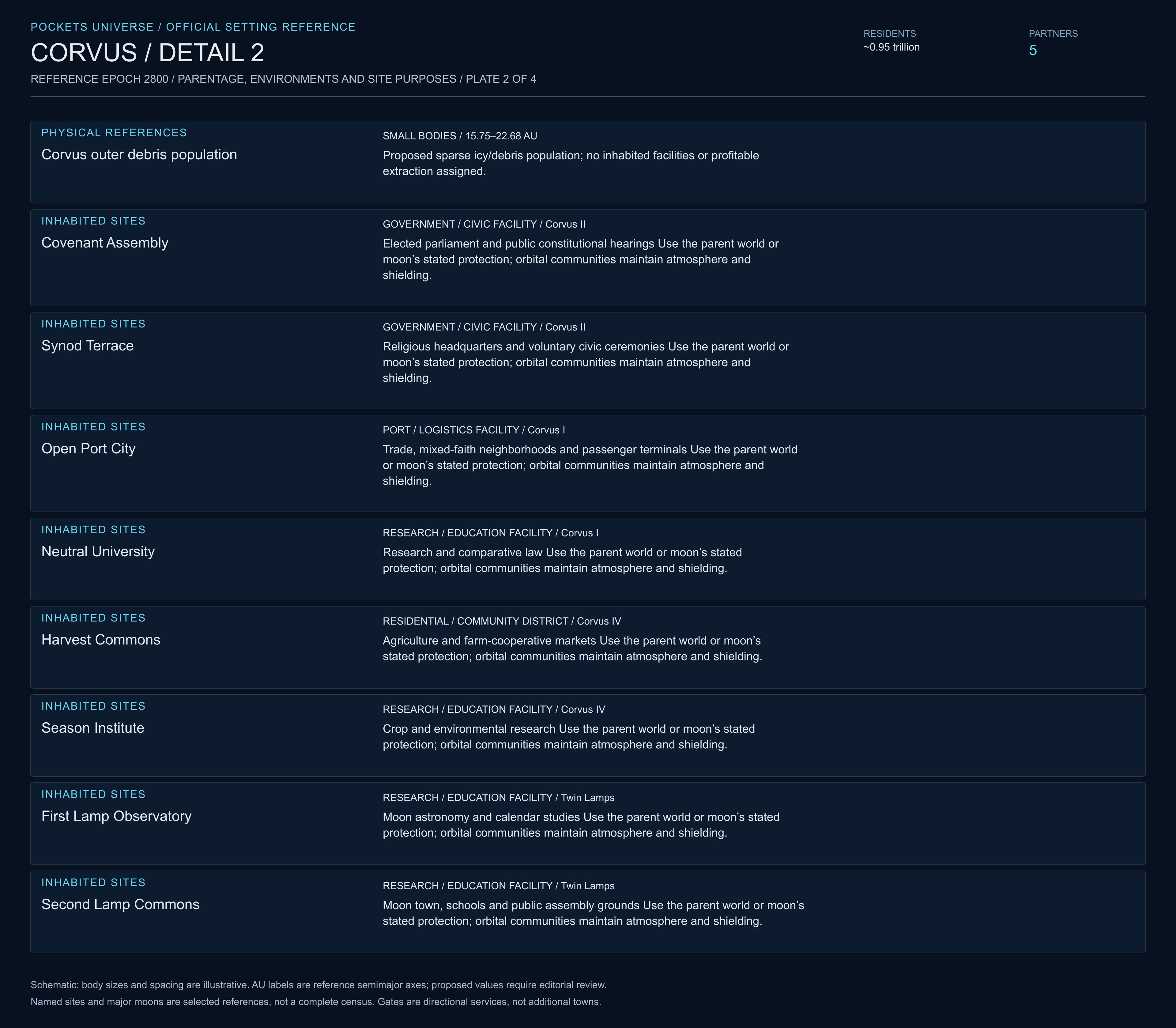
| Corvus II | Covenant Assembly | Elected parliament and public constitutional hearings |
| Corvus II | Synod Terrace | Religious headquarters and voluntary civic ceremonies |
| Corvus I | Open Port City | Trade, mixed-faith neighborhoods and passenger terminals |
| Corvus I | Neutral University | Research and comparative law |
| Corvus IV | Harvest Commons | Agriculture and farm-cooperative markets |
| Corvus IV | Season Institute | Crop and environmental research |
| Twin Lamps | First Lamp Observatory | Moon astronomy and calendar studies |
| Twin Lamps | Second Lamp Commons | Moon town, schools and public assembly grounds |
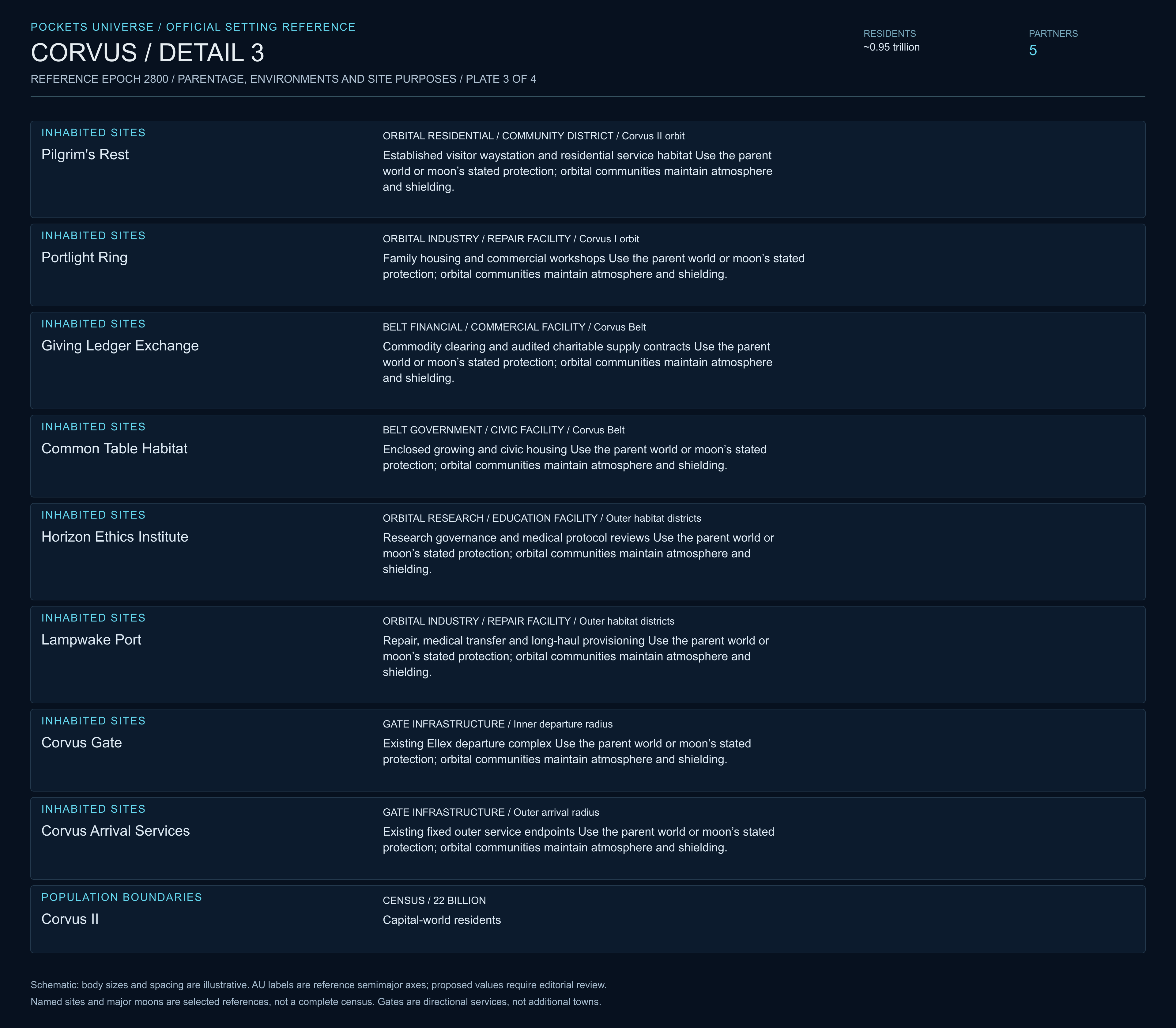
| Corvus II orbit | Pilgrim’s Rest | Established visitor waystation and residential service habitat |
| Corvus I orbit | Portlight Ring | Family housing and commercial workshops |
| Corvus Belt | Giving Ledger Exchange | Commodity clearing and audited charitable supply contracts |
| Corvus Belt | Common Table Habitat | Enclosed growing and civic housing |
| Outer habitat districts | Horizon Ethics Institute | Research governance and medical protocol reviews |
| Outer habitat districts | Lampwake Port | Repair, medical transfer and long-haul provisioning |
| Inner departure radius | Corvus Gate | Existing Ellex departure complex |
| Outer arrival radius | Corvus Arrival Services | Existing fixed outer service endpoints |
Planetary Architecture
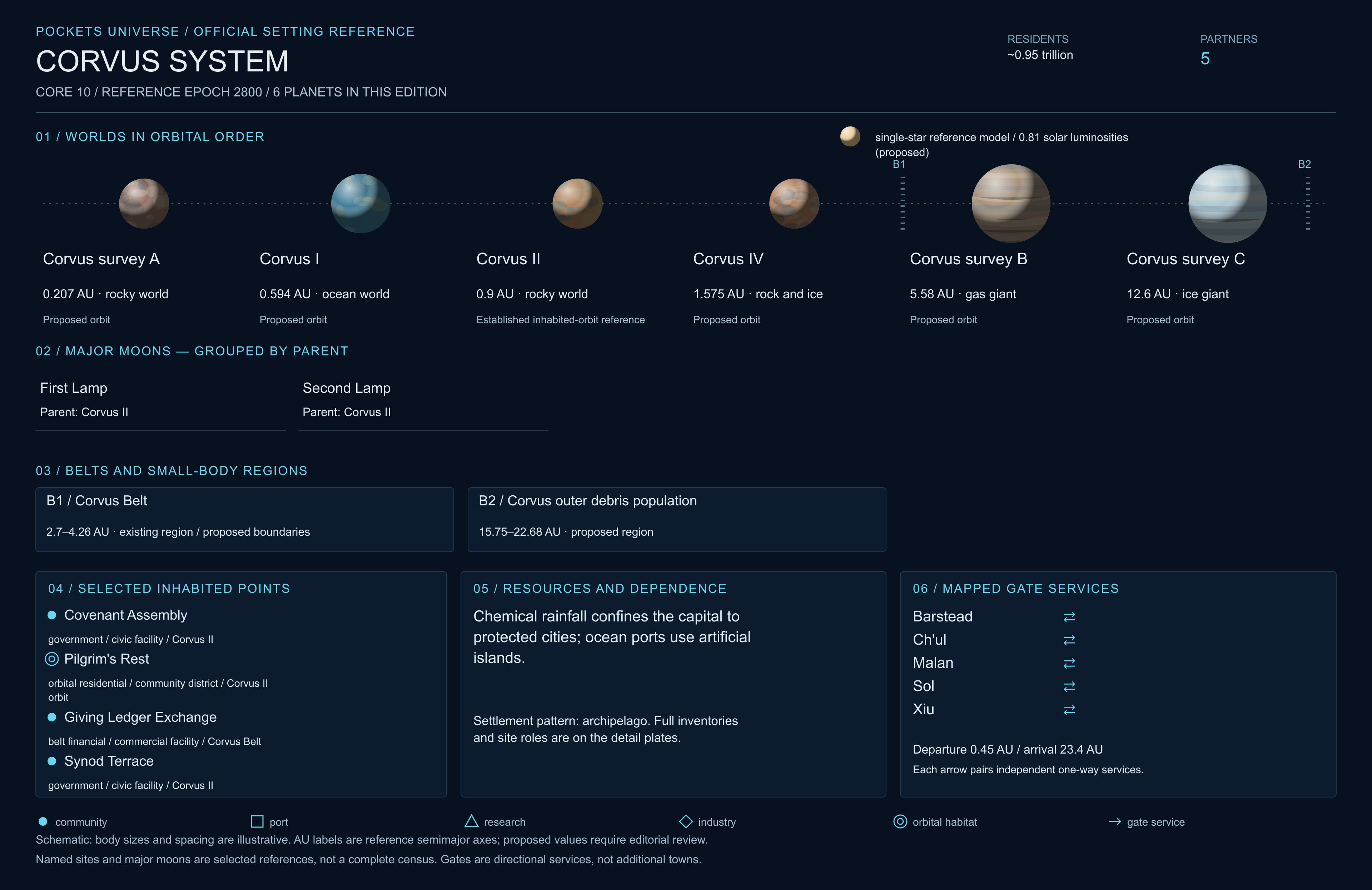
single-star reference model. 0.81 solar luminosities and approximately 0.949 solar masses (proposed working model).
| World, in orbital order | Approximate orbit | Composition and conditions |
|---|---|---|
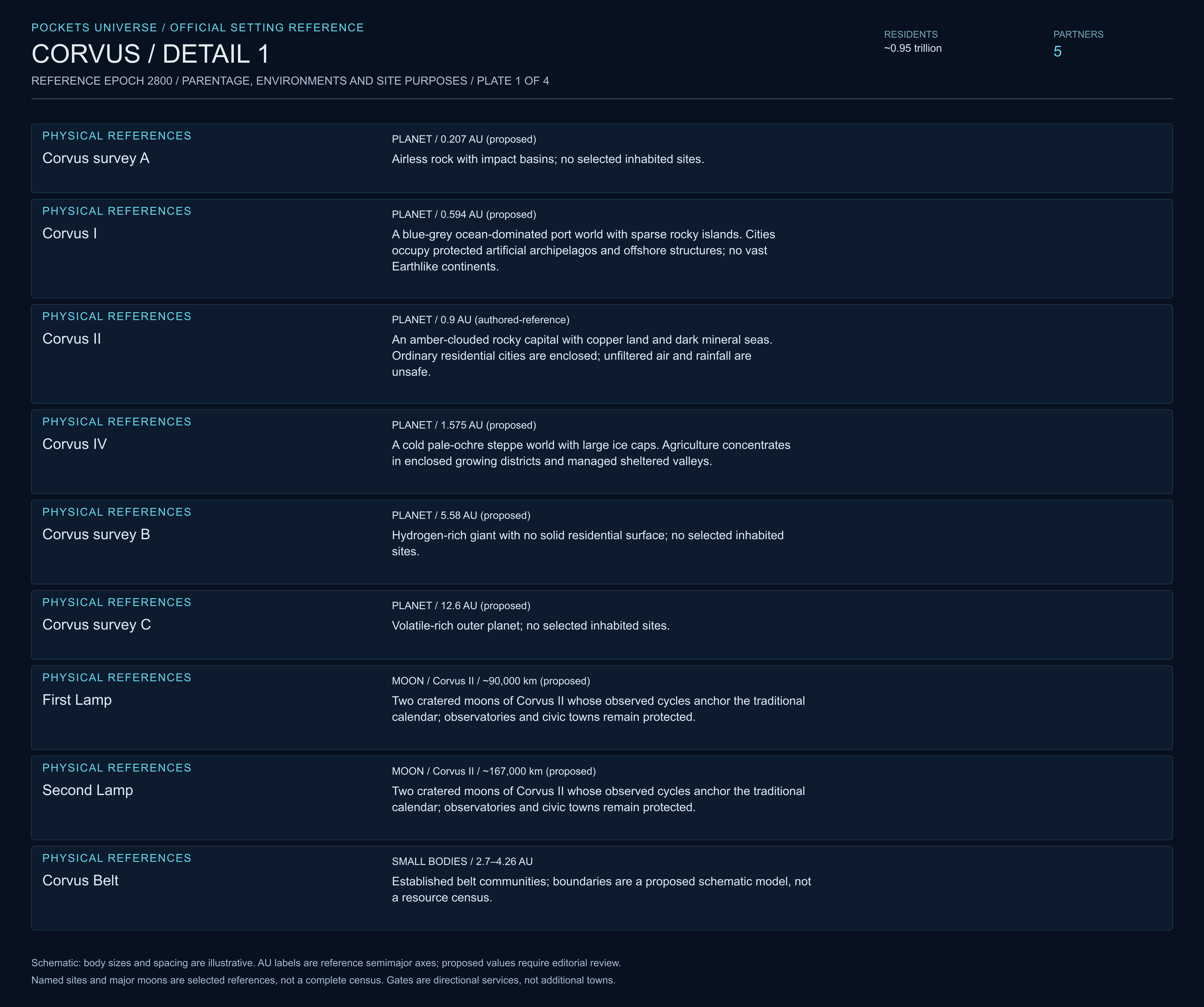
| Corvus survey A | 0.207 AU — proposed | rocky world. Airless rock with impact basins; no selected inhabited sites. |
| Corvus I | 0.594 AU — proposed | ocean world. A blue-grey ocean-dominated port world with sparse rocky islands. Cities occupy protected artificial archipelagos and offshore structures; no vast Earthlike continents. |
| Corvus II | 0.9 AU — established inhabited-orbit reference | rocky world. An amber-clouded rocky capital with copper land and dark mineral seas. Ordinary residential cities are enclosed; unfiltered air and rainfall are unsafe. |
| Corvus IV | 1.575 AU — proposed | rock and ice. A cold pale-ochre steppe world with large ice caps. Agriculture concentrates in enclosed growing districts and managed sheltered valleys. |
| Corvus survey B | 5.58 AU — proposed | gas giant. Hydrogen-rich giant with no solid residential surface; no selected inhabited sites. |
| Corvus survey C | 12.6 AU — proposed | ice giant. Volatile-rich outer planet; no selected inhabited sites. |
Major Moons
| Moon / group | Parent | Reference conditions |
|---|---|---|
| First Lamp | Corvus II | Two cratered moons of Corvus II whose observed cycles anchor the traditional calendar; observatories and civic towns remain protected. Approximate orbital semimajor axis 90,000 km (proposed). |
| Second Lamp | Corvus II | Two cratered moons of Corvus II whose observed cycles anchor the traditional calendar; observatories and civic towns remain protected. Approximate orbital semimajor axis 167,000 km (proposed). |
Named major satellites shown; uncatalogued small satellites are not a surveyed census.
Belts And Small Bodies
| Region | Approximate radial reference | Composition / use |
|---|---|---|
| Corvus Belt | 2.7–4.26 AU — proposed region boundaries | Established belt communities; boundaries are a proposed schematic model, not a resource census. |
| Corvus outer debris population | 15.75–22.68 AU — proposed | Proposed sparse icy/debris population; no inhabited facilities or profitable extraction assigned. |
Settlement Network
Chemical rainfall confines the capital to protected cities; ocean ports use artificial islands.
| Site / district | Location | Type | Purpose |
|---|---|---|---|
| Covenant Assembly | Corvus II | government / civic facility | Elected parliament and public constitutional hearings |
| Synod Terrace | Corvus II | government / civic facility | Religious headquarters and voluntary civic ceremonies |
| Open Port City | Corvus I | port / logistics facility | Trade, mixed-faith neighborhoods and passenger terminals |
| Neutral University | Corvus I | research / education facility | Research and comparative law |
| Harvest Commons | Corvus IV | residential / community district | Agriculture and farm-cooperative markets |
| Season Institute | Corvus IV | research / education facility | Crop and environmental research |
| First Lamp Observatory | Twin Lamps | research / education facility | Moon astronomy and calendar studies |
| Second Lamp Commons | Twin Lamps | research / education facility | Moon town, schools and public assembly grounds |
| Pilgrim’s Rest | Corvus II orbit | orbital residential / community district | Established visitor waystation and residential service habitat |
| Portlight Ring | Corvus I orbit | orbital industry / repair facility | Family housing and commercial workshops |
| Giving Ledger Exchange | Corvus Belt | belt financial / commercial facility | Commodity clearing and audited charitable supply contracts |
| Common Table Habitat | Corvus Belt | belt government / civic facility | Enclosed growing and civic housing |
| Horizon Ethics Institute | Outer habitat districts | orbital research / education facility | Research governance and medical protocol reviews |
| Lampwake Port | Outer habitat districts | orbital industry / repair facility | Repair, medical transfer and long-haul provisioning |
| Corvus Gate | Inner departure radius | gate infrastructure | Existing Ellex departure complex |
| Corvus Arrival Services | Outer arrival radius | gate infrastructure | Existing fixed outer service endpoints |
Port districts, civic buildings and working networks are not additional cities or independent population categories. Protected living areas, maintained power, atmosphere, thermal control and shielding follow local environmental needs. Regional freight supplies specialized components; self-sufficiency is not assumed.
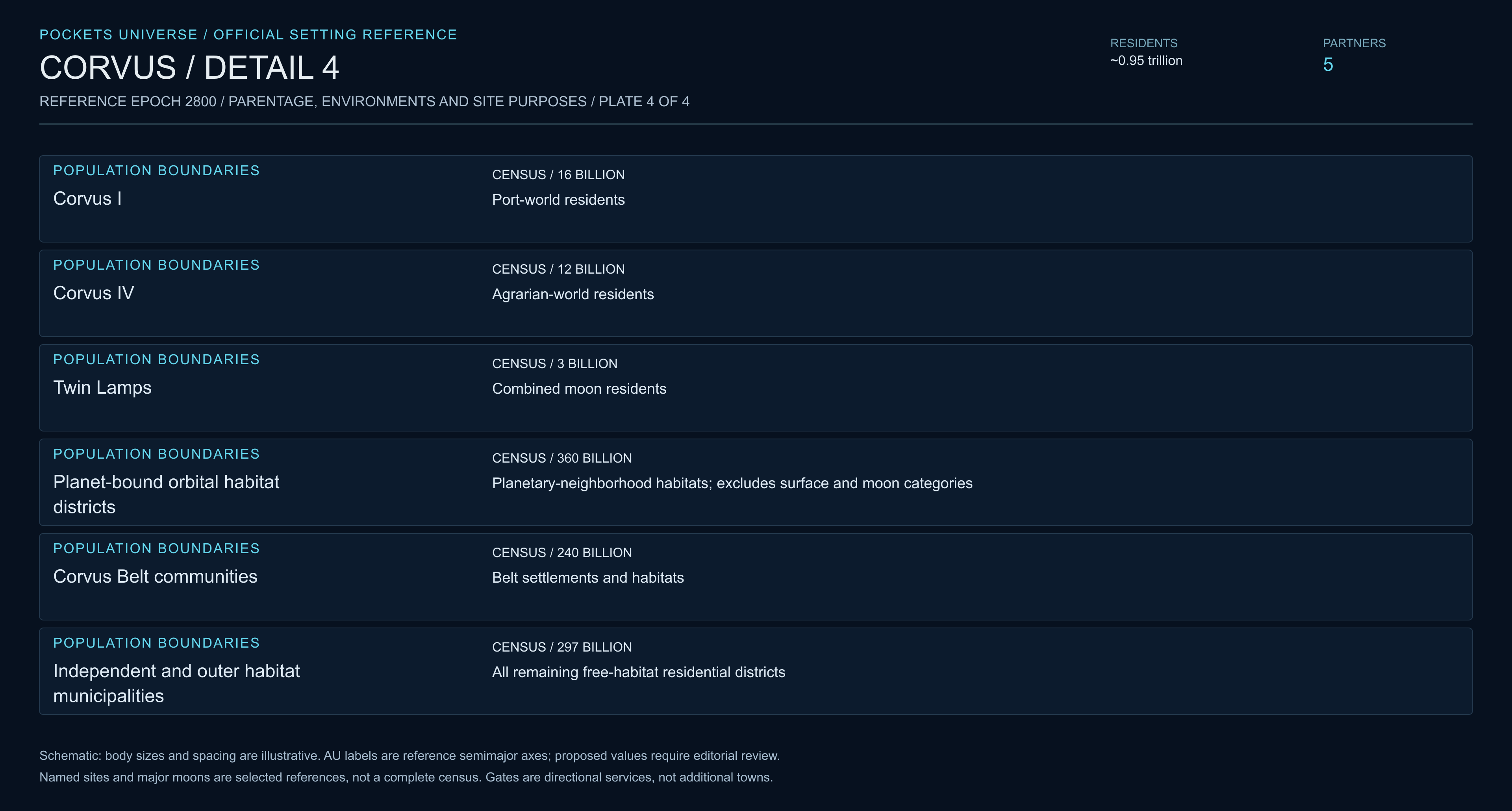
Population Boundaries
| Exclusive category | Residents, billions | Boundary |
|---|---|---|
| Corvus II | 22 | Capital-world residents |
| Corvus I | 16 | Port-world residents |
| Corvus IV | 12 | Agrarian-world residents |
| Twin Lamps | 3 | Combined moon residents |
| Planet-bound orbital habitat districts | 360 | Planetary-neighborhood habitats; excludes surface and moon categories |
| Corvus Belt communities | 240 | Belt settlements and habitats |
| Independent and outer habitat municipalities | 297 | All remaining free-habitat residential districts |
These categories total 950 billion residents. Named facilities belong to these categories and are not added again.
System Atlas
Open the overview above for full-resolution zoom and pan. The detail plates below provide the full reference inventory; their topics are listed with each link. The article also presents these facts as readable text. Body sizes and diagram spacing are illustrative; orbital labels distinguish established references from proposed design values.
Atlas Detail Plates
- Corvus detail plate 1: worlds and physical features
- Corvus detail plate 2: worlds and physical features, settlements and facilities
- Corvus detail plate 3: settlements and facilities, population categories
- Corvus detail plate 4: population categories
Reference Model And Limits
This edition combines established setting facts with explicitly proposed astronomy and revised recent worldbuilding. New survey identifiers are provisional labels, not new historical discoveries. A temperate orbit does not establish breathable air, safe weather or native life. New bodies and debris do not establish profitable resources.
- Stellar luminosity, unmeasured orbital values, belt boundaries and new physical models are proposed design values requiring editorial approval; they do not certify habitability.
- Existing navigation width describes the transit model, not a hard astronomical edge.
City And Station Profiles
- Open Port City — Trade, mixed-faith neighborhoods and passenger terminals.