Systems
Ino
Radiation advisories constrain surface work; sheltered fabrication and university moons support industry.
Article contents
At A Glance
- Region
- Core 10
- Population
- ~0.9 trillion
- Government
- Parliamentary democratic republic with an expert civil service
- Distance from Sol
- 15.38 light-years
- Operational width
- 58 AU
- Gate services
- 4
What Makes This System Distinctive
- Ino Prime: A pale-violet, dry highland world with limited dark lakes, thin shielding atmosphere and protected cities. Storm advisories determine when crews can safely work outside. The 5-planet reference inventory spans 0.399–13.02 AU.
- Radiation advisories constrain surface work; sheltered fabrication and university moons support industry.
- 2 individually shown major moon references; Ino Belt complete the selected small-body picture without implying profitable resources everywhere.
A founding research-and-engineering center that values demonstrable competence. Its democratic tension is how to respect expertise without confusing technical credentials with the right to govern.
Wonders
-
The Highland Dark Lakes — Natural · Ino Prime. Limited dark lakes interrupt a dry highland landscape under a thin shielding atmosphere. Viewed from protected transport, their abrupt contrast with the surrounding ground is striking; exposed visits remain governed by the world’s storm advisories.
-
Foundry Ring — Built · Ino II orbit. Heavy fabrication infrastructure frames an iron-grey world. A permitted visitor approach shows enormous engineered components beside the smaller craft and service structures that handle them, making the ring a destination for the scale of inhabited megastructure work.
-
Adel Research Gardens — Built · Adel. Managed enclosure ecosystems bring gardens to an ice-rich university moon. The contrast between cultivated interior complexity and the exterior landscape makes the habitat-ecology laboratories as visually compelling as they are useful.
Government
Universal adult suffrage elects the assembly; competitive examinations recruit professional civil servants rather than filter voters or candidates. Universities advise ministers without assigning them office. Independent review can challenge a metric or certification decision.
Local Culture
- Schoolchildren hold yearly failed-experiment fairs where a clear explanation wins more praise than a flashy result.
- A formal introduction often includes a project rather than a family name; hosts politely ask what went wrong.
- Public dashboards have a comment space for what the metric missed, an institution born from an embarrassing municipal failure.
Worlds And Moons
| Body | Environment and habitation |
|---|---|
| Ino Prime | A pale-violet, dry highland world with limited dark lakes, thin shielding atmosphere and protected cities. Storm advisories determine when crews can safely work outside. |
| Ino II | A cold iron-grey engineering world, mostly settled through sheltered fabrication districts and orbit. |
| Cit and Adel | Two protected university moons of Prime, one rocky and one ice-rich. Their gardens are enclosure ecology, not native green lunar surfaces. |
Civic And Political Traditions
Evidence Coalition (Public research, infrastructure standards and rigorous civil-service recruitment.); Human Measure Party (Public accountability for automated decisions and attention to unmeasured social needs.); Open Workshop Alliance (Independent inventors, accessible education and opposition to credential monopolies.)
Economy And Companies
Ino Works (megastructure engineering); Cite Laboratories; the Examiners’ Guild (the quasi-corporate body that credentials everyone).
Gate Connections
Ino has mapped services to Bharani, Kairn, Mast, Sol. Generating departure gates and available services are distinct: some crossings require a separate return gate. See Gates and communications.
Reading The Profile
Population figures are approximate. Local cultural descriptions represent traditions and institutions, rather than traits shared by every resident. Navigation distances are authored setting values; they are not measurements of real stars.
Settlements And Landmarks
Named places include planetary communities, orbital habitats, working ports, and research facilities. These are examples within larger settlement networks.
| Body or district | Site | Purpose |
|---|---|---|
| Ino Prime | Measured Assembly | Elected parliament and open technical hearings |
| Ino Prime | Failure Museum | Public history of mistakes and the safeguards they produced |
| Ino II | Ino Works District | Established megastructure engineering and residential yards |
| Ino II | Open Workshop City | Independent manufacturers and technical schools |
| Cit | Cit University Commons | University town and student housing |
| Adel | Adel Research Gardens | University town with habitat-ecology laboratories |
| Ino II orbit | Foundry Ring | Established heavy fabrication infrastructure |
| Ino Prime orbit | Peer Review Habitat | Residential research community |
| Ino Belt | Cite Test Range | Materials trials with controlled crew access |
| Ino Belt | Calibration Exchange | Certified components and independent audit services |
| Outer habitat districts | Null Result Observatory | Long-duration observations and instrument research |
| Outer habitat districts | Human Measure Commons | Family habitat with accessible public services |
| Inner departure radius | Ino Gate | Existing Ellex departure complex |
| Outer arrival radius | Ino Arrival Services | Existing outer arrival-mouth infrastructure |
Planetary Architecture
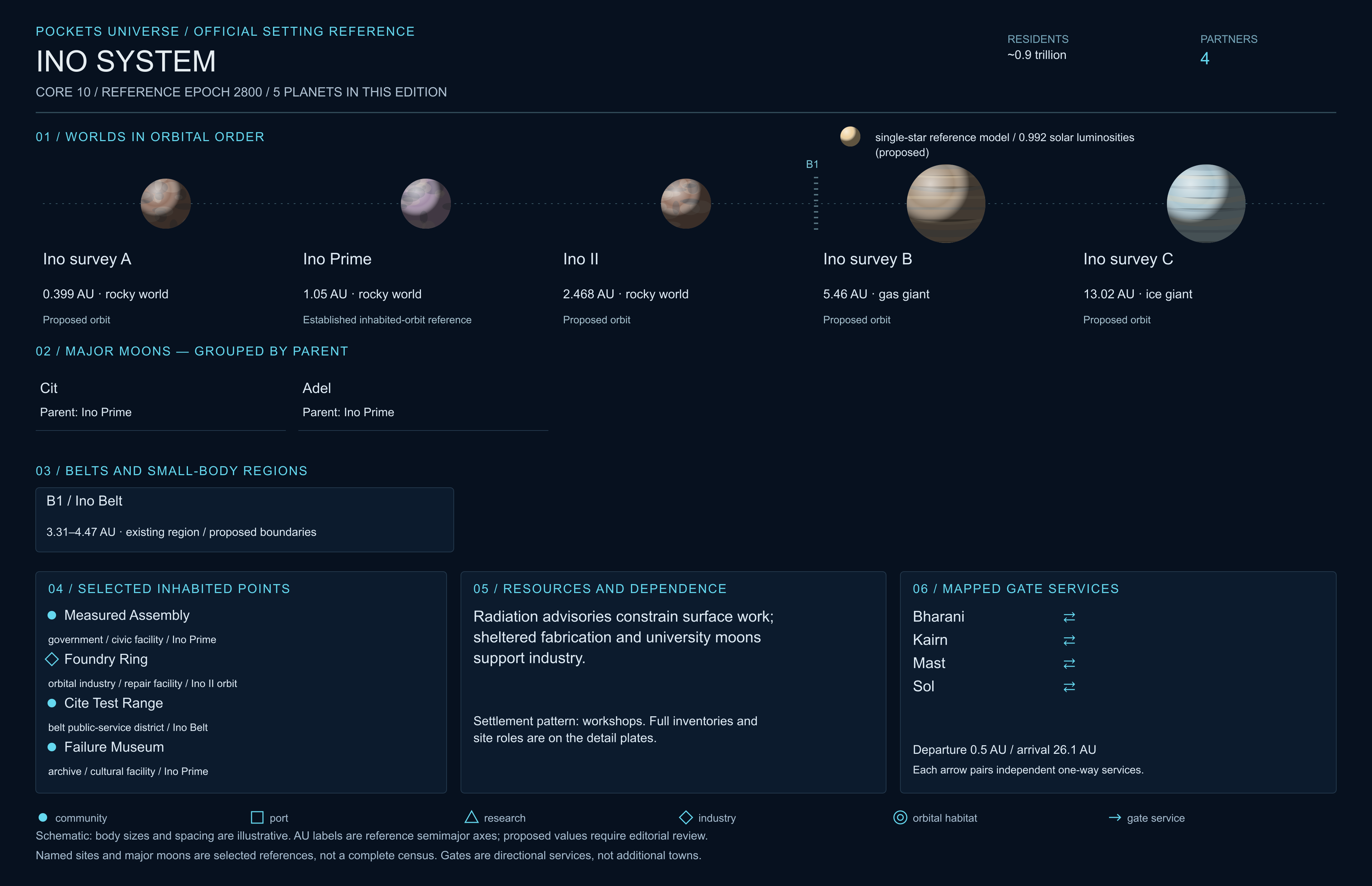
single-star reference model. 0.992 solar luminosities and approximately 0.998 solar masses (proposed working model).
| World, in orbital order | Approximate orbit | Composition and conditions |
|---|---|---|
| Ino survey A | 0.399 AU — proposed | rocky world. Airless rock with impact basins; no selected inhabited sites. |
| Ino Prime | 1.05 AU — established inhabited-orbit reference | rocky world. A pale-violet, dry highland world with limited dark lakes, thin shielding atmosphere and protected cities. Storm advisories determine when crews can safely work outside. |
| Ino II | 2.468 AU — proposed | rocky world. A cold iron-grey engineering world, mostly settled through sheltered fabrication districts and orbit. |
| Ino survey B | 5.46 AU — proposed | gas giant. Hydrogen-rich giant with no solid residential surface; no selected inhabited sites. |
| Ino survey C | 13.02 AU — proposed | ice giant. Volatile-rich outer planet; no selected inhabited sites. |
Major Moons
| Moon / group | Parent | Reference conditions |
|---|---|---|
| Cit | Ino Prime | Two protected university moons of Prime, one rocky and one ice-rich. Their gardens are enclosure ecology, not native green lunar surfaces. Approximate orbital semimajor axis 90,000 km (proposed). |
| Adel | Ino Prime | Two protected university moons of Prime, one rocky and one ice-rich. Their gardens are enclosure ecology, not native green lunar surfaces. Approximate orbital semimajor axis 167,000 km (proposed). |
Named major satellites shown; uncatalogued small satellites are not a surveyed census.
Belts And Small Bodies
| Region | Approximate radial reference | Composition / use |
|---|---|---|
| Ino Belt | 3.31–4.47 AU — proposed region boundaries | Established belt communities; boundaries are a proposed schematic model, not a resource census. |
Settlement Network
Radiation advisories constrain surface work; sheltered fabrication and university moons support industry.
| Site / district | Location | Type | Purpose |
|---|---|---|---|
| Measured Assembly | Ino Prime | government / civic facility | Elected parliament and open technical hearings |
| Failure Museum | Ino Prime | archive / cultural facility | Public history of mistakes and the safeguards they produced |
| Ino Works District | Ino II | residential / community district | Established megastructure engineering and residential yards |
| Open Workshop City | Ino II | research / education facility | Independent manufacturers and technical schools |
| Cit University Commons | Cit | research / education facility | University town and student housing |
| Adel Research Gardens | Adel | research / education facility | University town with habitat-ecology laboratories |
| Foundry Ring | Ino II orbit | orbital industry / repair facility | Established heavy fabrication infrastructure |
| Peer Review Habitat | Ino Prime orbit | orbital research / education facility | Residential research community |
| Cite Test Range | Ino Belt | belt public-service district | Materials trials with controlled crew access |
| Calibration Exchange | Ino Belt | belt public-service district | Certified components and independent audit services |
| Null Result Observatory | Outer habitat districts | orbital research / education facility | Long-duration observations and instrument research |
| Human Measure Commons | Outer habitat districts | orbital residential / community district | Family habitat with accessible public services |
| Ino Gate | Inner departure radius | gate infrastructure | Existing Ellex departure complex |
| Ino Arrival Services | Outer arrival radius | gate infrastructure | Existing outer arrival-mouth infrastructure |
Port districts, civic buildings and working networks are not additional cities or independent population categories. Protected living areas, maintained power, atmosphere, thermal control and shielding follow local environmental needs. Regional freight supplies specialized components; self-sufficiency is not assumed.
Population Boundaries
| Exclusive category | Residents, billions | Boundary |
|---|---|---|
| Ino Prime | 18 | Capital-world residents |
| Ino II | 16 | Engineering-world residents |
| Cit and Adel | 6 | Combined university-moon residents |
| Planet-bound orbital habitat districts | 370 | Planetary neighborhoods, excluding surface and moons |
| Ino Belt communities | 230 | Belt manufacturing and habitat districts |
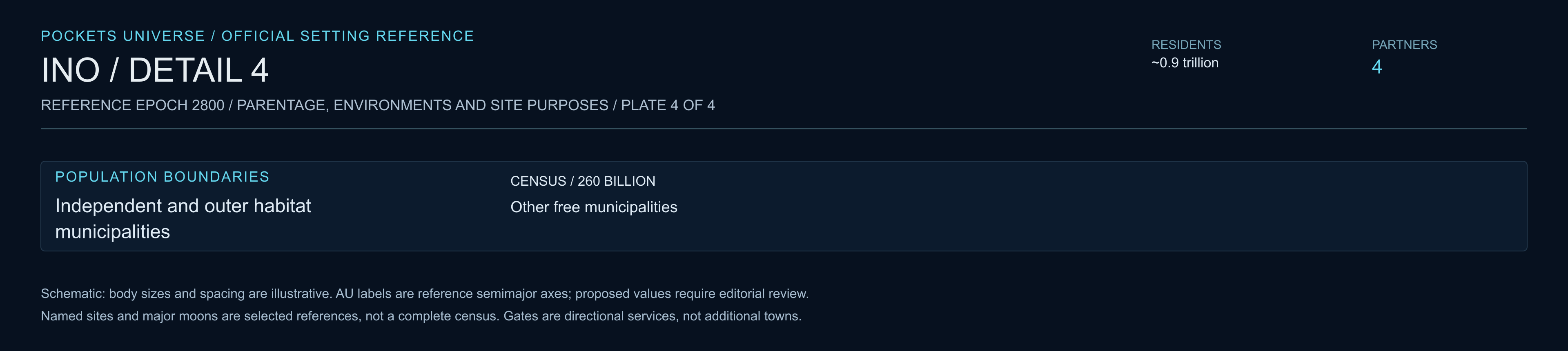
| Independent and outer habitat municipalities | 260 | Other free municipalities |
These categories total 900 billion residents. Named facilities belong to these categories and are not added again.
System Atlas
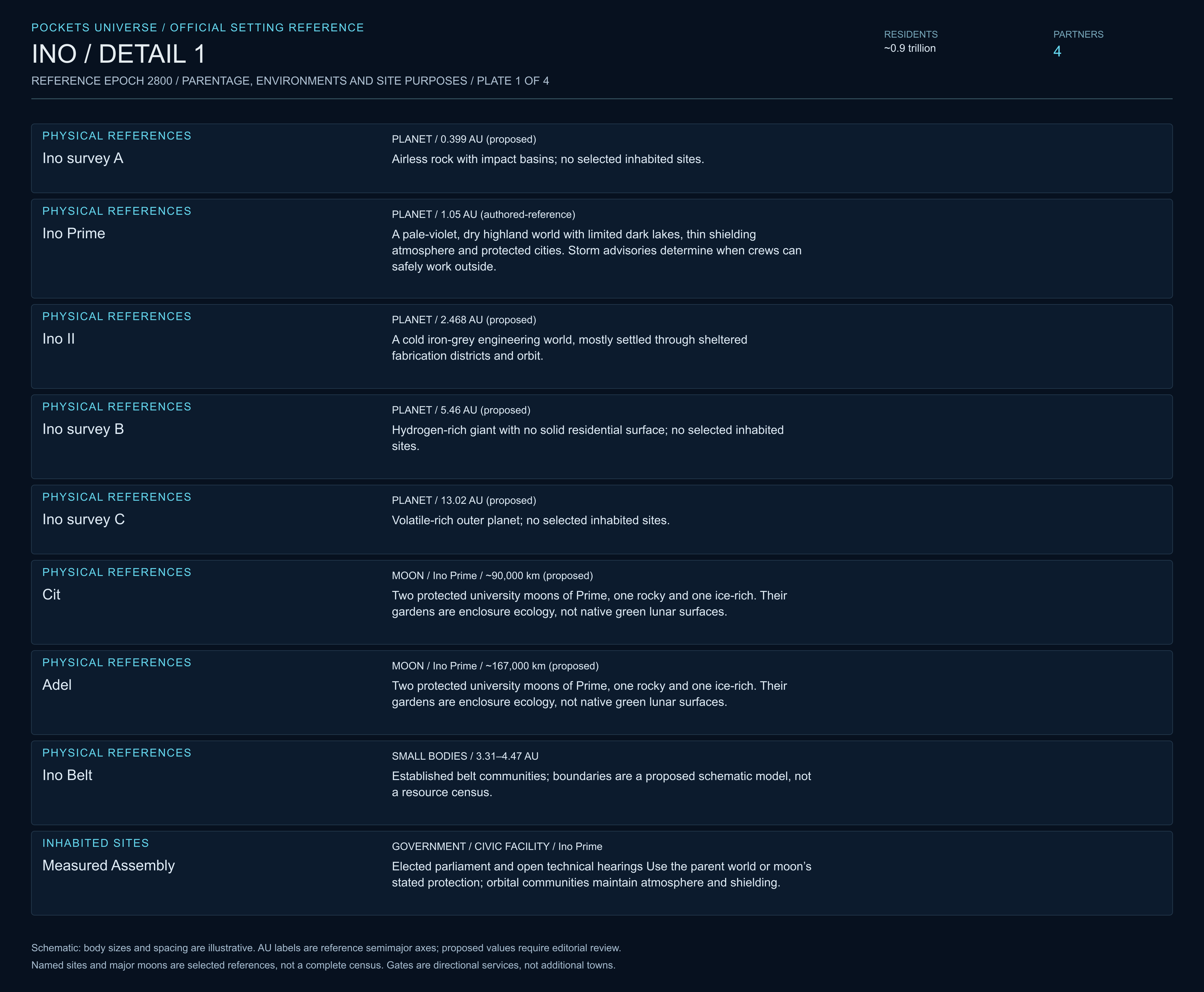
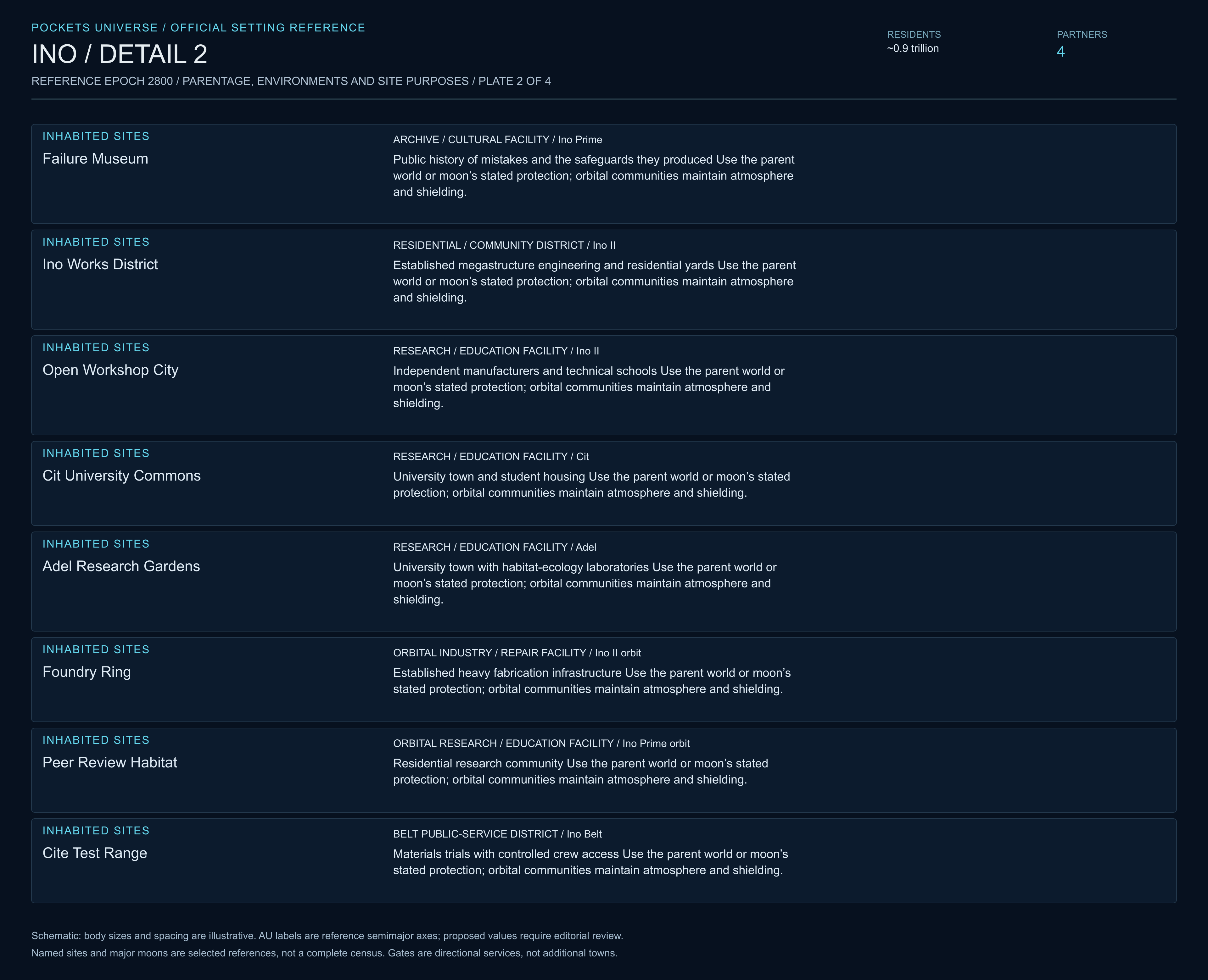
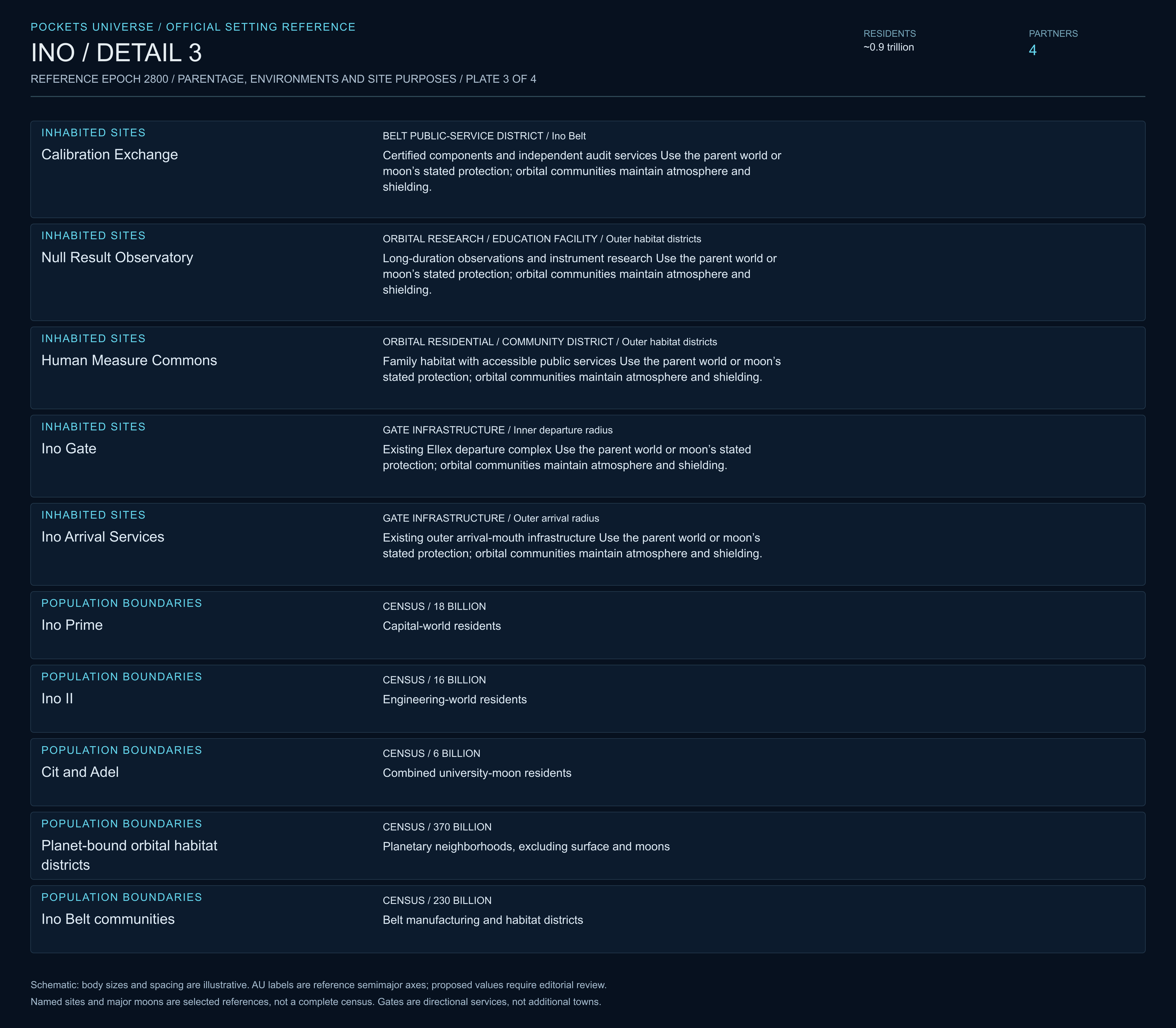
Open the overview above for full-resolution zoom and pan. The detail plates below provide the full reference inventory; their topics are listed with each link. The article also presents these facts as readable text. Body sizes and diagram spacing are illustrative; orbital labels distinguish established references from proposed design values.
Atlas Detail Plates
- Ino detail plate 1: worlds and physical features, settlements and facilities
- Ino detail plate 2: settlements and facilities
- Ino detail plate 3: settlements and facilities, population categories
- Ino detail plate 4: population categories
Reference Model And Limits
This edition combines established setting facts with explicitly proposed astronomy and revised recent worldbuilding. New survey identifiers are provisional labels, not new historical discoveries. A temperate orbit does not establish breathable air, safe weather or native life. New bodies and debris do not establish profitable resources.
- Stellar luminosity, unmeasured orbital values, belt boundaries and new physical models are proposed design values requiring editorial approval; they do not certify habitability.
- Existing navigation width describes the transit model, not a hard astronomical edge.
City And Station Profiles
- Open Workshop City — Independent manufacturers and technical schools.