Technology
The Net / Feeds
Local networks, delayed Federation-wide sharing, and competing controls over information.
Article contents
Also known as: The Net, Feeds, The Feed, Net
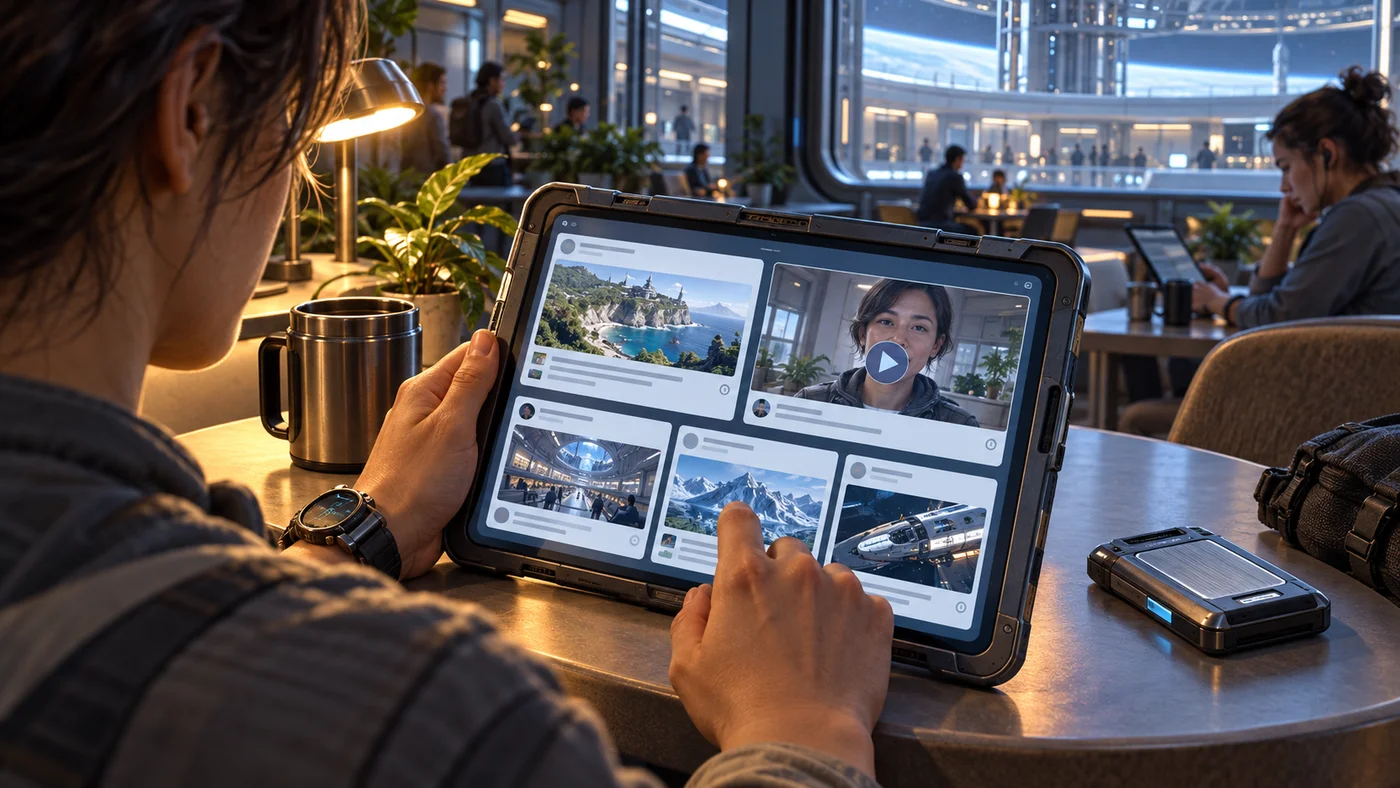
The Net is the networked information environment used for communication, entertainment, reference, and sharing across human space. Feeds are the streams of content people read, watch, contribute to, and discuss within it. The terms often overlap in everyday speech, but a feed is a way of following content rather than the whole underlying network.
At the 2800 reference date, a person may participate in a local community while following material from across the United Systems of Humankind. Shared access does not mean shared timing, identical content, or equal freedom to publish.
Local, Regional, And Federation-Wide Networks
Networks exist at different scales. A settlement or station can maintain local exchanges; a system can have its own feeds and services; several systems can share a regional information community. These can coexist with broader Federation-wide distribution.
| Scope | Typical use | Constraint |
|---|---|---|
| Settlement or station | Nearby discussion, local notices, and community content | Access depends on local infrastructure and policy |
| System | Shared media, institutions, and discussion across worlds and habitats | Light-travel distance still affects exchanges within the system |
| Multi-system | Regional interests and content shared between connected systems | Updates must cross the gate network |
| Federation-wide | Widely circulated news, entertainment, opinions, and reference | Different systems receive and admit content at different times |
These are overlapping communities, not four universal subscription plans. Following a regional feed does not remove the physical delay between its participating systems.
Publishing And Following Content
Feeds carry video, entertainment, opinions, discussion, and recorded messages. Live participation is possible where the local communications distance permits it. A recording can also circulate far beyond the people who watched the original event.
Sharing moves content into other conversations and communities. A widely followed item may have local copies and responses in several systems before later updates arrive. Those communities can be discussing different stages of the same developing subject.
Personal assistants help users work with information already available to them. They do not receive untransported facts from another system, and a local copy can remain useful during an external outage. See AI and robotics.
Distance And Freshness
Federation-wide sharing uses the delayed communications network described in Gates and communications. Ellex communications ships collect traffic, carry it through one-way wormhole services, and hand off stored data. Collection schedules, transit, local light-beam distances, transfers, and queues all affect delivery.
News can arrive sooner than a passenger or relief ship, but a Federation-wide livestream is not instantaneous. A question sent to another system and its recorded reply must each make the journey.
The time of an event, the time of publication, and the time a reader receives it can differ. A recent arrival in a local feed may describe an older event. Dates and provenance therefore matter when comparing accounts or reading changing information.
Access Restrictions And Controlled Feeds
Local governments can restrict access to the broader Net and shape which feeds residents may use. More draconian systems may permit only heavily monitored local material, limiting outside reporting and the range of discussion available to their population.
Other systems allow broader participation. A multi-system community can consequently have unequal reach: an item accessible in one member system may be blocked, withheld, or absent in another. The existence of a Federation-wide network is not a guarantee that every resident can freely browse it.
Control over viewing, sharing, and local discussion is distinct from control over carriage. Ellex Corporation operates the official inter-system communications network; local authorities govern content access within their own jurisdictions. Those layers can both affect what reaches a reader without being the same institution or policy.
Copies And Circulation
Transport control does not confer possession of every copy. Received material can be stored, shared locally, or carried on ship drives and personal communications units. Subsequent movement between systems still obeys gate transit and local travel constraints.
Restrictions can impede circulation without guaranteeing that every independent copy will be found and erased. Conversely, the survival of a copy does not guarantee that everyone can discover it or that it will reach the next system quickly.
The result is a shared information world with strong local differences. Infrastructure, distance, access policy, and individual sharing all shape what people know. Daily life describes the Net’s place in ordinary communities; Fabrication and interfaces covers the devices and displays used to interact with it.