Technology
Mason Drive
The sublight propulsion system behind travel within inhabited star systems, first developed in Sol in 2215.
Article contents
Also known as: Mason propulsion
At A Glance
- Inventor
- Dylan Mason
- Introduced
- 2215
- Role
- Sublight spacecraft propulsion
- Ordinary planning range
- 0.5–1.0 g
- Premium sustained reference
- 1.2 g
- Operational velocity ceiling
- About 1% of light speed (2,998 km/s)
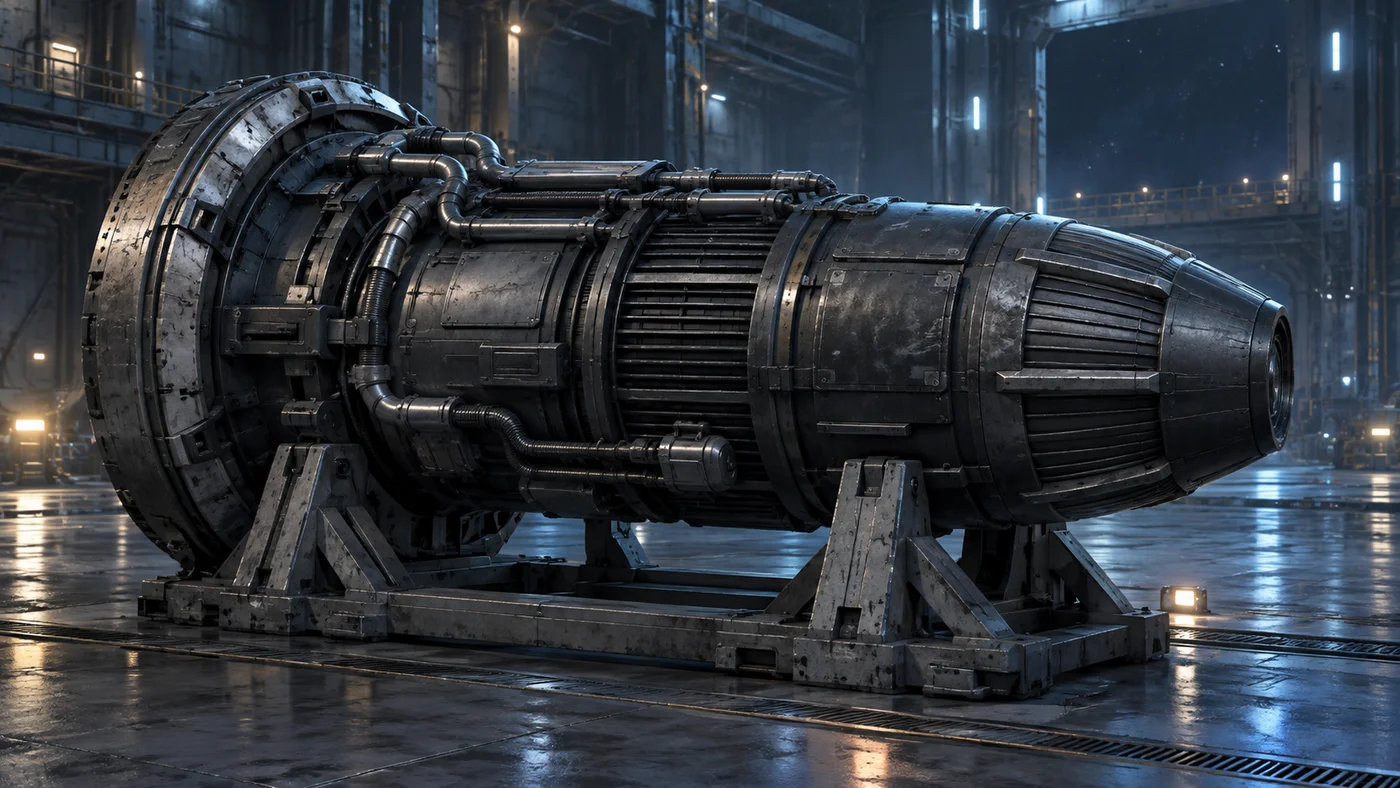
The Mason Drive is the propulsion system that made widespread settlement of Sol possible and continues to underpin local spacecraft journeys in 2800. It supplies acceleration for travel between worlds, stations, and gate infrastructure. Interstellar crossings use wormhole gates; the drive serves the flights on either side of those crossings.
History And Settlement
Dylan Mason invented the drive in 2215. Over the following seventy years, Mason propulsion enabled hundreds of human colonies and stations throughout Sol. Those early settlements remained within humanity’s home system. The Wormhole Gate, developed in 2285, subsequently opened settlement in other star systems.
Early Earth–Mars journeys took approximately a week even near the planets’ greatest separation. This is a rounded historical performance benchmark. Actual travel time depends on the route, departure date, acceleration profile, and the motion of the destination.
Operating Profiles In 2800
| Service | Planning acceleration | Practical meaning |
|---|---|---|
| Ordinary service | 0.5–1.0 g | Operators select a profile appropriate to the ship, passengers, cargo, and route. Lower settings and coasting may be necessary. |
| Premium sustained service | 1.2 g | A reference rating for continuous crewed cruise, subject to the ship’s loaded-mass rating and passenger support. |
Acceleration and speed describe different parts of a journey. Acceleration changes velocity; maintaining a constant velocity does not itself impose an acceleration load on passengers. A ship can therefore travel rapidly during a coast without subjecting its occupants to the loading of an active burn.
The planning values describe service profiles rather than a guarantee for every vessel. They do not establish an exceptional military boost rating or a universal maximum engine thrust.
Velocity Ceiling And Long Routes
Mason itineraries use an operational sublight ceiling of roughly one percent of light speed, about 2,998 km/s, in the system’s navigation frame. This is an operating limit for route planning, not a universal limit on motion measured by every observer.
At 1.2 g, a ship starting with negligible velocity in that frame reaches the ceiling after about 2.95 days of uninterrupted acceleration. A sufficiently long transfer includes acceleration, a coast at the ceiling, and a braking leg. A higher permitted acceleration shortens the burns; it does not raise the velocity ceiling.
How A Flight Works
- Plan the interception. Navigation accounts for the departure and destination velocities, stellar clearance, obstacles, approach rules, and traffic. A benchmark distance does not define a safe flight path.
- Secure the ship. Cargo and equipment are restrained. Before full acceleration, every occupant is fitted into a rated gel couch, and the ship’s loaded-mass propulsion rating is checked.
- Accelerate. Thrust builds velocity along the planned vector. Reduced-thrust periods may allow ordinary activity when conditions permit; full acceleration requires couch confinement.
- Coast if required. Cutting thrust removes sustained thrust loading but leaves the ship moving. Coasting may be required by the velocity ceiling or resource and heat budgets.
- Turn and brake. Thrust is cut before physical turnover. After reorientation and support checks, braking thrust is ramped up to reduce velocity. The vessel does not instantly stop or begin moving backward.
- Match the destination. The ship brakes to meet the destination’s motion. Final approach, traffic clearance, and docking add time beyond the main transfer.
Shorter routes may use an acceleration leg followed by braking without a long coast. Turning the ship is a physical maneuver rather than an instantaneous reversal of passenger loading.
Passengers And Cargo
Rated gel couches are mandatory during full acceleration and braking. They support occupants against thrust and maneuver loads; they do not eliminate the need to control those loads. The least capable occupied couch and the ship’s loaded condition constrain the usable profile.
Medical needs, cargo requirements, economy, and route restrictions can require slower travel. Permission to stand depends on acceleration and maneuvering conditions. A coast can allow release from thrust confinement, while constant speed alone does not create weight.
Gates And Complete Itineraries
A wormhole crossing and a local Mason flight are separate portions of a journey. Arrival mouths and generating departure gates occupy different locations, so an onward connection can require a substantial flight within the destination system. Return routing can differ because individual crossings are one-way.
A complete itinerary therefore includes local transfers, gate crossings, collection, queues, and final approach. The historical week-long Earth–Mars benchmark cannot be substituted for every local leg, and increasing Mason acceleration does not change the gate’s transit rules.
Energy And Design Boundaries
Propulsion requires energy, heat rejection, and a viable momentum budget. The established performance does not specify the drive’s fuel, reaction mass, reactor type, exhaust velocity, manufacturer, or thrust for each ship class.
The illustration presents an exterior concept for the wiki. Its casing, fittings, and proportions are visual design choices, rather than a cutaway or a confirmed engineering specification. No particular internal mechanism is established by the image.