Systems
Colat
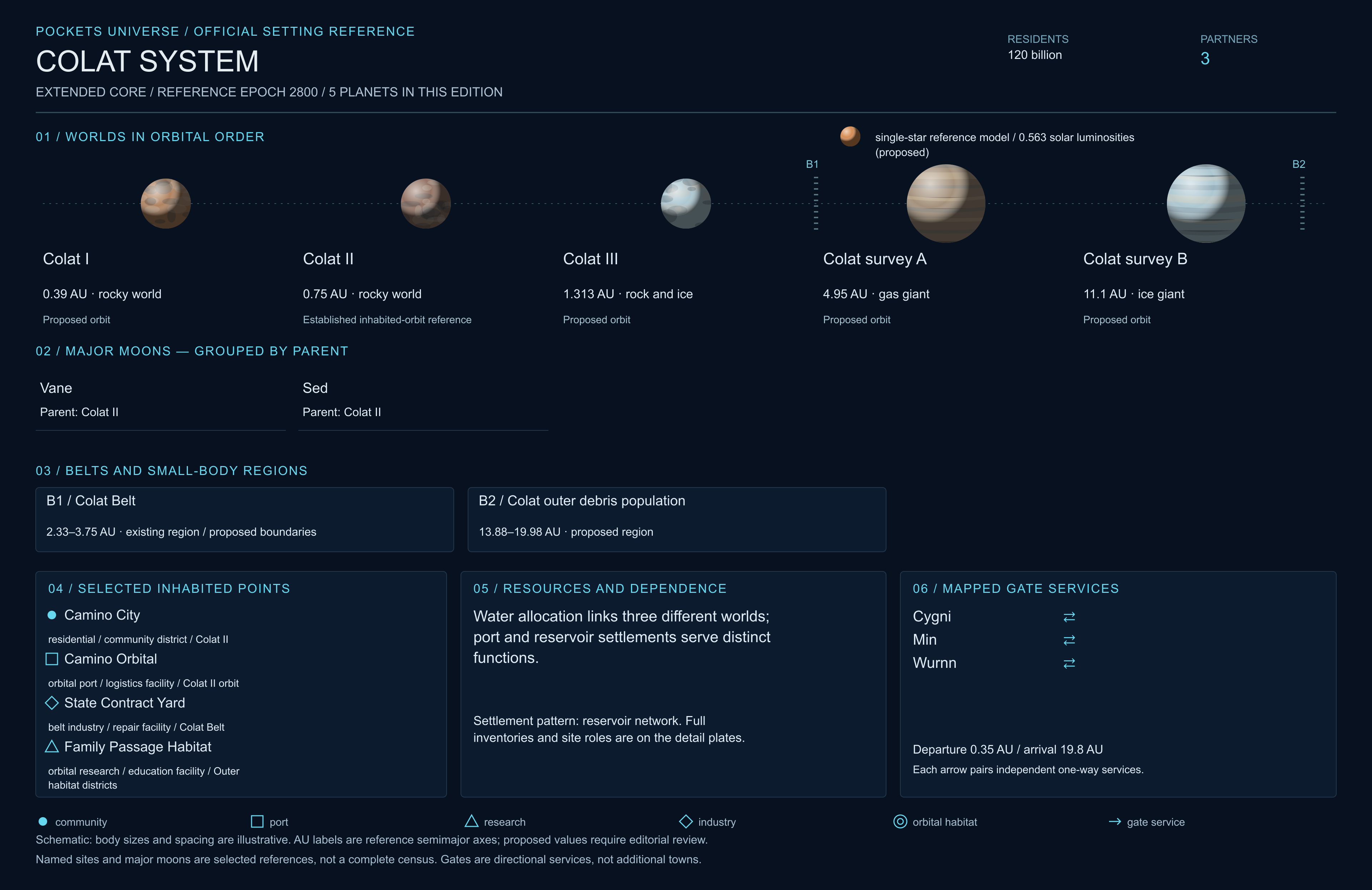
Water allocation links three different worlds; port and reservoir settlements serve distinct functions.
Article contents
At A Glance
- Region
- Extended Core
- Population
- 120 billion
- Government
- Autocracy
- Distance from Sol
- 20.28 light-years
- Operational width
- 44 AU
- Gate services
- 3
What Makes This System Distinctive
- Colat II: Teal-hazed rocky capital with mineral lakes and enclosed cities; Camino City remains Cary Princep’s birthplace. The 5-planet reference inventory spans 0.39–11.1 AU.
- Water allocation links three different worlds; port and reservoir settlements serve distinct functions.
- 2 individually shown major moon references; Colat Belt and Colat outer debris population complete the selected small-body picture without implying profitable resources everywhere.
Three worlds and one rationed reservoir.
Wonders
-
The Teal Lake Prospect — Natural · Colat II. Mineral lakes catch the light beneath teal haze outside enclosed cities. Seen from Camino City’s protected environment, the coloured water and veiled landscape have a beauty that should not be mistaken for a human-compatible outdoor setting.
-
Camino Orbital — Built · Colat II orbit. The established orbital links passenger life and logistics above the veiled capital world. The view of enclosed urban ground through teal atmosphere gives its everyday transfer spaces a dramatic planetary setting.
-
The Cold Reserves — Built · Cold Reserve Town, Colat III. Protected reservoir settlements sit within ice-rich country, bringing stored water and family habitation together. The contrast between pale exterior ice and maintained interiors makes the system’s dependence on managed reserves visible.
Government
An entrenched strongman governor who long ago bent the term limits, the “President-for-now.”
Local Culture
Families keep a carefully framed first water-allocation notice as both a founding relic and a private joke. Public jokes praise the President-for-now for the weather; private jokes ask when now ends. Camino children collect Navy ship-call cards from relatives who work the docks.
Worlds And Moons
| Body | Environment and settlement |
|---|---|
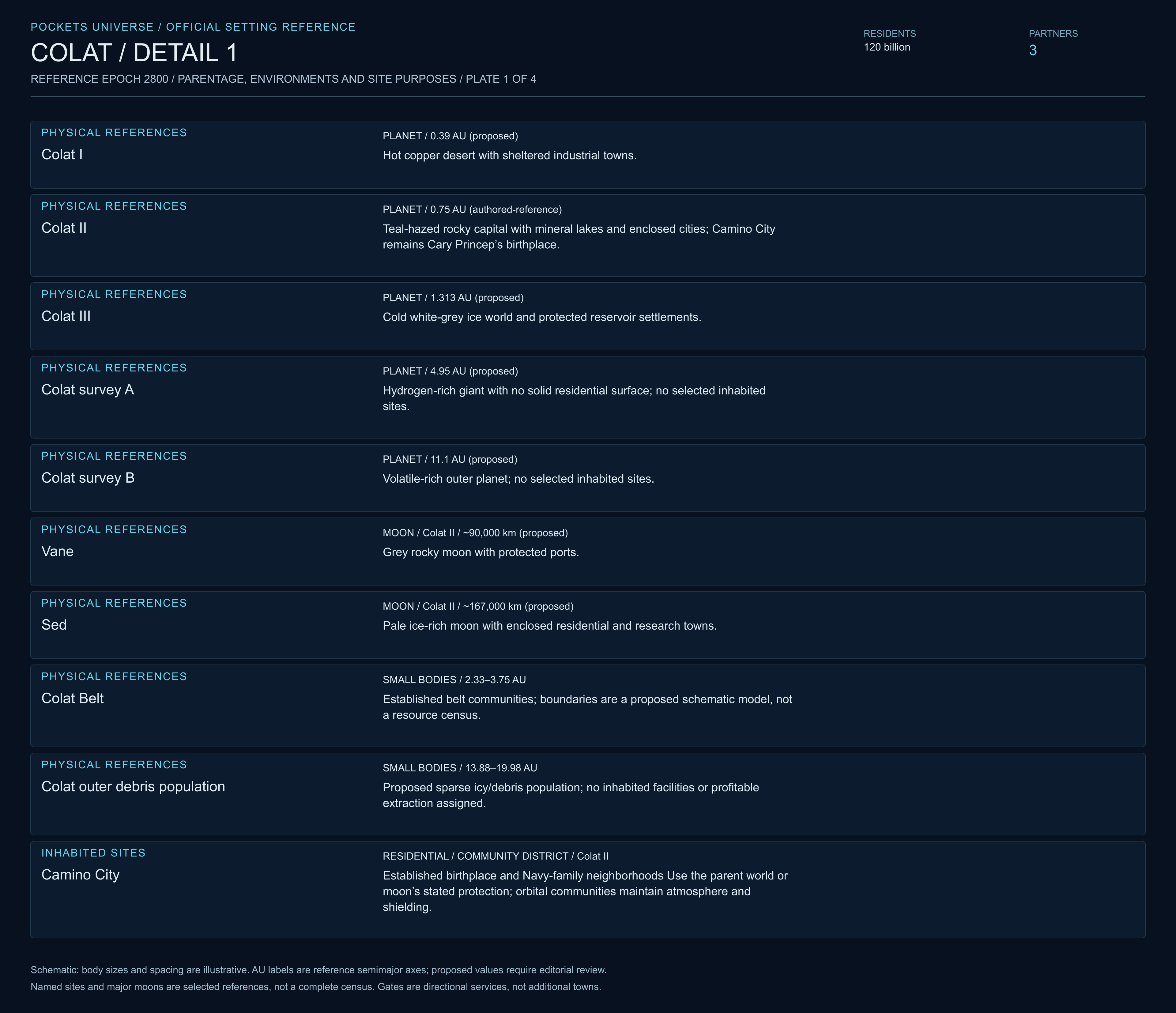
| Colat II | Teal-hazed rocky capital with mineral lakes and enclosed cities; Camino City remains Cary Princep’s birthplace. |
| Colat I | Hot copper desert with sheltered industrial towns. |
| Colat III | Cold white-grey ice world and protected reservoir settlements. |
| Vane | Grey rocky moon with protected ports. |
| Sed | Pale ice-rich moon with enclosed residential and research towns. |
Economy And Companies
Colat State Industries (strongman-aligned); Camino Media (state-leaning press); Colat Aerospace.
Gate Connections
Colat has mapped services to Cygni, Min, Wurnn. Generating departure gates and available services are distinct: some crossings require a separate return gate. See Gates and communications.
Reading The Profile
Population figures are approximate. Local cultural descriptions represent traditions and institutions, rather than traits shared by every resident. Navigation distances are authored setting values; they are not measurements of real stars.
Settlements And Landmarks
Named places include planetary communities, orbital habitats, working ports, and research facilities. These are examples within larger settlement networks.
| Body or district | Site | Purpose |
|---|---|---|
| Colat II | Camino City | Established birthplace and Navy-family neighborhoods |
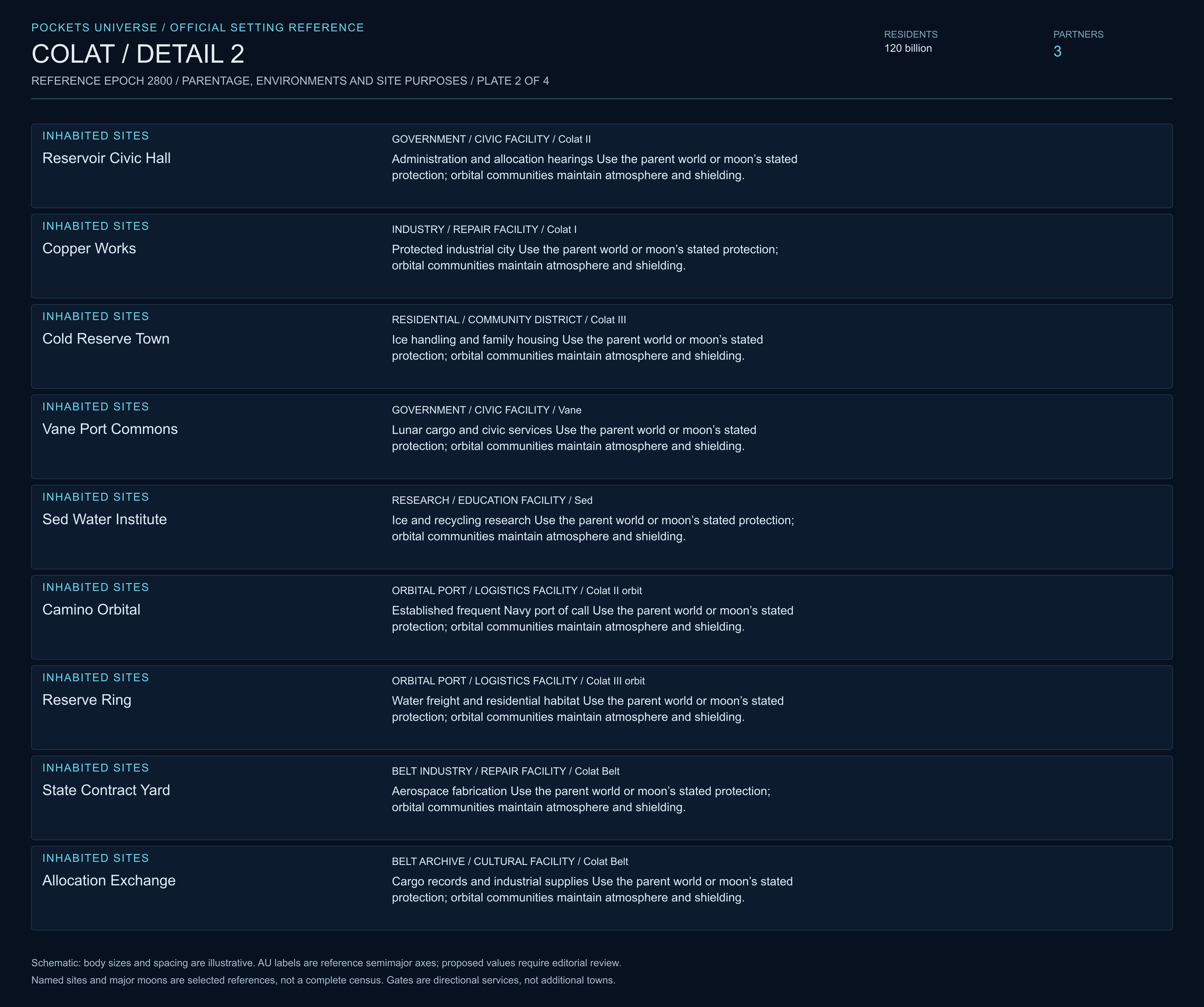
| Colat II | Reservoir Civic Hall | Administration and allocation hearings |
| Colat I | Copper Works | Protected industrial city |
| Colat III | Cold Reserve Town | Ice handling and family housing |
| Vane | Vane Port Commons | Lunar cargo and civic services |
| Sed | Sed Water Institute | Ice and recycling research |
| Colat II orbit | Camino Orbital | Established frequent Navy port of call |
| Colat III orbit | Reserve Ring | Water freight and residential habitat |
| Colat Belt | State Contract Yard | Aerospace fabrication |
| Colat Belt | Allocation Exchange | Cargo records and industrial supplies |
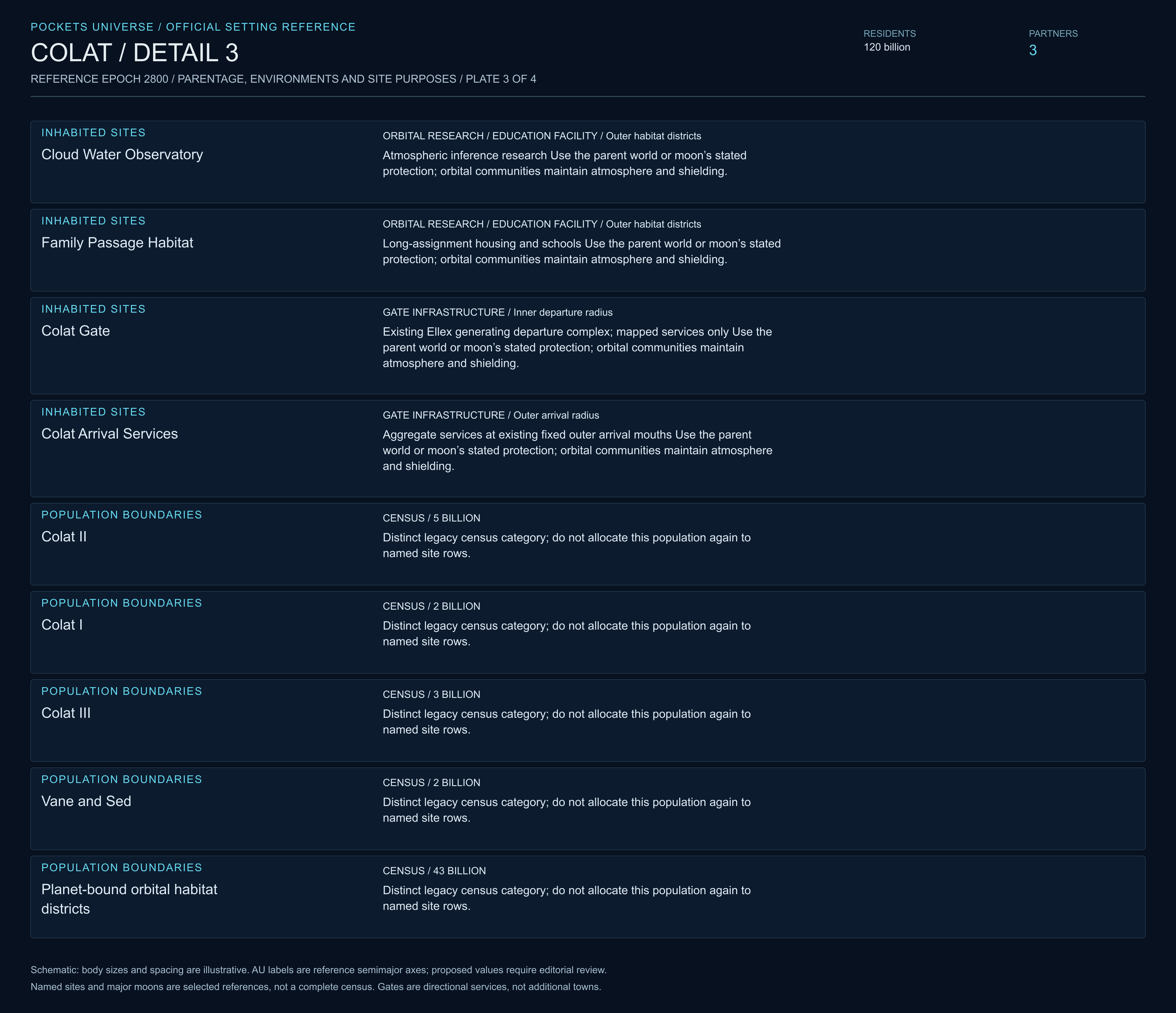
| Outer habitat districts | Cloud Water Observatory | Atmospheric inference research |
| Outer habitat districts | Family Passage Habitat | Long-assignment housing and schools |
| Inner departure radius | Colat Gate | Existing Ellex generating departure complex; mapped services only |
| Outer arrival radius | Colat Arrival Services | Aggregate services at existing fixed outer arrival mouths |
Planetary Architecture
single-star reference model. 0.563 solar luminosities and approximately 0.866 solar masses (proposed working model).
| World, in orbital order | Approximate orbit | Composition and conditions |
|---|---|---|
| Colat I | 0.39 AU — proposed | rocky world. Hot copper desert with sheltered industrial towns. |
| Colat II | 0.75 AU — established inhabited-orbit reference | rocky world. Teal-hazed rocky capital with mineral lakes and enclosed cities; Camino City remains Cary Princep’s birthplace. |
| Colat III | 1.313 AU — proposed | rock and ice. Cold white-grey ice world and protected reservoir settlements. |
| Colat survey A | 4.95 AU — proposed | gas giant. Hydrogen-rich giant with no solid residential surface; no selected inhabited sites. |
| Colat survey B | 11.1 AU — proposed | ice giant. Volatile-rich outer planet; no selected inhabited sites. |
Major Moons
| Moon / group | Parent | Reference conditions |
|---|---|---|
| Vane | Colat II | Grey rocky moon with protected ports. Approximate orbital semimajor axis 90,000 km (proposed). |
| Sed | Colat II | Pale ice-rich moon with enclosed residential and research towns. Approximate orbital semimajor axis 167,000 km (proposed). |
Named major satellites shown; uncatalogued small satellites are not a surveyed census.
Belts And Small Bodies
| Region | Approximate radial reference | Composition / use |
|---|---|---|
| Colat Belt | 2.33–3.75 AU — proposed region boundaries | Established belt communities; boundaries are a proposed schematic model, not a resource census. |
| Colat outer debris population | 13.88–19.98 AU — proposed | Proposed sparse icy/debris population; no inhabited facilities or profitable extraction assigned. |
Settlement Network
Water allocation links three different worlds; port and reservoir settlements serve distinct functions.
| Site / district | Location | Type | Purpose |
|---|---|---|---|
| Camino City | Colat II | residential / community district | Established birthplace and Navy-family neighborhoods |
| Reservoir Civic Hall | Colat II | government / civic facility | Administration and allocation hearings |
| Copper Works | Colat I | industry / repair facility | Protected industrial city |
| Cold Reserve Town | Colat III | residential / community district | Ice handling and family housing |
| Vane Port Commons | Vane | government / civic facility | Lunar cargo and civic services |
| Sed Water Institute | Sed | research / education facility | Ice and recycling research |
| Camino Orbital | Colat II orbit | orbital port / logistics facility | Established frequent Navy port of call |
| Reserve Ring | Colat III orbit | orbital port / logistics facility | Water freight and residential habitat |
| State Contract Yard | Colat Belt | belt industry / repair facility | Aerospace fabrication |
| Allocation Exchange | Colat Belt | belt archive / cultural facility | Cargo records and industrial supplies |
| Cloud Water Observatory | Outer habitat districts | orbital research / education facility | Atmospheric inference research |
| Family Passage Habitat | Outer habitat districts | orbital research / education facility | Long-assignment housing and schools |
| Colat Gate | Inner departure radius | gate infrastructure | Existing Ellex generating departure complex; mapped services only |
| Colat Arrival Services | Outer arrival radius | gate infrastructure | Aggregate services at existing fixed outer arrival mouths |
Port districts, civic buildings and working networks are not additional cities or independent population categories. Protected living areas, maintained power, atmosphere, thermal control and shielding follow local environmental needs. Regional freight supplies specialized components; self-sufficiency is not assumed.
Population Boundaries
| Exclusive category | Residents, billions | Boundary |
|---|---|---|
| Colat II | 5 | Distinct legacy census category; do not allocate this population again to named site rows. |
| Colat I | 2 | Distinct legacy census category; do not allocate this population again to named site rows. |
| Colat III | 3 | Distinct legacy census category; do not allocate this population again to named site rows. |
| Vane and Sed | 2 | Distinct legacy census category; do not allocate this population again to named site rows. |
| Planet-bound orbital habitat districts | 43 | Distinct legacy census category; do not allocate this population again to named site rows. |
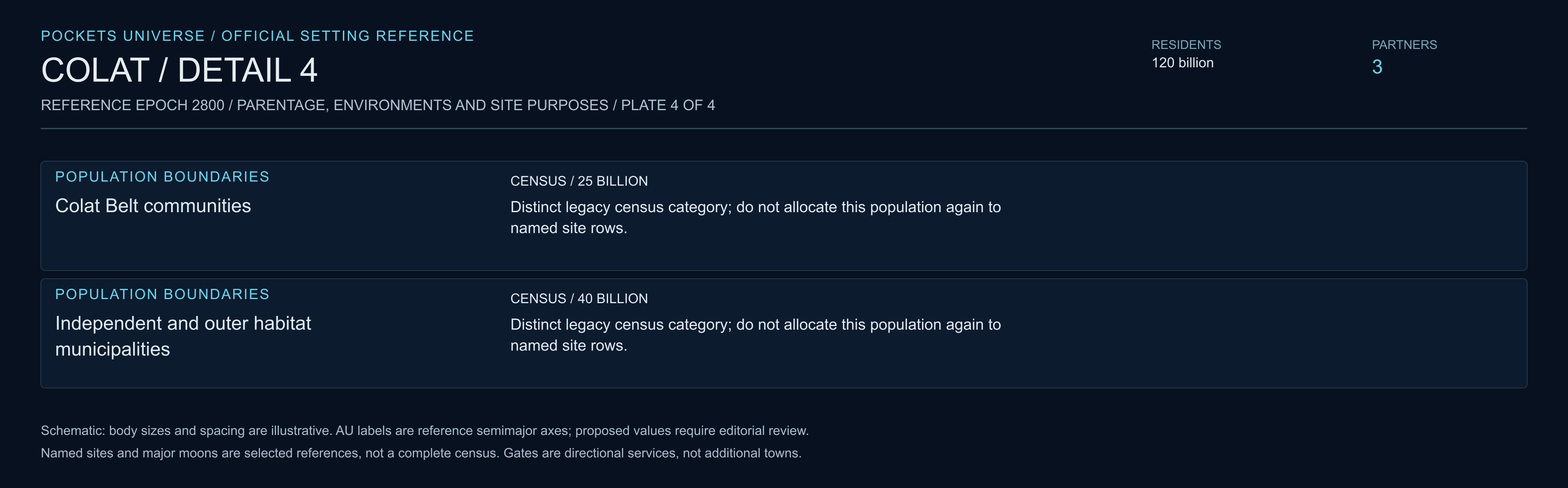
| Colat Belt communities | 25 | Distinct legacy census category; do not allocate this population again to named site rows. |
| Independent and outer habitat municipalities | 40 | Distinct legacy census category; do not allocate this population again to named site rows. |
These categories total 120 billion residents. Named facilities belong to these categories and are not added again.
System Atlas
Open the overview above for full-resolution zoom and pan. The detail plates below provide the full reference inventory; their topics are listed with each link. The article also presents these facts as readable text. Body sizes and diagram spacing are illustrative; orbital labels distinguish established references from proposed design values.
Atlas Detail Plates
- Colat detail plate 1: worlds and physical features, settlements and facilities
- Colat detail plate 2: settlements and facilities
- Colat detail plate 3: settlements and facilities, population categories
- Colat detail plate 4: population categories
Reference Model And Limits
This edition combines established setting facts with explicitly proposed astronomy and revised recent worldbuilding. New survey identifiers are provisional labels, not new historical discoveries. A temperate orbit does not establish breathable air, safe weather or native life. New bodies and debris do not establish profitable resources.
- Stellar luminosity, unmeasured orbital values, belt boundaries and new physical models are proposed design values requiring editorial approval; they do not certify habitability.
- Existing navigation width describes the transit model, not a hard astronomical edge.