Systems
Kaldor
Warm basins concentrate winter cities and libraries; distant instrument settlements use sheltered maintenance.
Article contents
At A Glance
- Region
- Extended Core
- Population
- 300 billion
- Government
- Academic-cultural republic
- Distance from Sol
- 15.33 light-years
- Operational width
- 82 AU
- Gate services
- 4
What Makes This System Distinctive
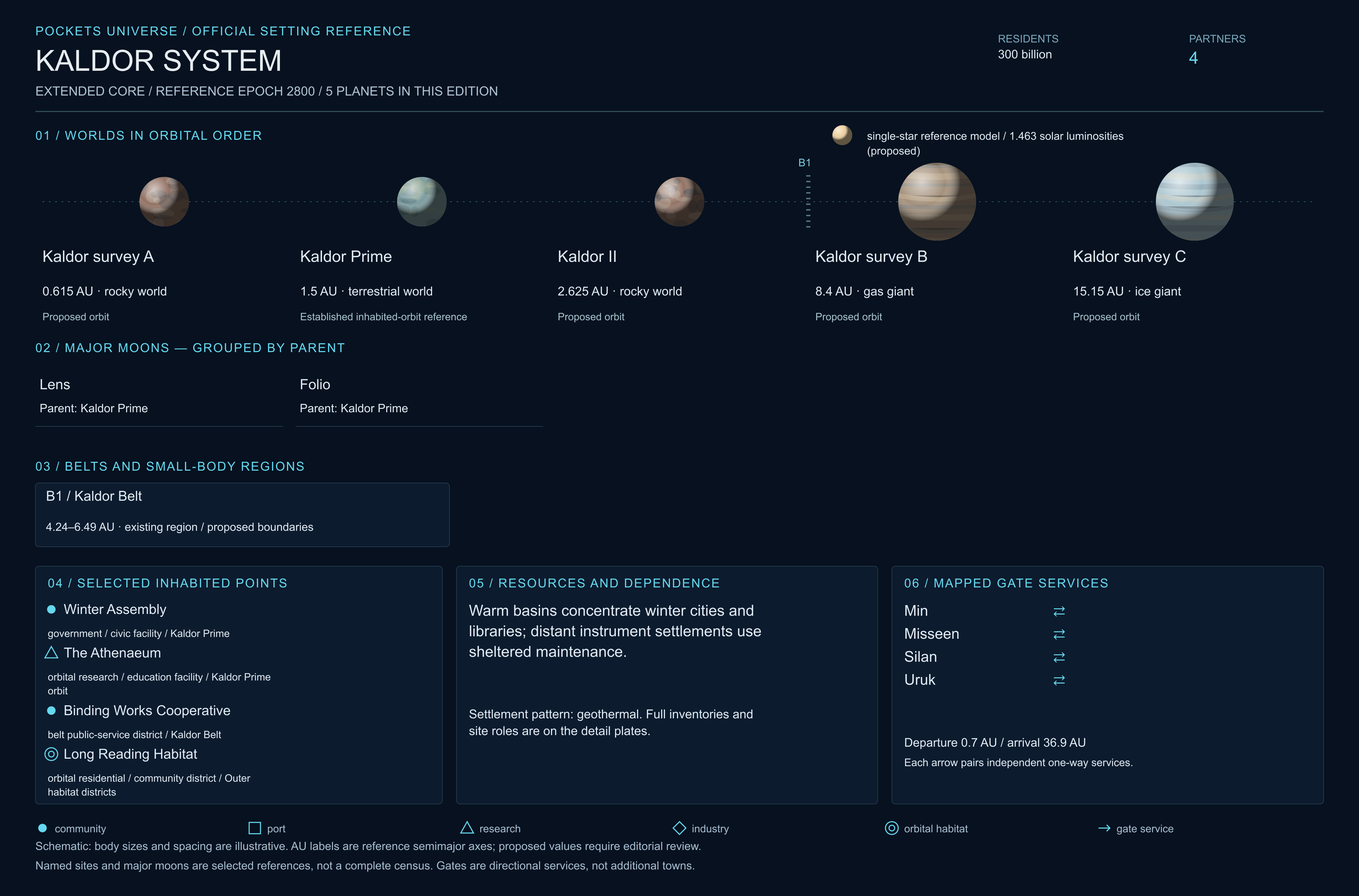
- Kaldor Prime: Silver-blue winter world with geothermal basins, protected cities and brief seasonal green near maintained settlements. The 5-planet reference inventory spans 0.615–15.15 AU.
- Warm basins concentrate winter cities and libraries; distant instrument settlements use sheltered maintenance.
- 2 individually shown major moon references; Kaldor Belt complete the selected small-body picture without implying profitable resources everywhere.
Libraries in the long winter.
Wonders
-
The Winter Green Basins — Natural · Kaldor Prime. Geothermal basins interrupt a winter world, with brief seasonal green near maintained settlements. The contrast between the surrounding cold country and these limited milder pockets makes the short growing season especially vivid.
-
The Athenaeum — Built · Kaldor Prime orbit. The orbital archive and university annex turn accumulated learning into an inhabited destination. Public reading spaces and the winter world outside place the intimacy of a book or record against the scale of an entire planetary horizon.
-
Lens Observatory — Built · Lens. A protected research community occupies one of the system’s observatory moons. The stark exterior instruments and cratered ground, seen from permitted routes, make an architectural expression of a society devoted to patient observation.
Government
Elected, heavily influenced by its universities and academies.
Local Culture
Winter reading feasts begin with a maintenance worker reading the archive’s power log. Dinner guests bring a disputed footnote instead of a bottle; the host must supply the missing context. Children trade facsimile mistakes and compete to discover the printer’s oldest recurring error.
Worlds And Moons
| Body | Environment and settlement |
|---|---|
| Kaldor Prime | Silver-blue winter world with geothermal basins, protected cities and brief seasonal green near maintained settlements. |
| Kaldor II | Pale dry cold plateau world with sheltered towns and instruments. |
| Lens | Grey cratered observatory moon. |
| Folio | Pale dusty observatory moon with protected archive communities. |
Economy And Companies
the Great Presses (publishing houses); the Kaldor Academies (quasi-corporate); Lyceum Data.
Gate Connections
Kaldor has mapped services to Min, Misseen, Silan, Uruk. Generating departure gates and available services are distinct: some crossings require a separate return gate. See Gates and communications.
Reading The Profile
Population figures are approximate. Local cultural descriptions represent traditions and institutions, rather than traits shared by every resident. Navigation distances are authored setting values; they are not measurements of real stars.
Settlements And Landmarks
Named places include planetary communities, orbital habitats, working ports, and research facilities. These are examples within larger settlement networks.
| Body or district | Site | Purpose |
|---|---|---|
| Kaldor Prime | Winter Assembly | Elected civic chamber |
| Kaldor Prime | Geothermal Reading Quarter | Libraries and protected residential streets |
| Kaldor II | Plateau Instrument Town | Fabrication and calibration |
| Kaldor II | Short Summer Institute | Seasonal climate and crop research |
| Lens | Lens Observatory | Lunar astronomical research |
| Folio | Folio Archive Town | Protected records and schools |
| Kaldor Prime orbit | The Athenaeum | Established orbital archive and university annex |
| Kaldor II orbit | Open Shelf Ring | Student and technician habitat |
| Kaldor Belt | Binding Works Cooperative | Publishing materials and precision parts |
| Kaldor Belt | Citation Exchange | Data and cargo contracts |
| Outer habitat districts | Footnote Observatory | Deep-sky records and instrument maintenance |
| Outer habitat districts | Long Reading Habitat | Family housing and public education |
| Inner departure radius | Kaldor Gate | Existing Ellex generating departure complex; mapped services only |
| Outer arrival radius | Kaldor Arrival Services | Aggregate services at existing fixed outer arrival mouths |
Planetary Architecture
single-star reference model. 1.463 solar luminosities and approximately 1.1 solar masses (proposed working model).
| World, in orbital order | Approximate orbit | Composition and conditions |
|---|---|---|
| Kaldor survey A | 0.615 AU — proposed | rocky world. Airless rock with impact basins; no selected inhabited sites. |
| Kaldor Prime | 1.5 AU — established inhabited-orbit reference | terrestrial world. Silver-blue winter world with geothermal basins, protected cities and brief seasonal green near maintained settlements. |
| Kaldor II | 2.625 AU — proposed | rocky world. Pale dry cold plateau world with sheltered towns and instruments. |
| Kaldor survey B | 8.4 AU — proposed | gas giant. Hydrogen-rich giant with no solid residential surface; no selected inhabited sites. |
| Kaldor survey C | 15.15 AU — proposed | ice giant. Volatile-rich outer planet; no selected inhabited sites. |
Major Moons
| Moon / group | Parent | Reference conditions |
|---|---|---|
| Lens | Kaldor Prime | Grey cratered observatory moon. Approximate orbital semimajor axis 90,000 km (proposed). |
| Folio | Kaldor Prime | Pale dusty observatory moon with protected archive communities. Approximate orbital semimajor axis 167,000 km (proposed). |
Named major satellites shown; uncatalogued small satellites are not a surveyed census.
Belts And Small Bodies
| Region | Approximate radial reference | Composition / use |
|---|---|---|
| Kaldor Belt | 4.24–6.49 AU — proposed region boundaries | Established belt communities; boundaries are a proposed schematic model, not a resource census. |
Settlement Network
Warm basins concentrate winter cities and libraries; distant instrument settlements use sheltered maintenance.
| Site / district | Location | Type | Purpose |
|---|---|---|---|
| Winter Assembly | Kaldor Prime | government / civic facility | Elected civic chamber |
| Geothermal Reading Quarter | Kaldor Prime | residential / community district | Libraries and protected residential streets |
| Plateau Instrument Town | Kaldor II | industry / repair facility | Fabrication and calibration |
| Short Summer Institute | Kaldor II | research / education facility | Seasonal climate and crop research |
| Lens Observatory | Lens | research / education facility | Lunar astronomical research |
| Folio Archive Town | Folio | research / education facility | Protected records and schools |
| The Athenaeum | Kaldor Prime orbit | orbital research / education facility | Established orbital archive and university annex |
| Open Shelf Ring | Kaldor II orbit | orbital public-service district | Student and technician habitat |
| Binding Works Cooperative | Kaldor Belt | belt public-service district | Publishing materials and precision parts |
| Citation Exchange | Kaldor Belt | belt port / logistics facility | Data and cargo contracts |
| Footnote Observatory | Outer habitat districts | orbital research / education facility | Deep-sky records and instrument maintenance |
| Long Reading Habitat | Outer habitat districts | orbital residential / community district | Family housing and public education |
| Kaldor Gate | Inner departure radius | gate infrastructure | Existing Ellex generating departure complex; mapped services only |
| Kaldor Arrival Services | Outer arrival radius | gate infrastructure | Aggregate services at existing fixed outer arrival mouths |
Port districts, civic buildings and working networks are not additional cities or independent population categories. Protected living areas, maintained power, atmosphere, thermal control and shielding follow local environmental needs. Regional freight supplies specialized components; self-sufficiency is not assumed.
Population Boundaries
| Exclusive category | Residents, billions | Boundary |
|---|---|---|
| Kaldor Prime | 10 | Distinct legacy census category; do not allocate this population again to named site rows. |
| Kaldor II | 4 | Distinct legacy census category; do not allocate this population again to named site rows. |
| Lens and Folio | 2 | Distinct legacy census category; do not allocate this population again to named site rows. |
| Planet-bound orbital habitat districts | 120 | Distinct legacy census category; do not allocate this population again to named site rows. |
| Kaldor Belt communities | 64 | Distinct legacy census category; do not allocate this population again to named site rows. |
| Independent and outer habitat municipalities | 100 | Distinct legacy census category; do not allocate this population again to named site rows. |
These categories total 300 billion residents. Named facilities belong to these categories and are not added again.
System Atlas
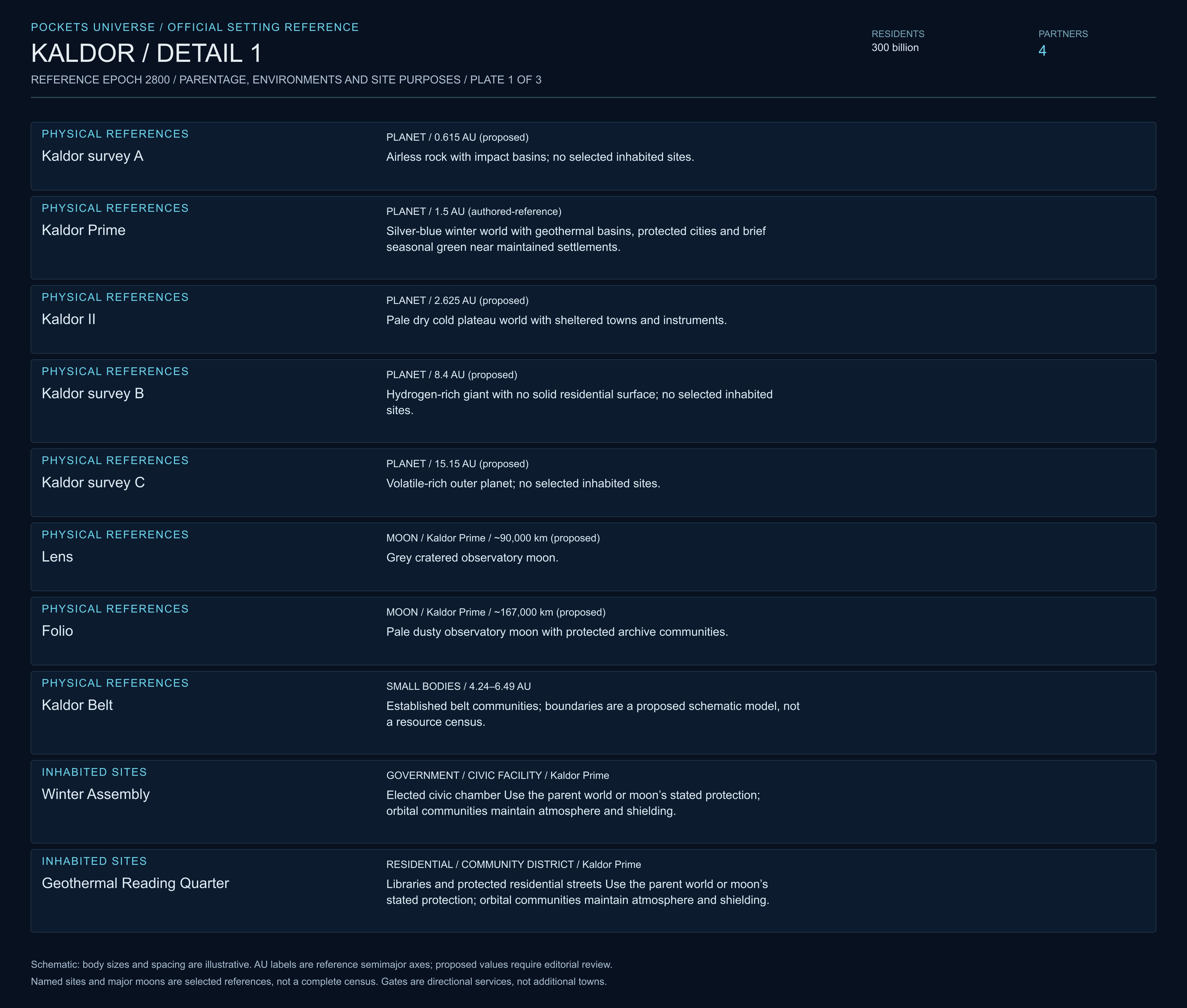
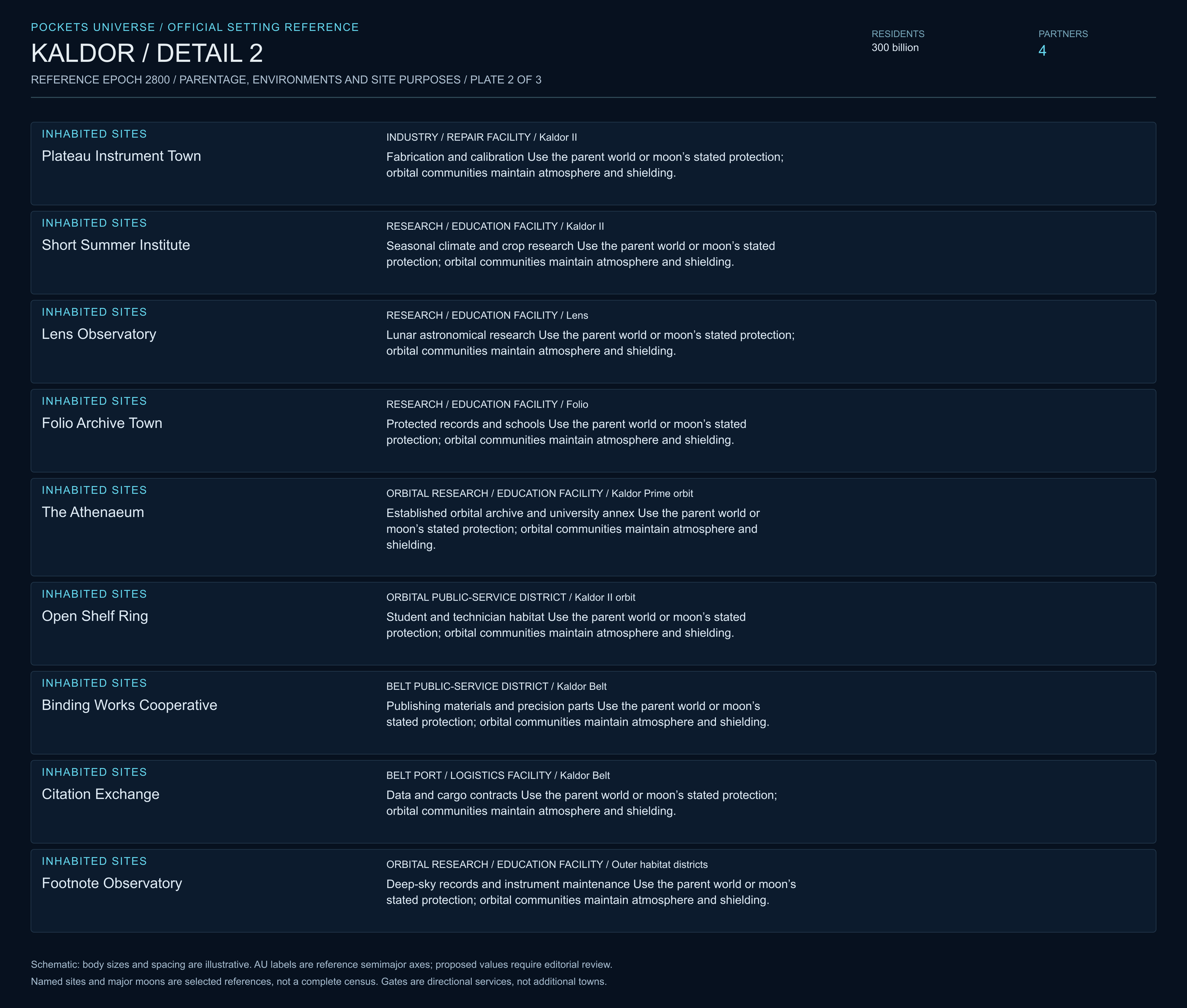
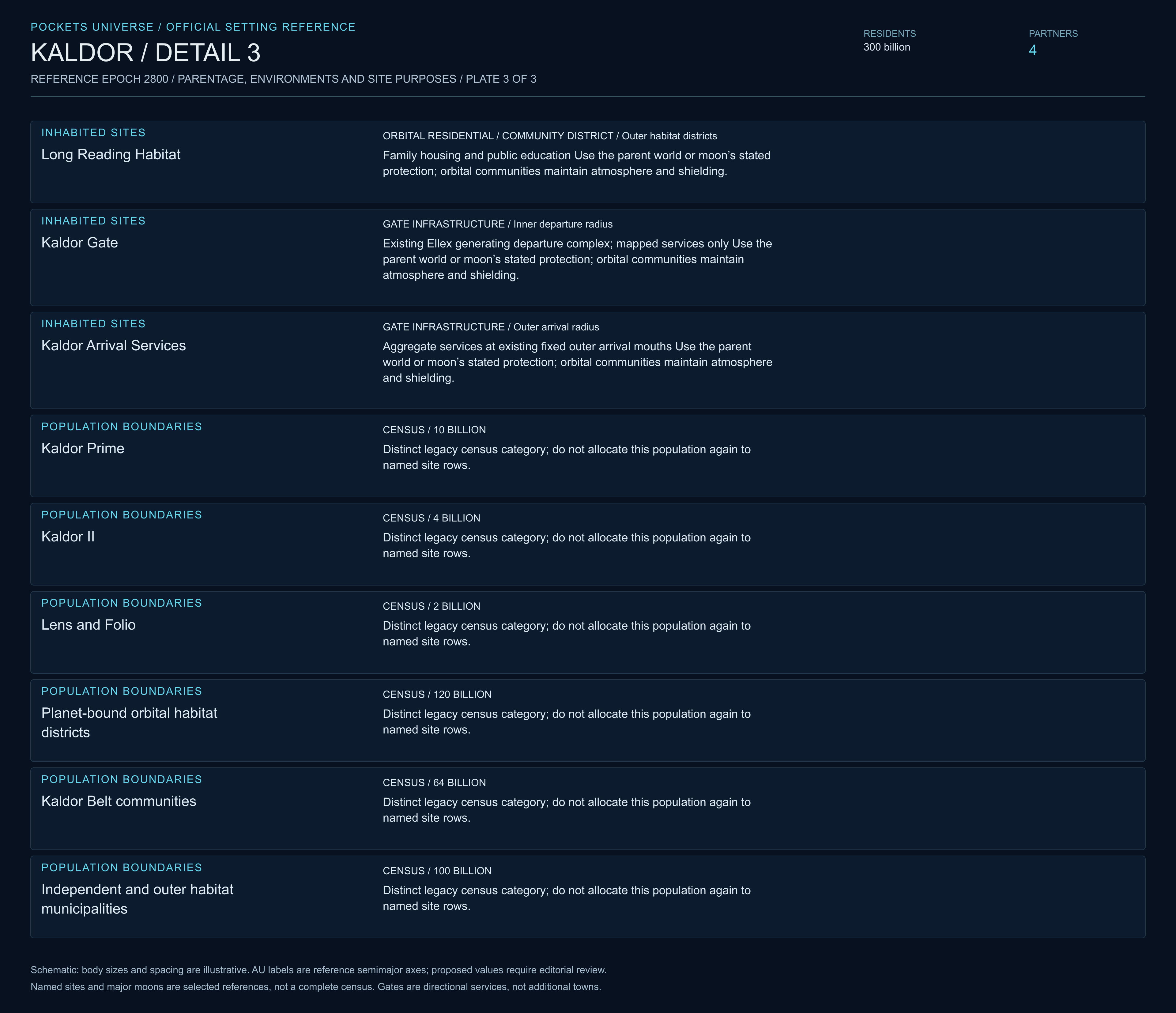
Open the overview above for full-resolution zoom and pan. The detail plates below provide the full reference inventory; their topics are listed with each link. The article also presents these facts as readable text. Body sizes and diagram spacing are illustrative; orbital labels distinguish established references from proposed design values.
Atlas Detail Plates
- Kaldor detail plate 1: worlds and physical features, settlements and facilities
- Kaldor detail plate 2: settlements and facilities
- Kaldor detail plate 3: settlements and facilities, population categories
Reference Model And Limits
This edition combines established setting facts with explicitly proposed astronomy and revised recent worldbuilding. New survey identifiers are provisional labels, not new historical discoveries. A temperate orbit does not establish breathable air, safe weather or native life. New bodies and debris do not establish profitable resources.
- Stellar luminosity, unmeasured orbital values, belt boundaries and new physical models are proposed design values requiring editorial approval; they do not certify habitability.
- Existing navigation width describes the transit model, not a hard astronomical edge.
City And Station Profiles
- The Athenaeum — Established orbital archive and university annex.