Systems
Osara
Osara Prime provisions Kazi's three small research sites; most landscape is uninhabited and jungle dominates Kazi.
Article contents
At A Glance
- Region
- Branch
- Population
- tens of thousands total (Kazi planet ~10,000)
- Government
- System administrator
- Distance from Sol
- 43.09 light-years
- Operational width
- 64 AU
- Gate services
- 2
What Makes This System Distinctive
- Kazi: Hot humid rainforest world; 28-hour day and three university colony sites. Jungle outweighs practical buildings. The 6-planet reference inventory spans 0.63–18 AU.
- Osara Prime provisions Kazi’s three small research sites; most landscape is uninhabited and jungle dominates Kazi.
- 6 individually shown major moon references; Osara outer debris population complete the selected small-body picture without implying profitable resources everywhere.
Wonders
-
Kazi’s Great-Tree Canopy — Natural · Kazi. Thick jungle and large trees dominate the landscape, with distinctive alien species appearing among the greater mass of forest. Viewed from maintained colony edges, the canopy makes the practical buildings seem small and the speed of vegetation’s return unmistakable.
-
The Jungle Railway — Built · Kazi. The established railway links the depot, communications station and secondary research hub through dense rainforest. Its maintained corridor gives a remarkable travelling view of immense trees and rapid regrowth; the research network is a working colony rather than a resort.
-
Ona Orbital Station — Built · Ona orbit. A civilian modular station with a ring, docking extensions and lit habitation sections stands above the large pale-tan world. The station and planetary backdrop form a striking approach view without settling Ona’s still-unresolved composition or atmosphere.
-
The Rust-Red Inner World — Natural · Kala. Kala’s small rust-red rocky globe provides a stark visual contrast with Kazi’s blue-green rainforest world. It is a destination to see from a suitably equipped craft; no surface visitor facilities or resolved atmospheric conditions are implied.
Government
A system administrator oversees Osara Prime and the outposts. Osara University owns the research colony on Kazi. Government and Federation grants, other-system support, and revenue fund its research.
Moons And Stations
The atlas labels six moons: Kazi I and II, Prime I and II, and Ona I and II. Ona Orbital Station is a civilian modular station orbiting Ona, distinct from the gate infrastructure.
Economy And Local Life
Mining, relay services, provisioning, and biological research form part of the frontier economy. Established companies include Osara Mining & Relay and Depot Provisioning. Communities rely on useful posts, practical maintenance, and a stoic approach to remote living.
Gate Connections
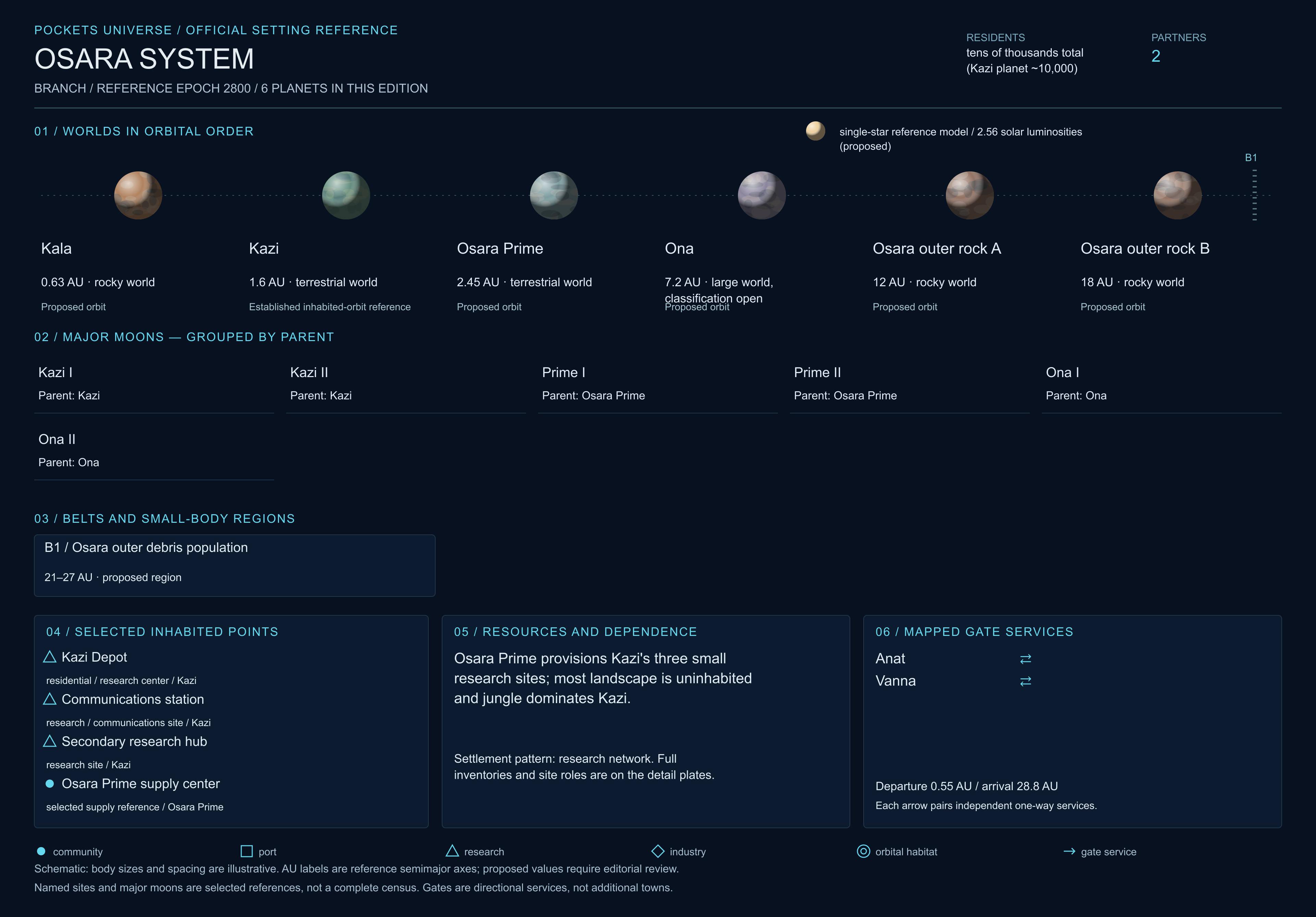
Osara has mapped services to Anat, Vanna. Generating departure gates and available services are distinct: some crossings require a separate return gate. See Gates and communications.
Reading The Profile
Population figures are approximate. Local cultural descriptions represent traditions and institutions, rather than traits shared by every resident. Navigation distances are authored setting values; they are not measurements of real stars.
Kazi’S Research Network
Kazi Depot houses roughly 9,000 residents and serves as the main headquarters. A railway connects the depot with a communications station and a secondary research hub; roughly 1,000 people live across the two outlying sites.
Planetary Architecture
single-star reference model. 2.56 solar luminosities and approximately 1.265 solar masses (proposed working model).
| World, in orbital order | Approximate orbit | Composition and conditions |
|---|---|---|
| Kala | 0.63 AU — proposed | rocky world. Small rust-red inner rocky world; detailed surface conditions remain unassigned. |
| Kazi | 1.6 AU — established inhabited-orbit reference | terrestrial world. Hot humid rainforest world; 28-hour day and three university colony sites. Jungle outweighs practical buildings. |
| Osara Prime | 2.45 AU — proposed | terrestrial world. Inhabited political center and normal source of Kazi’s fuel and supplies. |
| Ona | 7.2 AU — proposed | large world, classification open. Large pale-tan outer world; composition and atmosphere remain unresolved. |
| Osara outer rock A | 12 AU — proposed | rocky world. Previously noted barren outer rock; proposed survey identifier, no inhabitants assigned. |
| Osara outer rock B | 18 AU — proposed | rocky world. Previously noted barren outer rock; proposed survey identifier, no inhabitants assigned. |
Major Moons
| Moon / group | Parent | Reference conditions |
|---|---|---|
| Kazi I | Kazi | Proposed physical model: Cratered silicate moon with pale highlands and dark impact floors. No new inhabited site is assigned. Approximate orbital semimajor axis 90,000 km (proposed). |
| Kazi II | Kazi | Proposed physical model: Small dark rocky satellite with basaltic plains and sharp scarps. No new inhabited site is assigned. Approximate orbital semimajor axis 167,000 km (proposed). |
| Prime I | Osara Prime | Proposed physical model: Rocky moon with stepped basin walls and fractured uplands. No new inhabited site is assigned. Approximate orbital semimajor axis 244,000 km (proposed). |
| Prime II | Osara Prime | Proposed physical model: Rocky satellite with buried polar frost; no open-air settlement assigned. No new inhabited site is assigned. Approximate orbital semimajor axis 321,000 km (proposed). |
| Ona I | Ona | Proposed physical model: Outer rock-and-ice moon with a pale fractured crust. No new inhabited site is assigned. Approximate orbital semimajor axis 398,000 km (proposed). |
| Ona II | Ona | Proposed physical model: Dark icy satellite with deep craters and shaded frost deposits. No new inhabited site is assigned. Approximate orbital semimajor axis 475,000 km (proposed). |
Named major satellites shown; uncatalogued small satellites are not a surveyed census.
Belts And Small Bodies
| Region | Approximate radial reference | Composition / use |
|---|---|---|
| Osara outer debris population | 21–27 AU — proposed | Proposed sparse outer debris population; no new settlement or profitable resource assignment. |
Settlement Network
Osara Prime provisions Kazi’s three small research sites; most landscape is uninhabited and jungle dominates Kazi.
| Site / district | Location | Type | Purpose |
|---|---|---|---|
| Kazi Depot | Kazi | residential / research center | Main colony support and research headquarters; approximately 9,000 residents. |
| Communications station | Kazi | research / communications site | Colony communications and supporting research; part of the remaining roughly 1,000 residents. |
| Secondary research hub | Kazi | research site | Secondary colony research; connected by railway, part of the remaining roughly 1,000 residents. |
| Osara Prime supply center | Osara Prime | selected supply reference | Political administration and provisioning for the research colony; descriptive location label, not a new city. |
| Ona Orbital Station | Ona orbit | orbital station | Established civilian modular orbital; separate from gate infrastructure. |
Port districts, civic buildings and working networks are not additional cities or independent population categories. Protected living areas, maintained power, atmosphere, thermal control and shielding follow local environmental needs. Regional freight supplies specialized components; self-sufficiency is not assumed.
System Atlas
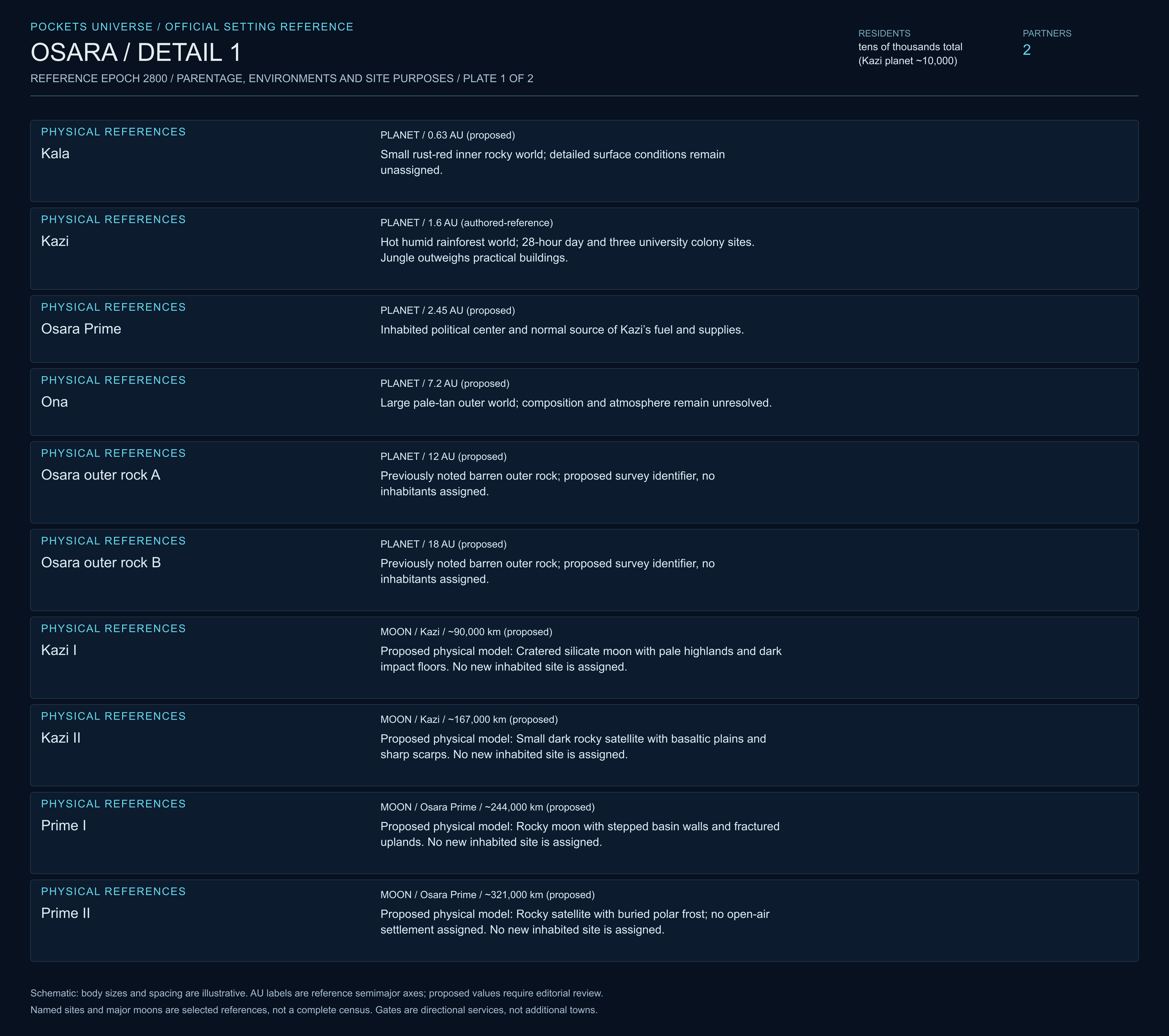
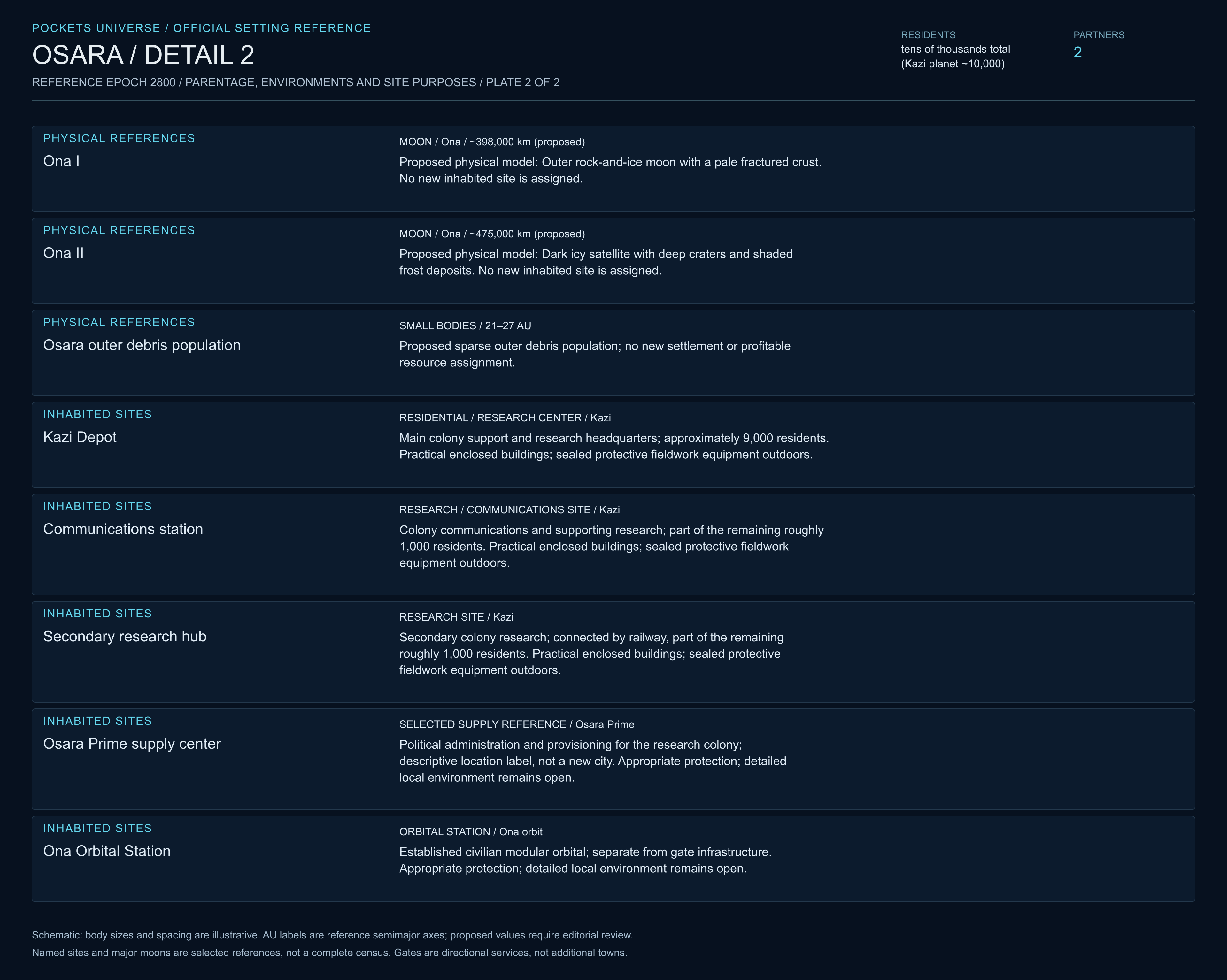
Open the overview above for full-resolution zoom and pan. The detail plates below provide the full reference inventory; their topics are listed with each link. The article also presents these facts as readable text. Body sizes and diagram spacing are illustrative; orbital labels distinguish established references from proposed design values.
Atlas Detail Plates
- Osara detail plate 1: worlds and physical features
- Osara detail plate 2: worlds and physical features, settlements and facilities
Reference Model And Limits
This edition combines established setting facts with explicitly proposed astronomy and revised recent worldbuilding. New survey identifiers are provisional labels, not new historical discoveries. A temperate orbit does not establish breathable air, safe weather or native life. New bodies and debris do not establish profitable resources.
- The earlier relay moon remains unidentified; do not invent its parentage or identify it with one of the six atlas moons.
- Ona is not declared a gas giant from its appearance alone.
- Kazi’s colony count remains 10,000 with approximately 9,000 at the depot; no individual split is assigned to the other two sites.
- Stellar luminosity, unmeasured orbital values, belt boundaries and new physical models are proposed design values requiring editorial approval; they do not certify habitability.
- Existing navigation width describes the transit model, not a hard astronomical edge.
Branch Region
This system belongs to the Ballas Branch. The regional profile compares its member systems, approximate population, industries and everyday security.